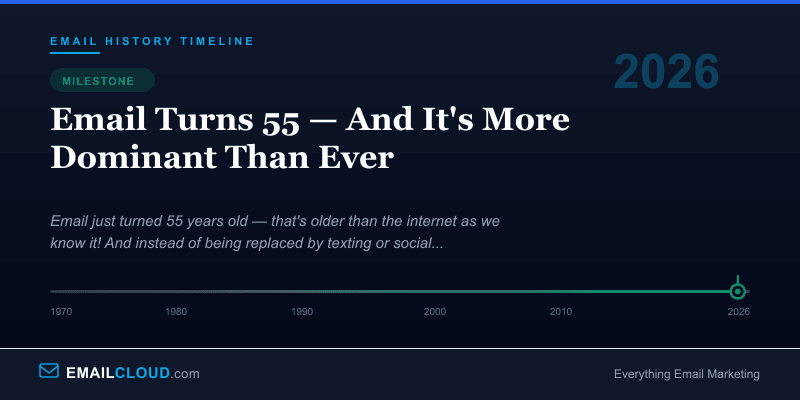
2026: Email Turns 55 — And It's More Dominant Than Ever
In 1971, Ray Tomlinson sent the first networked email message between two computers sitting side by side in a Cambridge, Massachusetts lab. He chose the @ symbol to separate usernames from machine names — a decision that would become one of the most recognized typographic conventions in human history. When asked what that first message said, Tomlinson admitted he couldn’t remember. Probably something like “QWERTYUIOP.” It didn’t matter. The mechanism mattered.
Fifty-five years later, that mechanism handles 370 billion messages a day, serves 4.6 billion users, generates the highest marketing ROI of any digital channel, and underpins the entire global economy. Email at 55 isn’t a legacy technology clinging to relevance. It’s the foundation of how the internet communicates, transacts, authenticates, and does business.
The story of email at 55 is not a story about survival. It’s a story about dominance.
The Numbers at 55
The raw statistics in 2026 are staggering in their scale.
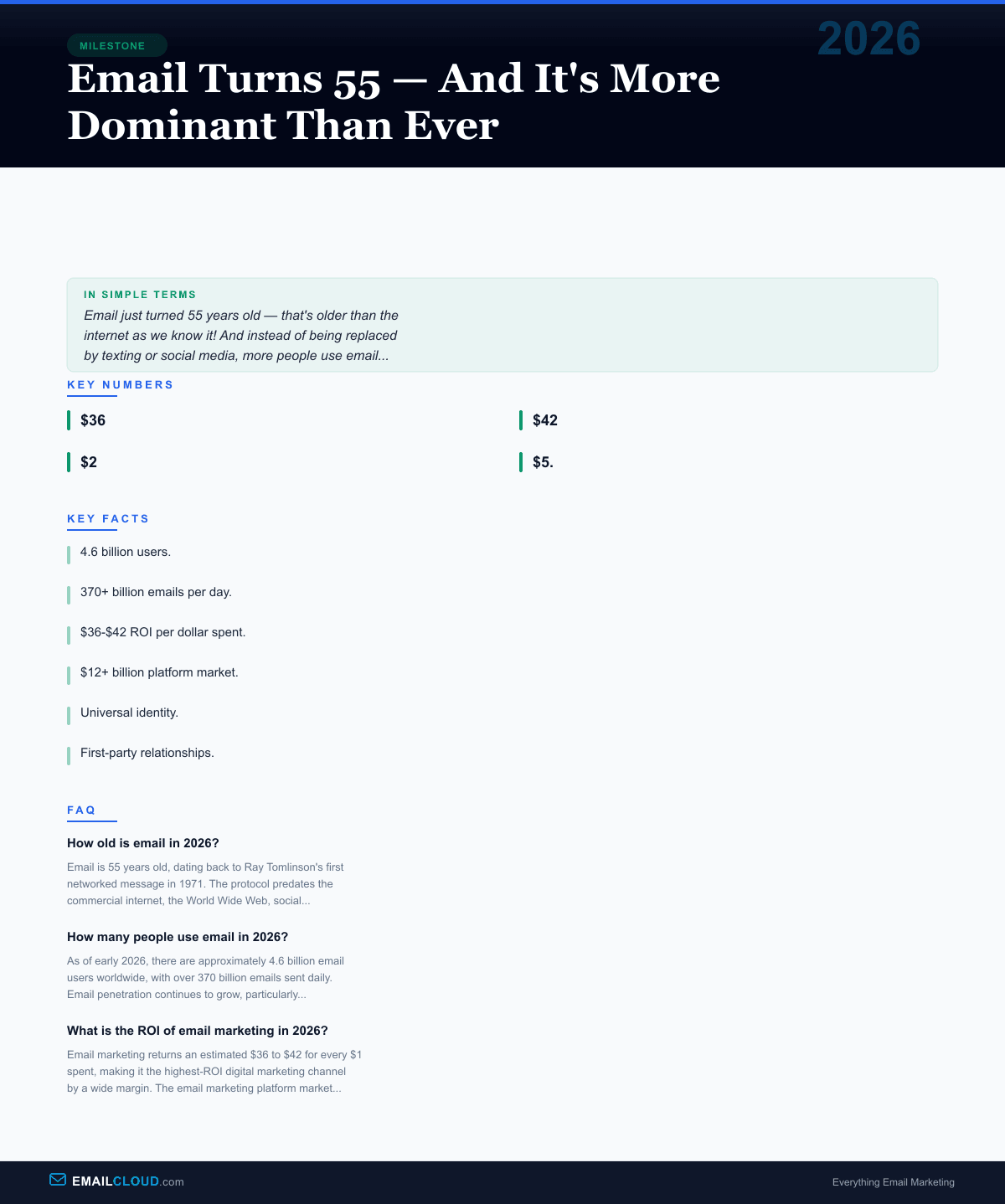
4.6 billion users. More than half of the world’s population has an email address. Email penetration exceeds that of every social media platform, every messaging app, and every other digital communication tool. It is the closest thing to a universal digital identifier that exists.
370+ billion emails per day. The volume of email continues to grow year over year, driven by transactional messages, marketing campaigns, newsletters, automated notifications, and personal communication. The infrastructure required to move this volume — the SMTP servers, the DNS lookups, the spam filters, the storage systems — represents one of the largest continuously operating distributed systems ever built.
$36-$42 ROI per dollar spent. Email marketing’s return on investment has been consistently reported in this range for years, and the number has proven remarkably stable. Social media marketing delivers $2-$5. Paid search delivers $2-$8. Display advertising hovers around $1-$3. Email isn’t just the best performing marketing channel — it outperforms the next best channel by a factor of five or more.
$12+ billion platform market. The email marketing technology market has grown into a significant industry segment, expanding at roughly 13% compound annual growth rate. This doesn’t include the broader ecosystem of deliverability tools, data providers, and services that support email operations.
The Newsletter Economy Matures
The most dynamic part of email’s ecosystem in 2026 is the newsletter economy, which has matured from a niche creator movement into a legitimate media sector worth over $10 billion annually.
The trajectory has been remarkable. Substack demonstrated that individual writers could build sustainable businesses on email subscriptions. beehiiv provided the growth tools for newsletter-first publishers. Ghost offered the open-source alternative. Platforms like Bulletin, Buttondown, and dozens of others expanded the options.
What emerged was a new media model. Newsletter publishers own their audience directly — no algorithm sits between the writer and the reader. Monetization comes through paid subscriptions, sponsorships, and advertising networks built specifically for newsletters. The economics work because email’s delivery is essentially free, the audience relationship is direct, and the engagement metrics (for newsletters, click and read rates are measurable) far exceed what social media delivers.
Major media companies have taken notice. Traditional publishers that once dismissed newsletters as a distribution footnote now treat them as primary products. Journalists who left newsrooms to start newsletters have built media businesses that rival the publications they left. The newsletter isn’t supplementary to media anymore — for many publishers, it is the media.
Authentication Is Now Universal
One of the most significant structural changes in email’s recent history reached full maturity in 2026: universal authentication.
The 2024 Gmail and Yahoo authentication mandates required bulk senders to implement SPF, DKIM, and DMARC. The effect was immediate and cascading. Senders who hadn’t authenticated their email were suddenly unable to reach Gmail and Yahoo inboxes — which together represent a majority of consumer email addresses. The mandates effectively forced the entire email sending ecosystem to adopt proper authentication within months.
By 2026, email authentication is no longer a best practice. It’s table stakes. The email ecosystem has, after decades of voluntary adoption and incremental progress, reached a state where unauthenticated email is effectively undeliverable to major consumer mailboxes. This is a transformative improvement in email security and deliverability — and it happened faster than anyone expected once the major inbox providers made it mandatory.
The authentication infrastructure — SPF, DKIM, and DMARC — was designed and standardized over the course of nearly two decades. It took mandatory enforcement by two companies to make it universal. That says something about both the difficulty of coordinating a decentralized ecosystem and the power of inbox providers to set standards.
Privacy-First Measurement
Email marketing measurement in 2026 looks fundamentally different from what it was five years ago. The death of open rates as a reliable metric — driven by Apple Mail Privacy Protection, Google’s pixel proxying, and the broader adoption of tracking prevention — has pushed the industry toward measurement approaches that are both more privacy-respecting and more business-relevant.
Click rates, conversion rates, revenue per email, and engagement scoring have replaced open rates as primary KPIs. The shift was painful for marketers who had built their strategies around open data, but the result is a more honest and useful measurement framework. When you can’t rely on a vanity metric, you’re forced to measure what actually matters.
Every Email Killer Has Failed
Perhaps the most remarkable aspect of email at 55 is the graveyard of technologies that were predicted to replace it.
The list of failed “email killers” is long and distinguished. Facebook was supposed to kill email with social messaging — Facebook’s own “Project Titan” email service launched in 2010 and was dead by 2014. Slack was supposed to kill email in the workplace — even Slack’s founders now acknowledge that email is complementary, not competitive. Google Wave was going to reinvent communication — it lasted less than two years. Threads, WhatsApp, Telegram, Discord, Microsoft Teams — each captured specific use cases, but none challenged email’s role as the universal business communication and marketing channel.
The pattern is consistent. New communication tools succeed by carving out niches — team chat, social messaging, ephemeral communication — but they succeed alongside email, not instead of it. Every person on Slack also has an email address. Every Threads user signed up with an email. Every WhatsApp Business account sends receipts and confirmations by email. The “email killers” end up depending on email infrastructure to function.
Why Email Endures
Email’s durability at 55 years isn’t luck. It’s architecture.
Open protocol. Email is built on open standards (SMTP, IMAP) that no single company controls. This is structurally different from every proprietary platform. Twitter can change its API. Facebook can change its algorithm. Slack can change its pricing. Nobody can change email because nobody owns it. This decentralization is email’s deepest competitive advantage.
Universal identity. An email address functions as a universal digital identity. It’s required to create accounts on virtually every other platform. It’s the recovery mechanism for passwords, the verification method for identities, and the default contact field in every form on the internet. Email’s role as an identity layer makes it nearly impossible to displace.
First-party relationships. In an era of increasing privacy regulation and third-party cookie deprecation, email’s consent-based, first-party data model is exactly aligned with where regulation and user expectations are heading. Email doesn’t rely on surveillance. It relies on permission. That alignment with the privacy zeitgeist is a strategic advantage that grows stronger every year.
Economic gravity. With the highest marketing ROI of any channel and a platform ecosystem worth over $12 billion, the economic incentives to maintain and improve email infrastructure are enormous. Investment flows toward the most effective channels, and email continues to be the most effective channel.
55 and Accelerating
The history of email is the history of the internet itself. Email predates the web. It predates social media, smartphones, cloud computing, and streaming video. It predates every technology trend of the last five decades. And it has outlasted, outperformed, or absorbed every challenge thrown at it.
At 55, email isn’t just surviving — it’s accelerating. The newsletter economy is creating new email-native businesses at unprecedented scale. Authentication improvements are making the ecosystem more secure than it’s ever been. Privacy-first measurement is improving the quality of email marketing. The platform market is growing at double-digit rates.
Every prediction of email’s demise has been wrong. Not just wrong in timing, but wrong in premise. Email isn’t a technology waiting to be replaced. It’s infrastructure — as fundamental to the internet as DNS, HTTP, and TCP/IP. You don’t replace infrastructure. You build on it.
Email at 55 is the backbone of the internet economy. At 60, at 75, at 100, it will still be here. The only thing that changes is how much it carries.
Infographic
Share this visual summary. Right-click to save.
Related Events
Frequently Asked Questions
How old is email in 2026?
Email is 55 years old, dating back to Ray Tomlinson's first networked message in 1971. The protocol predates the commercial internet, the World Wide Web, social media, smartphones, and every technology that has been predicted to replace it. It is the oldest continuously used internet application.
How many people use email in 2026?
As of early 2026, there are approximately 4.6 billion email users worldwide, with over 370 billion emails sent daily. Email penetration continues to grow, particularly in developing markets. Virtually every internet user and every business on the planet relies on email for communication.
What is the ROI of email marketing in 2026?
Email marketing returns an estimated $36 to $42 for every $1 spent, making it the highest-ROI digital marketing channel by a wide margin. The email marketing platform market is worth over $12 billion and growing at approximately 13% CAGR. No other marketing channel consistently delivers comparable returns.