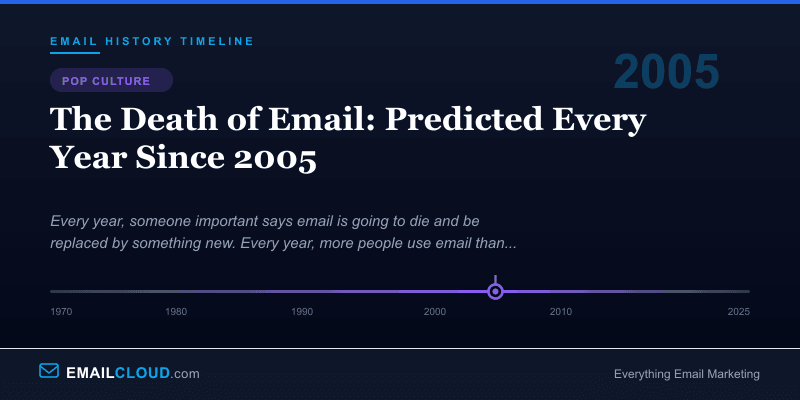
2005: The Death of Email: Predicted Every Year Since 2005
In 2005, a Wall Street Journal article asked whether email had become “a tool of the past.” The piece speculated that instant messaging and social networks would render email obsolete within a few years. It was a compelling argument. It was also, like every death-of-email prediction before and since, completely wrong.
The ritual has repeated annually for two decades. A new technology launches. A pundit declares it the email killer. Think pieces proliferate. Then the new technology either fails, finds its niche alongside email, or — in the supreme irony — uses email for notifications and account management. Meanwhile, email quietly adds another hundred million users and sends another few billion messages per day.
The Timeline of Failed Prophecies
The death-of-email prediction has a remarkably consistent rhythm. Here are some of the greatest hits.
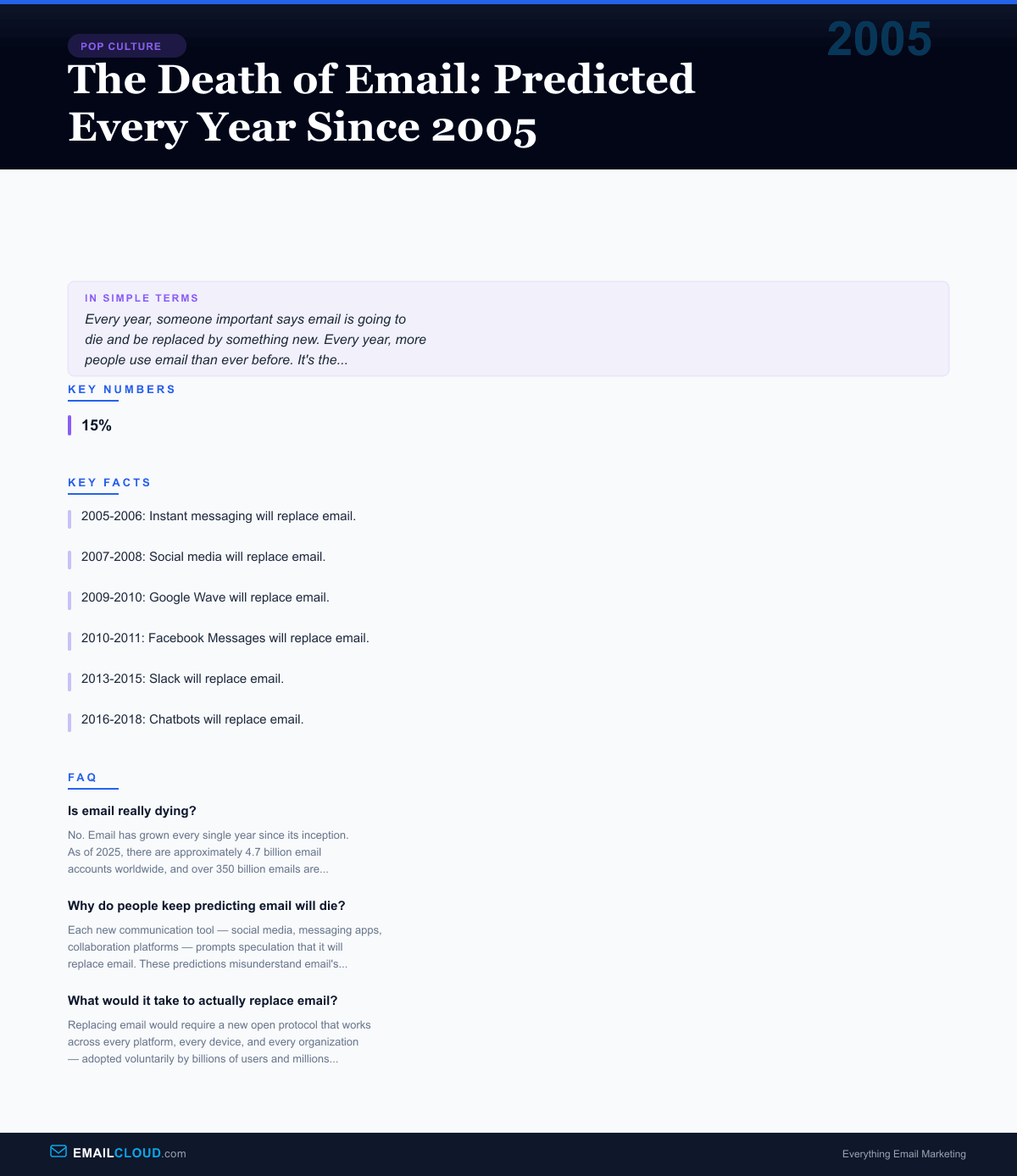
2005-2006: Instant messaging will replace email. AOL Instant Messenger, Yahoo Messenger, and MSN Messenger were at their peak. Tech commentators argued that real-time messaging was so superior to asynchronous email that the transition was inevitable. Then instant messaging plateaued, fragmented, and mostly died. AIM shut down in 2017. Email didn’t notice.
2007-2008: Social media will replace email. Facebook opened to the general public in 2006. Twitter launched the same year. The narrative shifted: why email when you can post? Why send a message when you can tweet? Sheryl Sandberg famously said in 2010 that teens don’t use email. She was partially right about teens and entirely wrong about the implication that email was doomed.
2009-2010: Google Wave will replace email. Google’s ambitious collaboration platform launched in 2009 with explicit claims that it was “what email would be if it were invented today.” It was discontinued 15 months later. (See our full Google Wave article for that story.)
2010-2011: Facebook Messages will replace email. Mark Zuckerberg personally announced Facebook’s unified messaging system with @facebook.com email addresses. Press coverage was breathless. Usage was minimal. The email addresses were discontinued in 2014.
2013-2015: Slack will replace email. Stewart Butterfield’s team communication platform was the most credible challenger. Slack genuinely reduced internal email at many companies. But it didn’t touch external communication, transactional email, newsletters, or any of the other functions email serves. Slack itself sends enormous volumes of email for notifications.
2016-2018: Chatbots will replace email. The bot hype cycle predicted that consumers would interact with brands through messaging bots rather than email. Most chatbots were terrible. Email was not threatened.
2020-2022: The newsletter renaissance proved email is growing. Substack, Revue, Beehiiv, and Ghost fueled a massive growth in email newsletters. The “email is dead” narrative suddenly seemed absurd as creators and publishers invested heavily in email-based businesses.
The Numbers That End Every Argument
If email were dying, the numbers would show a decline. They show the exact opposite.
Global email accounts: 2.6 billion (2006), 3.1 billion (2011), 3.9 billion (2015), 4.1 billion (2018), 4.5 billion (2023), approximately 4.7 billion (2025). Every single year, growth.
Daily email volume: approximately 120 billion (2006), 200 billion (2015), 300 billion (2020), 350 billion+ (2025). Every single year, growth.
Email marketing revenue: growing at 10-15% annually throughout the 2020s. The newsletter economy alone is worth billions.
These aren’t the numbers of a dying medium. They’re the numbers of one that’s so deeply embedded in how the world works that removing it would be like removing phone numbers or street addresses.
Why Email Survives Everything
The predictions fail because they misunderstand what email is. They treat email as a product — like AIM or Google Wave — that can be outcompeted by a better product. But email isn’t a product. It’s a protocol.
SMTP, the standard that moves email between servers, is an open specification that anyone can implement. Gmail talks to Outlook talks to Yahoo talks to a self-hosted server in someone’s basement. No company controls email. No company can shut it off. No company can change the algorithm and cut your reach. This openness is email’s immune system against replacement.
Every challenger to email is a proprietary platform. Slack users can only message Slack users. Teams users can only message Teams users. WhatsApp users can only message WhatsApp users. To replace email, a new platform would need to be adopted by essentially everyone on earth — every person, every company, every government, every institution — simultaneously and voluntarily. The coordination problem is practically unsolvable.
Email also serves too many functions for any single replacement to absorb. It’s an identity layer (every account on the internet requires an email address). It’s a transactional channel (order confirmations, password resets). It’s a marketing channel (newsletters, promotions). It’s a formal communication channel (business correspondence, legal communication). No single product has ever attempted to replace all of these functions, let alone succeeded.
The Unbundling That Strengthened Email
The most thoughtful version of the “email is dying” argument doesn’t claim a single product will replace it. It argues that email is being unbundled — specific use cases migrating to better-suited tools. Internal team chat moved to Slack. Quick personal messages moved to texting and WhatsApp. File sharing moved to cloud platforms. Group coordination moved to group chats.
But this unbundling actually strengthened email by stripping away its weakest use cases and concentrating it on its strongest ones: external business communication, transactional messaging, marketing, and universal identity. These aren’t scraps. They’re the core functions that drive commerce and communication across the internet.
The Prediction That Won’t Come True
Somewhere right now, someone is drafting a blog post arguing that email’s days are finally numbered. They might point to new messaging protocols, or declining engagement among Gen Z, or some emerging platform that does communication differently. They’ll make a compelling case.
And next year, email will send another 350 billion messages, add another hundred million users, and the prediction will join every other death-of-email forecast in the graveyard of failed prophecies. Not because email is perfect — it has plenty of problems — but because nothing can replace something that belongs to everyone and is controlled by no one. Email isn’t immortal. It’s just irreplaceable.
Infographic
Share this visual summary. Right-click to save.
Related Events
Frequently Asked Questions
Is email really dying?
No. Email has grown every single year since its inception. As of 2025, there are approximately 4.7 billion email accounts worldwide, and over 350 billion emails are sent daily. Email remains the most widely used digital communication tool on earth.
Why do people keep predicting email will die?
Each new communication tool — social media, messaging apps, collaboration platforms — prompts speculation that it will replace email. These predictions misunderstand email's role: it is an open protocol, not a product. No single company can kill it, and no proprietary replacement can match its universal interoperability.
What would it take to actually replace email?
Replacing email would require a new open protocol that works across every platform, every device, and every organization — adopted voluntarily by billions of users and millions of companies worldwide, with no single entity controlling it. This is a coordination problem so massive that it may be effectively impossible.