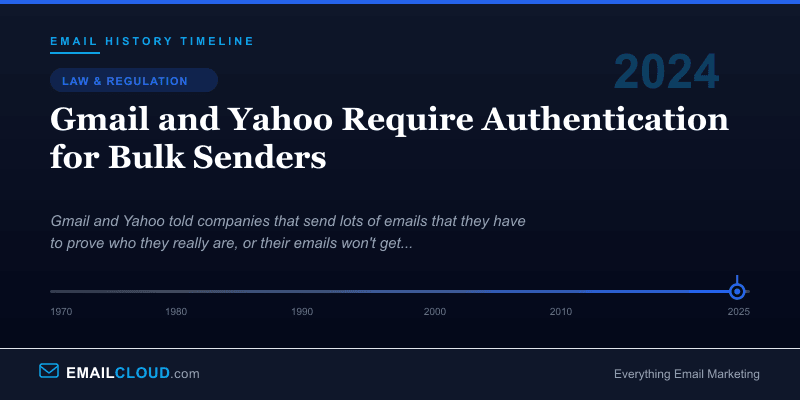
2024: Gmail and Yahoo Require Authentication for Bulk Senders
On October 3, 2023, Google and Yahoo made a joint announcement that sent the email marketing industry into a controlled panic. Starting February 2024, both platforms would require bulk email senders to implement proper authentication protocols — SPF, DKIM, and DMARC — or face delivery failures. For an industry that had spent two decades treating email authentication as optional best practice, the announcement was a seismic shift. Authentication was no longer recommended. It was mandatory.
The Announcement
Google’s Neil Kumaran and Yahoo’s Marcel Becker made coordinated announcements outlining new requirements for anyone sending email to Gmail or Yahoo Mail addresses. The requirements were straightforward but sweeping.
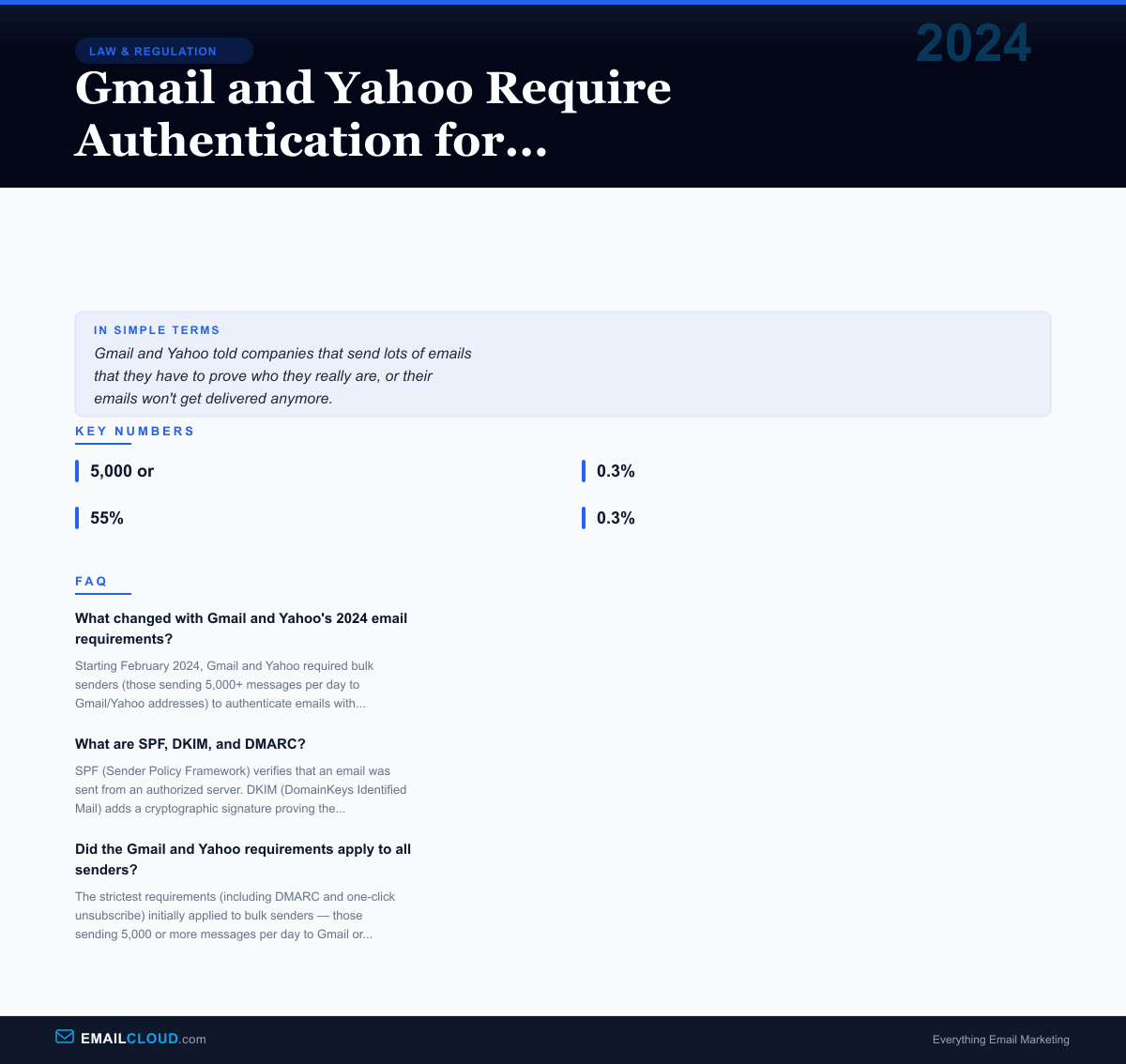
All senders had to have basic email authentication — SPF or DKIM at minimum. Bulk senders (defined as those sending 5,000 or more messages per day to Gmail addresses) faced additional requirements: SPF and DKIM authentication, a published DMARC policy (even a monitoring-only “p=none” policy counted), alignment between the From header domain and the authenticated domain, one-click unsubscribe functionality via the List-Unsubscribe header, a spam complaint rate below 0.3% (as measured by Google Postmaster Tools), and valid forward and reverse DNS for sending IPs.
The timeline was tight. Senders had roughly four months to comply. For organizations that already followed email best practices, the requirements were nothing new. For the substantial number of senders who had been cutting corners — sending from unauthenticated domains, lacking DMARC policies, making unsubscription difficult — it was a scramble.
Why It Happened
The announcement didn’t happen in a vacuum. Email authentication standards — SPF, DKIM, and DMARC — had existed for years, even decades. SPF was introduced in 2003. DKIM was standardized in 2007. DMARC was published in 2012. Despite being available for over a decade, adoption remained stubbornly incomplete.
A 2023 study found that only about 55% of domains had published DMARC records, and many of those used the weakest “p=none” policy that monitors but doesn’t enforce. SPF adoption was higher but still not universal. The email ecosystem was relying on a security framework that too many senders hadn’t bothered to implement.
Meanwhile, phishing, spoofing, and email fraud continued to grow. Attackers exploited the authentication gap, sending emails that appeared to come from legitimate domains but were actually forged. Without widespread DMARC enforcement, receiving servers couldn’t reliably distinguish genuine emails from spoofed ones.
Google and Yahoo, which together handle a massive share of global consumer email, decided to force the issue. By making authentication a delivery requirement rather than a best practice, they created an economic incentive that moral suasion alone hadn’t achieved: authenticate your email, or your messages don’t get delivered.
The Industry Response
The email marketing industry’s response was a mix of vindication and anxiety. Deliverability experts who had been advocating for authentication for years felt validated — their advice was now policy. But the practical challenge of getting every sender compliant in four months was enormous.
Email service providers (ESPs) like Mailchimp, SendGrid, Constant Contact, and others had to ensure that all their customers’ sending domains were properly authenticated. Many ESPs had been authenticating email on behalf of their customers using the ESP’s own domain, but the new requirements pushed toward authentication on the customer’s own domain — a more complex setup requiring DNS record changes.
IT teams at companies large and small found themselves suddenly tasked with adding DMARC records, configuring DKIM signing, and updating SPF records. For large enterprises with multiple sending systems — marketing, transactional, internal, CRM, support — the DNS configuration alone could be a significant project.
The one-click unsubscribe requirement also caught some senders off guard. While most modern email platforms supported the List-Unsubscribe header, not all implementations met the new standard. Google specifically required the List-Unsubscribe-Post header, enabling automated unsubscription without requiring the user to visit a webpage or send a separate email.
The Enforcement Rollout
Google began enforcement gradually in February 2024. Initially, non-compliant bulk senders received temporary errors (4xx responses) rather than permanent rejections, giving them a warning period to fix their authentication. By April 2024, enforcement tightened, and non-compliant emails began receiving permanent rejections (5xx responses).
Yahoo followed a similar gradual enforcement trajectory. Both platforms published detailed documentation and monitoring tools — Google Postmaster Tools became essential for bulk senders tracking their compliance status and spam complaint rates.
The 0.3% spam complaint rate threshold proved particularly impactful. Senders who had been tolerating higher complaint rates — often by ignoring the problem or blaming it on aggressive spam button users — were forced to clean up their practices. This meant better list hygiene, clearer consent processes, more prominent unsubscribe options, and more relevant content.
The Ripple Effects
The Gmail and Yahoo requirements triggered a cascade of positive changes across the email ecosystem. DMARC adoption surged. Organizations that had been putting off authentication finally implemented it, not because it was the right thing to do, but because their emails stopped getting delivered when they didn’t.
Email deliverability consultants reported being booked solid for months. DNS management tools saw increased usage. Authentication monitoring services grew rapidly. The entire industry infrastructure around email authentication expanded to meet the sudden demand.
Other mailbox providers took note. Microsoft’s Outlook.com and other major email platforms signaled intentions to adopt similar requirements, creating a clear trajectory toward universal authentication mandates.
What It Means for Email Marketers
The 2024 authentication requirements represent the most significant deliverability change in at least a decade. They established a new baseline for sending commercial email: you must prove you are who you say you are, you must make it easy to unsubscribe, and you must keep your complaint rate low.
For well-run email programs, these requirements changed nothing — they were already compliant. For everyone else, February 2024 was a wake-up call that email marketing has graduated from the wild west era. The technical bar for sending email at scale has been permanently raised, and there is no going back. Check your authentication setup with our Spam Word Checker and review the fundamentals in our SPF, DKIM, and DMARC guide.
Infographic
Share this visual summary. Right-click to save.
Related Events
Frequently Asked Questions
What changed with Gmail and Yahoo's 2024 email requirements?
Starting February 2024, Gmail and Yahoo required bulk senders (those sending 5,000+ messages per day to Gmail/Yahoo addresses) to authenticate emails with SPF, DKIM, and DMARC, maintain spam complaint rates below 0.3%, include one-click unsubscribe headers, and send only to recipients who have opted in. Non-compliant senders faced delivery failures and rejections.
What are SPF, DKIM, and DMARC?
SPF (Sender Policy Framework) verifies that an email was sent from an authorized server. DKIM (DomainKeys Identified Mail) adds a cryptographic signature proving the message wasn't altered in transit. DMARC (Domain-based Message Authentication, Reporting, and Conformance) tells receiving servers what to do with messages that fail SPF or DKIM checks. Together, they form email's authentication framework.
Did the Gmail and Yahoo requirements apply to all senders?
The strictest requirements (including DMARC and one-click unsubscribe) initially applied to bulk senders — those sending 5,000 or more messages per day to Gmail or Yahoo addresses. However, all senders were required to have basic SPF or DKIM authentication. Google indicated that requirements would expand to smaller senders over time.