2026: Open Rates Are Officially Dead as a Primary Email Metric
For over twenty years, the open rate was the first number every email marketer checked after hitting send. It was simple, intuitive, and satisfying: what percentage of recipients opened your email? A good open rate meant your subject line worked, your sender reputation was strong, and your audience was engaged. A bad open rate meant something was wrong.
By 2026, the open rate means almost nothing at all.
The death of open rates didn’t happen in a single event. It was a cascade that started with Apple’s Mail Privacy Protection in September 2021, accelerated as other email clients adopted similar protections, and reached its conclusion when the industry collectively acknowledged that a metric inflated by phantom data isn’t a metric — it’s a mirage.
How We Got Here
The tracking pixel — the invisible 1x1 image that powered open rate measurement — was always a hack. Embedded in HTML emails since the late 1990s, these tiny images were loaded from the sender’s server when a recipient opened an email. The image request registered as an “open” and recorded the recipient’s IP address, device type, and timestamp.
The system had known limitations even in its prime. Plain-text emails couldn’t be tracked. Image-blocking clients suppressed pixel loading. Automated security scanners sometimes triggered false opens. But for the majority of email recipients who used HTML-capable clients with images enabled, the tracking pixel provided a reasonable approximation of engagement.
Apple broke that approximation in 2021. Mail Privacy Protection pre-fetched all email content — including tracking pixels — through Apple’s proxy servers, regardless of whether the user actually opened the email. With Apple Mail handling roughly 50% of all email opens across iPhone, iPad, and Mac, the impact was immediate and severe. Open rates for many brands jumped 20-30 percentage points overnight as millions of Apple Mail users registered as “opened” without ever glancing at the message.
The Cascade Continues
The email marketing industry initially hoped that Apple’s move would be an outlier. Maybe other email clients wouldn’t follow suit. Maybe the industry could adapt by filtering out Apple Mail data and tracking opens for the remaining 50% of users.
That hope didn’t survive contact with reality.
By 2024, privacy-focused email clients and browser extensions that blocked tracking pixels had grown significantly. Proton Mail, Tutanota, and other privacy-first providers blocked remote content loading by default. Mozilla Thunderbird added enhanced tracking protection. Browser extensions that stripped tracking pixels from webmail interfaces grew in popularity.
Then Google moved. In 2025 and into early 2026, Google began implementing proxy-based image loading on Gmail’s mobile app, similar in effect to Apple’s approach. When the world’s most popular email platform and its largest competitor both break the same tracking mechanism, the mechanism is broken.
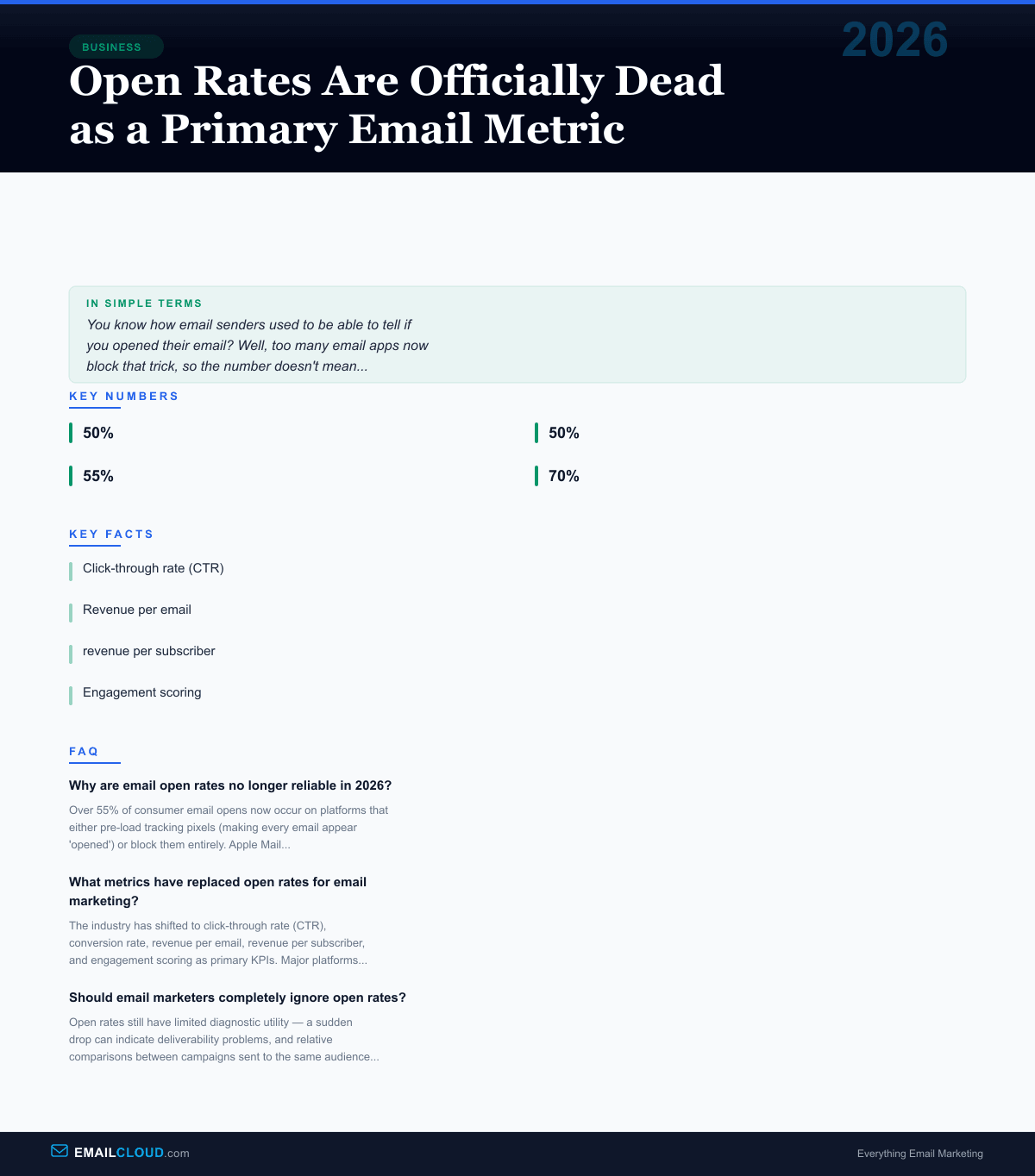
By early 2026, the data tells a stark story. Over 55% of consumer email opens now occur on platforms that either block tracking pixels entirely or pre-load them in ways that inflate open rates. For many brands, the real number is higher — subscriber bases skewed toward iPhone users or privacy-conscious demographics report 60-70% of their audience on pixel-blocking platforms.
The remaining 40-45% of opens that still generate reliable pixel data aren’t enough to save the metric. When more than half your data is garbage, the aggregate number is garbage too.
The Industry Pivots
To their credit, the major email marketing platforms saw this coming and prepared.
Klaviyo, which powers email for hundreds of thousands of ecommerce brands, shifted its default reporting to emphasize revenue attribution, click rates, and placed order rates. Open rates are still visible but no longer front-and-center in campaign reports.
ActiveCampaign introduced engagement scoring models that weight clicks, site visits, purchases, and replies more heavily than opens. Their automation triggers increasingly use click-based or conversion-based conditions rather than open-based ones.
Kit (formerly ConvertKit), popular with creators and newsletter publishers, redesigned its analytics dashboard to lead with click rate and subscriber growth. The platform’s documentation explicitly advises against using open rates for decision-making.
beehiiv, one of the fastest-growing newsletter platforms, reports open rates with a disclaimer about their unreliability and pushes click rate as the primary engagement metric.
Even Mailchimp, whose “Did they open it?” reporting was synonymous with email marketing for two decades, has restructured its dashboards to give equal or greater prominence to click-based metrics.
What Replaced the Open Rate
The transition to post-open-rate measurement isn’t a downgrade. If anything, the metrics that have taken the open rate’s place are better indicators of what actually matters.
Click-through rate (CTR) measures whether subscribers actually engage with your content by clicking links. Unlike open tracking, click tracking works by redirecting links through the sender’s tracking server — a mechanism that privacy tools generally don’t interfere with. A click represents a deliberate action, not a passive pixel load.
Conversion rate connects email directly to business outcomes. Did the subscriber make a purchase? Fill out a form? Sign up for a webinar? Conversion tracking requires downstream integration but provides data that directly maps to revenue.
Revenue per email and revenue per subscriber put a dollar value on email performance. For ecommerce brands, these metrics answer the only question that ultimately matters: how much money did this email make?
Engagement scoring combines multiple signals — clicks, website visits, purchases, replies, recency — into a composite engagement metric. This provides a more nuanced view of subscriber health than any single metric could.
Reply rate has emerged as a particularly valuable signal for B2B senders and newsletter publishers. A subscriber who replies to your email is unambiguously engaged, and replies are a strong positive signal to email providers for deliverability purposes.
The Holdouts
Not everyone has moved on. Some marketers, particularly in industries with less sophisticated email programs, still treat open rates as gospel. They make subject line decisions based on open data. They segment lists by “opened in the last 30 days.” They report open rates to leadership as proof of email program health.
These marketers are optimizing for a number that doesn’t mean what they think it means. An open rate of 45% might reflect 25% genuine engagement plus 20% phantom opens from Apple and Google’s proxy fetching. Making strategic decisions based on that inflated number leads to bad strategy — keeping disengaged subscribers on lists, declaring mediocre subject lines as winners, and missing the signals that actually predict conversion.
The Silver Lining
The death of open rates has, paradoxically, made email marketing better.
When you can’t rely on opens as a vanity metric, you’re forced to focus on outcomes. Did subscribers click? Did they buy? Did they engage in any way that actually affects the business? These questions lead to better emails — more compelling content, stronger calls to action, clearer value propositions.
The shift has also improved list hygiene practices. Instead of keeping subscribers who “opened” emails (which may have been phantom opens), marketers are using click engagement and purchase behavior to identify truly active subscribers. The result is cleaner lists, better deliverability, and more accurate performance data.
Email marketing in 2026 is measured by what it achieves, not by what it might have been glanced at. That’s progress. Our ROI Calculator can help you model the metrics that actually matter — revenue, conversions, and real return on your email investment.
Infographic
Share this visual summary. Right-click to save.
Related Events
Frequently Asked Questions
Why are email open rates no longer reliable in 2026?
Over 55% of consumer email opens now occur on platforms that either pre-load tracking pixels (making every email appear 'opened') or block them entirely. Apple Mail Privacy Protection started this in 2021, and by 2026, Google has added similar pixel-blocking on Gmail mobile. The result is that open rate data is inflated to the point of meaninglessness for a majority of subscribers.
What metrics have replaced open rates for email marketing?
The industry has shifted to click-through rate (CTR), conversion rate, revenue per email, revenue per subscriber, and engagement scoring as primary KPIs. Major platforms like ActiveCampaign, Klaviyo, Kit, and beehiiv have de-emphasized open rates in their dashboards and reporting, promoting action-based metrics instead.
Should email marketers completely ignore open rates?
Open rates still have limited diagnostic utility — a sudden drop can indicate deliverability problems, and relative comparisons between campaigns sent to the same audience can surface trends. But they should no longer be used as a primary KPI, for list segmentation decisions, or as the basis for A/B test winners. Click and conversion data provides far more reliable insight into actual subscriber engagement.