2024: 2024: Email Is Still the Number One Marketing Channel
Every year for the past two decades, someone has predicted that email would be dethroned as the most important digital marketing channel. Every year, email has responded by growing larger, generating more revenue, and widening its lead over the competition.
2024 was no different. While social media platforms battled for attention and relevance, while short-form video dominated cultural conversation, while messaging apps expanded globally, email quietly continued doing what it has always done: connecting businesses to customers, driving revenue, and delivering the highest return on investment of any digital marketing channel. The numbers in 2024 don’t just confirm email’s dominance — they make the case that the gap is widening.
The Numbers
The statistical case for email marketing in 2024 is overwhelming.
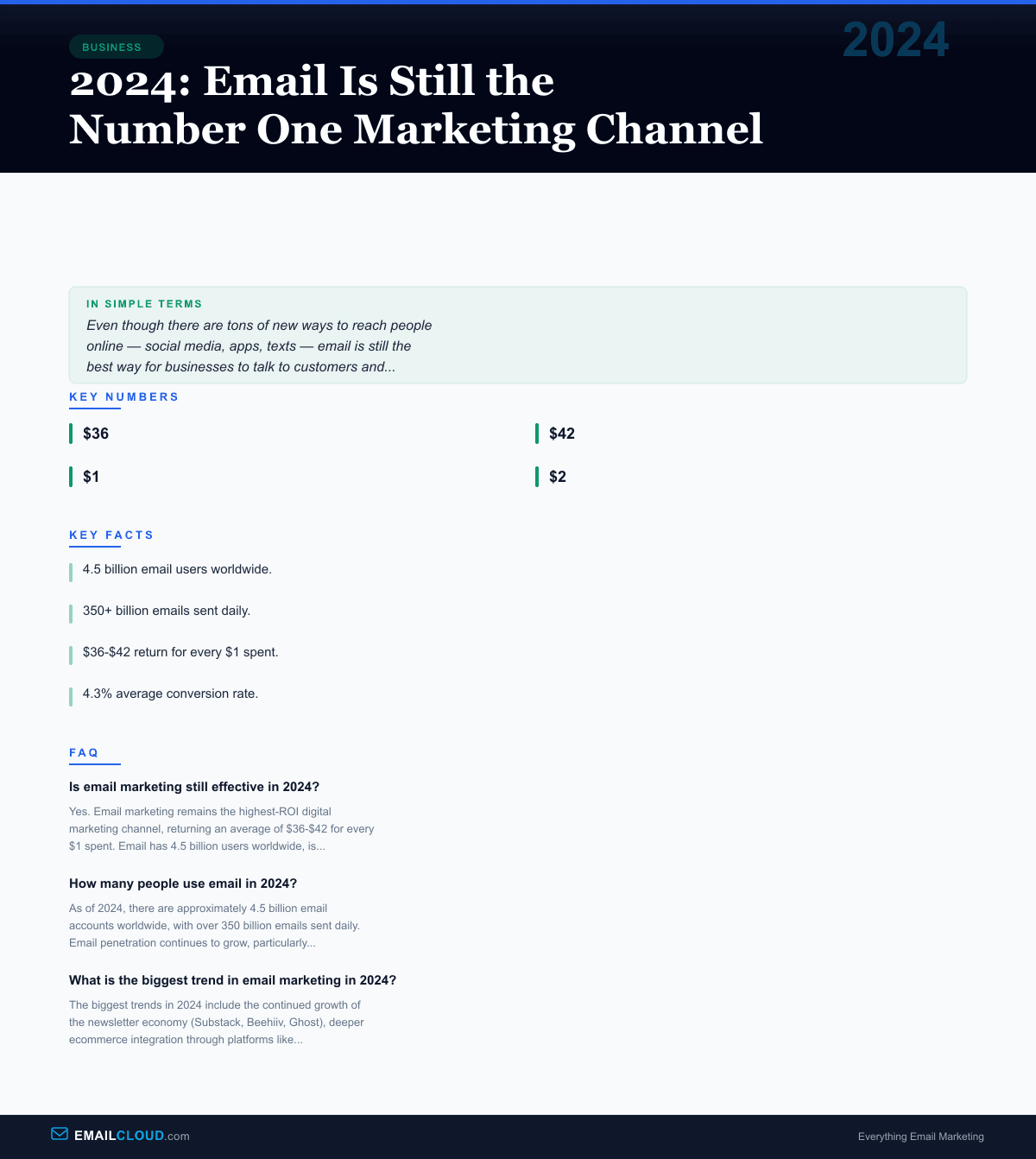
4.5 billion email users worldwide. More than half the planet has an email address. Email penetration continues to grow, particularly in developing markets where smartphone adoption brings first-time users online. No other marketing channel has this reach.
350+ billion emails sent daily. The volume of email continues to grow year over year. This includes transactional messages, marketing campaigns, newsletters, and personal communication. The sheer throughput demonstrates that email isn’t just surviving — it’s the busiest communication channel on the internet.
$36-$42 return for every $1 spent. Email marketing’s ROI has remained consistent at these levels for years, far exceeding social media ($2-$5), paid search ($2-$8), and display advertising ($1-$3). No channel comes close.
4.3% average conversion rate. Email marketing converts at nearly double the rate of social media marketing and outperforms most paid advertising channels. For ecommerce specifically, email-driven traffic converts at rates that make every other channel look like a warmup.
The Newsletter Renaissance
Perhaps the most striking development in email’s 2024 story is the newsletter economy. What was once considered a dying format — the email newsletter — has become the foundation of a multi-billion-dollar creator economy.
Substack has demonstrated that writers, journalists, and experts can build sustainable businesses entirely on email newsletters, with top creators earning seven-figure incomes from paid subscriptions. The platform has shown that email is the only channel where creators truly own their audience relationship — not renting it from an algorithm.
Beehiiv has emerged as a newsletter platform for growth-oriented publishers, offering monetization tools, referral systems, and advertising networks built specifically for newsletter businesses.
Ghost has established itself as the open-source alternative, powering newsletters for publishers who want full ownership of their platform and data.
The newsletter economy has attracted venture capital investment, media coverage, and talent from traditional media. Journalists who left legacy publications started newsletters and discovered that direct email relationships with readers were more valuable than advertising-supported page views.
Ecommerce and Email
In ecommerce, email’s dominance in 2024 is particularly pronounced. Klaviyo’s IPO in September 2023, which valued the email marketing platform at over $9 billion, was Wall Street’s emphatic endorsement of email’s role in ecommerce.
The key ecommerce email flows — abandoned cart recovery, post-purchase follow-up, win-back campaigns, browse abandonment, and welcome series — collectively generate 25-40% of total email marketing revenue for most ecommerce businesses. These automated, behavioral emails run continuously, generating revenue while the marketing team sleeps.
The integration between email platforms and ecommerce infrastructure has deepened to the point where email is not just a marketing channel but a core business function. A Shopify store without email automation is leaving significant revenue on the table — and most store owners now recognize this.
Post-Privacy Adaptation
Email marketing in 2024 operates in a post-Apple-MPP, post-GDPR, increasingly privacy-aware environment. Apple’s Mail Privacy Protection (September 2021) broke traditional open rate tracking. GDPR, CASL, and similar legislation imposed strict consent requirements. Third-party cookie deprecation eliminated some cross-channel tracking capabilities.
Rather than weakening email, these privacy changes have strengthened it. Email’s first-party data model — built on direct relationships between senders and subscribers — is inherently privacy-compatible. Unlike advertising channels that rely on third-party tracking, email works with data that subscribers voluntarily provide.
The shift from open-rate-centric to click-and-conversion-centric measurement has also improved email marketing quality. Marketers who can’t rely on open rates as a vanity metric are forced to focus on metrics that actually matter: clicks, conversions, revenue per email, and subscriber lifetime value. The result is better emails.
The Resilience Factor
What makes email’s 2024 dominance remarkable is the number of challenges it has absorbed and overcome.
Social media captured attention and cultural mindshare — but email’s conversion rates remained superior. Privacy regulations imposed new constraints — but email’s consent-based model was already aligned with the direction of regulation. New messaging platforms (Slack, Teams, WhatsApp Business) carved out specific use cases — but none challenged email’s role as the universal business communication and marketing channel. The rise of SMS marketing added a new channel — but most marketers found that SMS and email work best together rather than as substitutes.
Email absorbed each challenge, adapted, and continued growing. The resilience isn’t accidental — it’s structural. Email is an open protocol, not a proprietary platform. No company controls it. No algorithm can throttle it. No competitor can shut it off. These structural advantages, which have protected email since its invention, continue to make it irreplaceable.
Looking Forward
The evidence from 2024 doesn’t just confirm email’s current dominance — it suggests that email’s position is strengthening. The newsletter economy is creating new email-native businesses. Ecommerce integration is deepening. Privacy changes are favoring first-party channels. The tools are getting better. The automation is getting smarter.
If there’s a pattern in email’s 50-year history, it’s that the channel’s importance grows in direct proportion to the number of people who predict its decline. 2024 was another data point in that pattern: email’s biggest year yet, with no credible challenger on the horizon.
For marketers, the message is clear. Email isn’t just a channel — it’s the channel. The businesses that invest in building their email capabilities, growing their subscriber lists, and optimizing their email programs will outperform those that chase the latest shiny platform. The data has been telling this story for 20 years. 2024 just told it a little louder.
Infographic
Share this visual summary. Right-click to save.
Related Events
Frequently Asked Questions
Is email marketing still effective in 2024?
Yes. Email marketing remains the highest-ROI digital marketing channel, returning an average of $36-$42 for every $1 spent. Email has 4.5 billion users worldwide, is growing at 3-4% annually, and continues to outperform social media, paid search, and display advertising in conversion rates and revenue generation.
How many people use email in 2024?
As of 2024, there are approximately 4.5 billion email accounts worldwide, with over 350 billion emails sent daily. Email penetration continues to grow, particularly in developing markets. Nearly every internet user has at least one email address.
What is the biggest trend in email marketing in 2024?
The biggest trends in 2024 include the continued growth of the newsletter economy (Substack, Beehiiv, Ghost), deeper ecommerce integration through platforms like Klaviyo, privacy-centric measurement approaches following Apple's Mail Privacy Protection, and increased use of behavioral personalization and automation.