2000: The Birth of Transactional Email: From Receipts to Revenue
Somewhere around the turn of the millennium, a quiet revolution happened in the email world. It didn’t make headlines. No one gave a TED talk about it. But as ecommerce started to take off — Amazon scaling beyond books, eBay processing millions of auctions, early online retailers figuring out this whole internet selling thing — a new category of email was born: the transactional message.
Order confirmations. Shipping notifications. Password resets. Account verification emails. These messages, triggered automatically by a user’s action rather than blasted to a marketing list, would become the backbone of online commerce. Today, transactional email is so fundamental to how the internet works that most people don’t think about it at all. That invisibility is precisely what makes it so important.
The Problem That Created Transactional Email
In the earliest days of ecommerce, buying something online was an act of faith. You entered your credit card number into a website, clicked “submit,” and… then what? Did it work? Was the order placed? When would it ship? Would it ship at all?
Early online merchants quickly discovered that the moment between “order placed” and “package arrives” was filled with anxiety. Customers called. They emailed. They wanted reassurance that their money hadn’t vanished into the digital void. The solution was obvious: send an automatic confirmation email the instant the order was processed.
Amazon, as it so often did, figured this out early. By the late 1990s, Amazon’s order confirmation emails were already a model of clarity — order number, items purchased, shipping address, estimated delivery date, all delivered to the inbox within seconds of checkout. The emails weren’t just customer service; they were trust-building infrastructure. Every confirmation email said, in effect: “We got your money, here’s proof, and here’s what happens next.”
From Necessity to Infrastructure
What started as order confirmations quickly expanded into an entire category. By the early 2000s, online businesses were sending automated emails for dozens of triggers:
Account lifecycle emails covered the customer journey from signup to cancellation. Welcome emails, email verification, profile updates, and account closure confirmations all became standard.
Commerce emails tracked the buying process end to end. Order confirmations, payment receipts, shipping notifications with tracking numbers, delivery confirmations, and return acknowledgments formed a chain of communication that kept customers informed at every stage.
Security emails protected accounts. Password reset links, two-factor authentication codes, login alerts from new devices, and suspicious activity warnings all relied on email as the delivery mechanism.
Platform notification emails kept users engaged. Social media notifications, comment replies, direct messages, and activity summaries all used email to pull users back to the platform.
Each of these categories shared common characteristics that set them apart from marketing email. They were expected by the recipient (you just reset your password, so you’re watching for that email). They were time-sensitive (a two-factor authentication code that arrives five minutes late is useless). And they were one-to-one (triggered by an individual’s action, not blasted to a list).
The Infrastructure Challenge
As transactional email volume grew, businesses discovered that sending these messages reliably was harder than it looked. Marketing emails could tolerate some delay — if a promotional newsletter arrived five minutes late, nobody noticed. But a password reset email that didn’t arrive within 30 seconds? That was a customer service disaster.
This reliability requirement created a new category of email infrastructure companies. Rather than competing with Mailchimp and Constant Contact for marketing budgets, companies like Postmark (founded 2009), SendGrid (founded 2009), and Mailgun (founded 2010) focused on fast, reliable delivery of transactional messages. They built infrastructure optimized for speed and deliverability rather than template design and campaign management.
The technical challenges were significant. Transactional email servers needed to handle massive spikes (imagine a flash sale generating thousands of order confirmations per minute), maintain near-perfect uptime (a down email server means customers can’t reset passwords), and achieve consistent inbox placement (a confirmation email that lands in spam is almost as bad as no email at all).
The Revenue Opportunity
The smartest marketers recognized that transactional emails represented an extraordinary marketing opportunity hiding in plain sight. These messages had open rates of 60-80% — four to five times higher than marketing emails. They had the customer’s full attention. And they were delivering information the customer actually wanted.
The question became: what else can we include in these emails?
Amazon pioneered this approach with product recommendations in order confirmation emails. “You bought this book — customers who bought this book also bought these three.” The recommendations were relevant, timely (the customer was already in a buying mindset), and embedded in a message the customer was going to read anyway.
Other brands followed. Shipping confirmation emails began including discount codes for the next purchase. Account creation emails included onboarding tips and feature highlights. Even password reset emails started incorporating subtle branding elements.
This blurring of transactional and marketing content created regulatory questions. The CAN-SPAM Act and later GDPR drew distinctions between transactional and commercial messages. Transactional emails didn’t require an unsubscribe link or prior consent because they were fulfilling a service the customer requested. But when those emails started including promotional content, the classification became murky.
The Scale Today
By the mid-2020s, transactional email dwarfs marketing email in volume. Industry estimates suggest that transactional messages account for over 60% of all business email sent. Every login, every purchase, every password reset, every notification, every verification — all of it flows through email infrastructure.
The companies that built that infrastructure became substantial businesses. Twilio acquired SendGrid for $2 billion in 2018. Sinch acquired Mailgun in 2021. Postmark was acquired by ActiveCampaign. The transactional email infrastructure market, which barely existed in 2000, became a multi-billion-dollar industry.
The irony is that transactional email’s greatest success is its invisibility. When it works perfectly — and it usually does — nobody thinks about it. The order confirmation arrives. The password reset works. The shipping notification updates. The system just works. That seamless reliability, built by thousands of engineers solving thousands of problems over two decades, is the foundation on which modern ecommerce stands. Every time you buy something online and immediately get a confirmation in your inbox, you’re experiencing the legacy of a revolution that never bothered to announce itself.
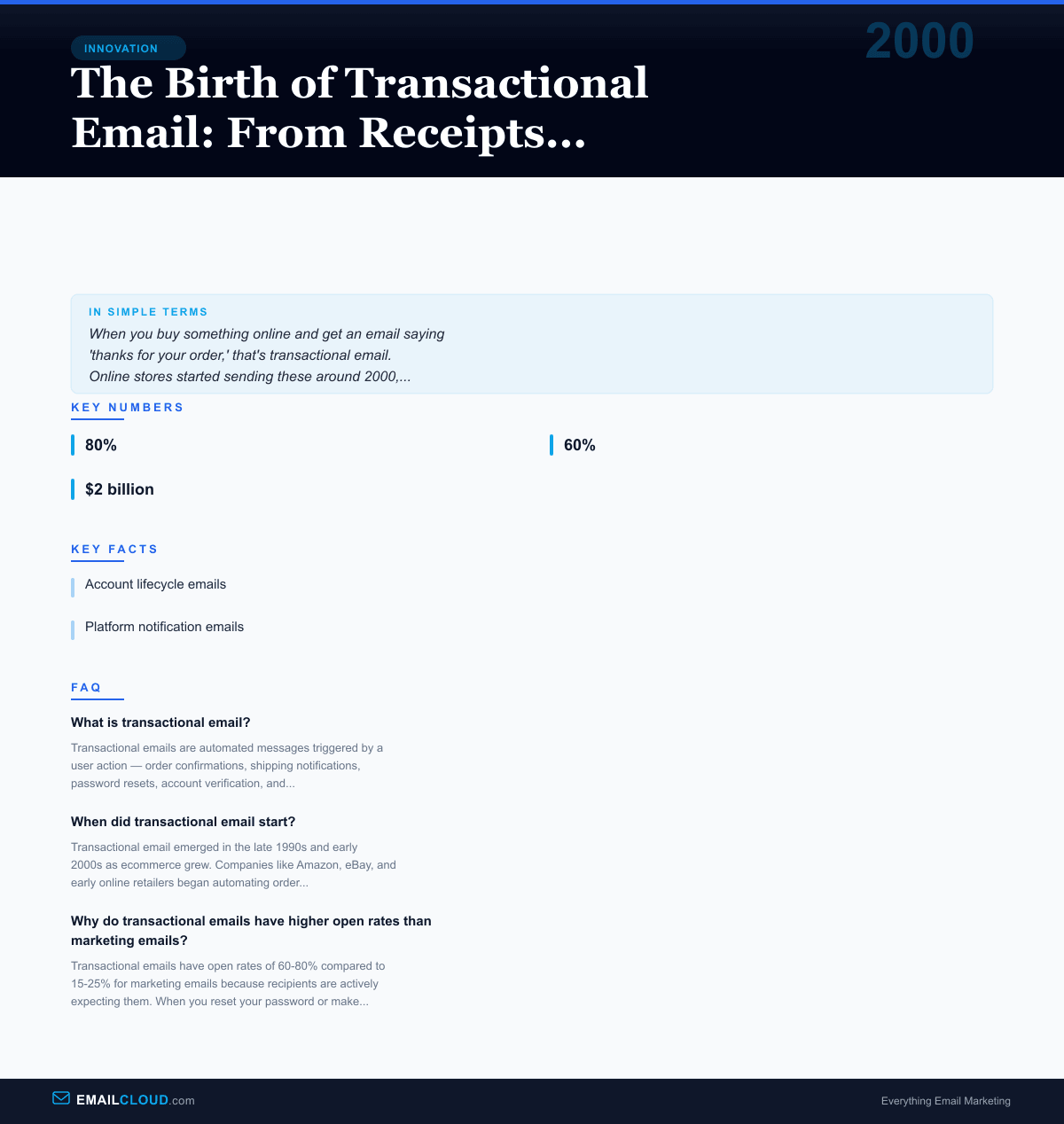
Infographic
Share this visual summary. Right-click to save.
Related Events
Frequently Asked Questions
What is transactional email?
Transactional emails are automated messages triggered by a user action — order confirmations, shipping notifications, password resets, account verification, and similar one-to-one communications. Unlike marketing emails, they are expected by the recipient and typically have very high open rates (60-80%).
When did transactional email start?
Transactional email emerged in the late 1990s and early 2000s as ecommerce grew. Companies like Amazon, eBay, and early online retailers began automating order confirmations and shipping updates. By 2002-2003, transactional email was standard practice for any online business.
Why do transactional emails have higher open rates than marketing emails?
Transactional emails have open rates of 60-80% compared to 15-25% for marketing emails because recipients are actively expecting them. When you reset your password or make a purchase, you look for that confirmation email. This expectation drives engagement rates that marketing emails can't match.