1999: From 'Dear {Name}' to Hyper-Personalization
The first generation of email marketing was a megaphone. One message, broadcast to everyone, identical for all. The from line might change, but the experience was the same whether you were a loyal customer or a brand-new subscriber, whether you were interested in running shoes or winter coats, whether you’d bought something yesterday or not at all.
Then someone had the idea of putting the subscriber’s name at the top. And everything started to change.
The Merge Tag Era (Late 1990s)
The earliest form of email personalization was the merge tag — a placeholder variable in an email template that would be replaced with subscriber-specific data when the email was sent. The most common was the first name tag: “Dear {FNAME}” became “Dear Sarah” or “Dear Michael” when the email went out.
This was borrowed directly from direct mail, where mail merge had been a standard practice since the 1980s. Personalized direct mail pieces — “Dear Mr. Johnson, as a valued resident of Springfield…” — had long been shown to outperform generic mailings. Email marketers applied the same principle.
The results were immediate and measurable. Studies from the early 2000s showed that personalized subject lines (“Sarah, your weekly deals inside”) outperformed generic alternatives (“Your weekly deals inside”) by 15-25% in open rates. The recipient’s own name was an attention signal — a pattern interrupt in a sea of impersonal marketing messages.
Email platforms like Constant Contact, AWeber, and early Mailchimp all offered basic merge tag functionality. The implementation was simple: store subscriber data in fields (first name, last name, company, city), reference those fields in the email template, and the platform handled the rest.
Beyond the Name (Mid-2000s)
The limitations of merge tags became apparent quickly. Personalization based on a subscriber’s name was better than nothing, but it was still cosmetic. “Dear Sarah” followed by a completely generic email was personalization in the thinnest possible sense — the greeting was customized, but the content was identical for everyone.
The next step was segment-based personalization: sending different messages to different groups based on shared characteristics. Instead of one email to the entire list, a retailer might send one version to customers who’d purchased in the last 30 days and a different version to those who hadn’t purchased in six months. The messages looked different, contained different offers, and spoke to different levels of customer engagement.
This wasn’t true one-to-one personalization — it was one-to-segment. But it represented a significant leap from one-to-all. A re-engagement email to lapsed customers performed dramatically better than sending the same promotional offer to everyone, including people who’d just bought something yesterday.
Behavioral Personalization (Late 2000s-2010s)
The real personalization revolution arrived when email platforms began integrating with ecommerce and web analytics data. Instead of personalizing based on static profile data (name, location, signup date), marketers could now personalize based on dynamic behavioral data — what the subscriber actually did.
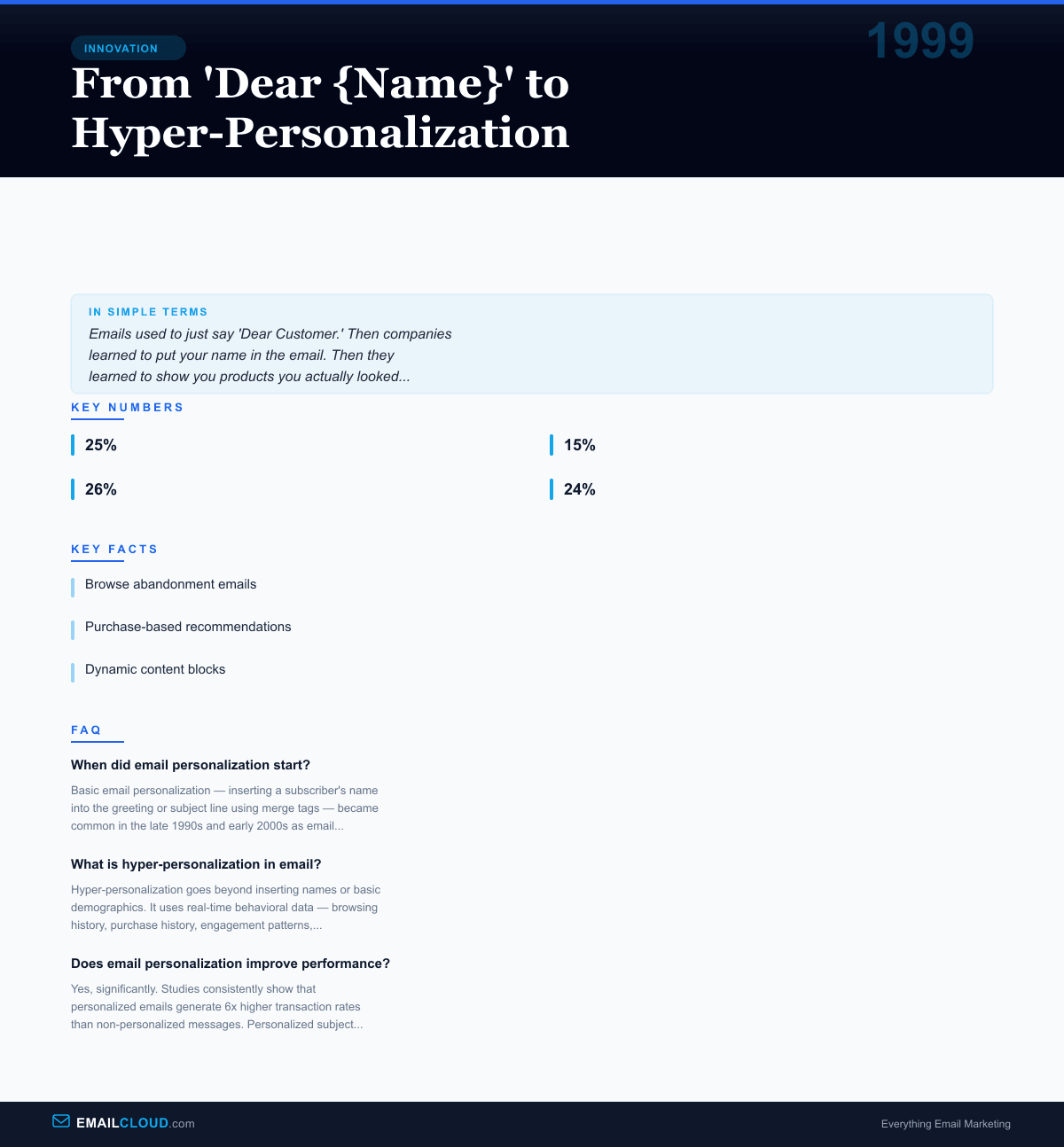
Browse abandonment emails targeted users who viewed specific products on a website without purchasing. “Still thinking about those running shoes?” accompanied by an image of the exact shoes they’d viewed. These emails were personalized not by who the person was, but by what they did.
Purchase-based recommendations analyzed what a customer had bought and suggested related products. Amazon’s “customers who bought this also bought” approach, applied to email. Each recipient received different recommendations based on their individual purchase history.
Dynamic content blocks allowed different sections of a single email to display different content based on subscriber attributes. A clothing retailer’s weekly email might show men’s clothing to male subscribers and women’s clothing to female subscribers — same email template, different content blocks, personalized experience.
Klaviyo, launched in 2012, was built from the ground up around this behavioral approach. The platform ingested ecommerce data — every page view, every cart addition, every purchase — and made it available for email personalization. A Shopify store using Klaviyo could automatically send emails featuring the exact products each customer had shown interest in.
The Data Foundation
Effective personalization required data, and the 2010s saw a massive expansion in the data available to email marketers. Customer data platforms (CDPs) aggregated behavioral data from multiple sources — website, mobile app, in-store, social media — into unified customer profiles that email platforms could reference.
Email service providers built deeper integrations with ecommerce platforms, CRMs, and analytics tools. The data flowing into email personalization engines expanded from basic profile fields (name, email, location) to comprehensive behavioral histories (pages viewed, products considered, purchases made, emails engaged with, customer lifetime value).
This data abundance made truly individualized emails possible. Not just “Dear Sarah” — but “Dear Sarah, based on your interest in trail running shoes and your recent purchase of moisture-wicking socks, here are three items we think you’ll love, with a 15% discount because you’re a Gold member.”
The Performance Evidence
The business case for personalization was overwhelming. Study after study confirmed that more personalization meant better results.
Emails with personalized subject lines achieved 26% higher open rates (Campaign Monitor). Personalized emails delivered 6x higher transaction rates than non-personalized messages (Experian). Dynamic product recommendations in emails accounted for 24% of email marketing revenue for ecommerce companies (Barilliance). Triggered personalized emails generated 4x higher revenue per email than batch campaigns (Bluecore).
The data was unambiguous: personalization worked. Every increment of personalization — from name to segment to behavior to real-time dynamic content — produced measurable improvements in engagement and revenue.
Where Personalization Stands Today
By the mid-2020s, the most sophisticated email programs achieve near-complete individualization. Each subscriber receives an email that is unique to them — unique product recommendations, unique content blocks, unique offer amounts, sent at the optimal time for their individual engagement pattern.
The gap between the most and least personalized email programs has never been wider. At one end, major retailers and DTC brands send emails where every element is dynamically generated based on real-time behavioral data. At the other end, many small businesses still send the same newsletter to their entire list with a first-name merge tag.
The journey from “Dear {FNAME}” to hyper-personalization took roughly 25 years. The technology evolved from simple text replacement to sophisticated behavioral engines. But the underlying principle hasn’t changed: an email that feels like it was written for you performs better than one that feels like it was written for everyone. The tools for achieving that feeling have simply gotten much, much better.
Infographic
Share this visual summary. Right-click to save.
Related Events
Frequently Asked Questions
When did email personalization start?
Basic email personalization — inserting a subscriber's name into the greeting or subject line using merge tags — became common in the late 1990s and early 2000s as email marketing platforms added mail merge capabilities. Behavioral personalization based on browsing and purchase data emerged in the late 2000s and early 2010s.
What is hyper-personalization in email?
Hyper-personalization goes beyond inserting names or basic demographics. It uses real-time behavioral data — browsing history, purchase history, engagement patterns, predicted preferences — to dynamically customize every element of an email, including product recommendations, content blocks, send time, and offer amount.
Does email personalization improve performance?
Yes, significantly. Studies consistently show that personalized emails generate 6x higher transaction rates than non-personalized messages. Personalized subject lines increase open rates by 26%. Dynamic product recommendations in emails drive 24% of email marketing revenue for ecommerce companies.