2001: Rise of Marketing Automation: From Manual Sends to Smart Flows
In the late 1990s, sending a marketing email worked like this: a marketer wrote the email, a designer made it look nice, someone exported a CSV of email addresses from a database, someone else uploaded the CSV to an email sending tool, and someone hit “send.” The same message went to everyone on the list at the same time. If you wanted to send a different message to a different segment, you repeated the entire process.
This was called “batch and blast,” and it was the state of the art. It was also manual, slow, and aggressively one-size-fits-all. The idea that email marketing could be automated — that software could send the right message to the right person at the right time without a human clicking “send” — was, in 2001, still largely theoretical.
Two decades later, marketing automation generates the majority of email marketing revenue for most ecommerce and SaaS companies. The journey from manual to automated is one of the most consequential evolutions in digital marketing history.
The Early Pioneers
The concept of automated marketing predates the internet. Direct mail companies in the 1980s used database marketing techniques to send targeted physical mailings based on customer segments. When email marketing emerged in the mid-1990s, it initially replicated the batch-and-blast model of direct mail — same message, big list, press send.
The first companies to push beyond batch-and-blast emerged around the turn of the millennium.
Eloqua, founded in 1999 in Ottawa, Canada, was one of the earliest platforms specifically designed for marketing automation. Eloqua offered lead scoring, automated email sequences, and campaign management tools aimed at B2B marketers. The platform was expensive and complex, but for enterprise marketing teams with the resources to implement it, the results were transformative.
Infusionsoft (later Keap), launched in 2001, targeted small businesses with a combination of CRM and email automation. The platform was among the first to offer visual workflow builders that let non-technical marketers design automated email sequences.
HubSpot, founded in 2006, combined content marketing, SEO, and email automation into what it called “inbound marketing.” HubSpot’s contribution was as much philosophical as technical — it popularized the idea that marketing should attract customers with valuable content rather than interrupting them with unsolicited messages.
Marketo, founded in 2006, competed directly with Eloqua for the enterprise B2B market. Marketo’s platform offered sophisticated lead nurturing, scoring, and analytics that allowed marketing teams to automate the journey from initial contact to sales-qualified lead.
Pardot, founded in 2007 and later acquired by Salesforce, provided B2B marketing automation integrated with the dominant CRM platform.
The Key Innovation: Behavioral Triggers
The fundamental innovation that separated marketing automation from basic email tools was the behavioral trigger. Instead of sending emails on a schedule (Monday’s newsletter, Wednesday’s promotion), automated systems could send emails in response to specific user actions.
A website visitor downloads a whitepaper? Automatically send a follow-up email three days later offering a related resource. A customer adds items to a shopping cart but doesn’t complete checkout? Send an abandoned cart reminder one hour later. A subscriber hasn’t opened an email in 90 days? Automatically enter them into a re-engagement sequence.
Behavioral triggers transformed email from a broadcast medium into a responsive one. The email wasn’t sent because the marketer decided to send it — it was sent because the recipient did something (or didn’t do something) that triggered a pre-configured response.
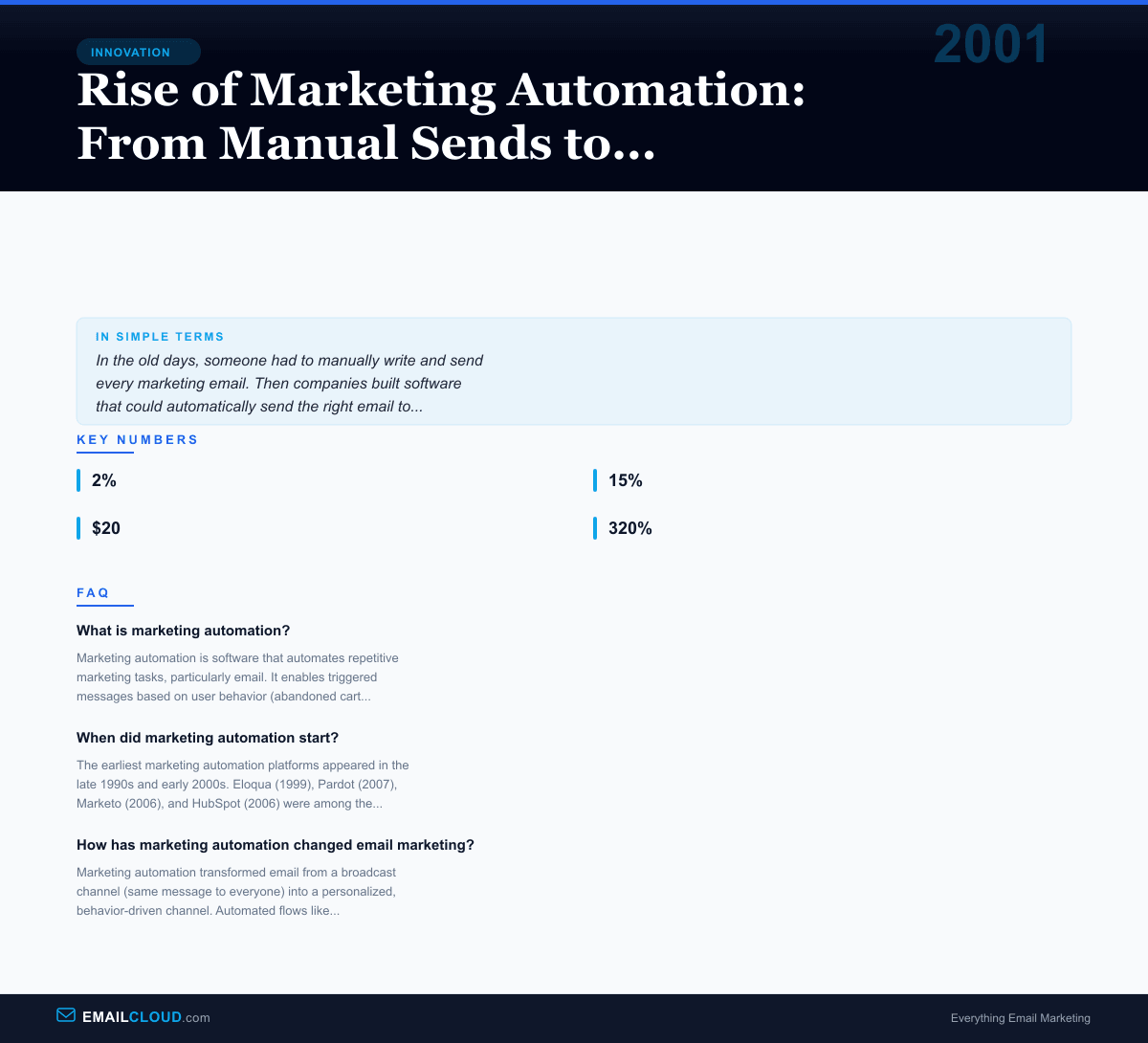
This shift was profound. A batch-and-blast email campaign might achieve a 2% conversion rate because the same message is sent to everyone regardless of their context. A triggered abandoned cart email might achieve a 10-15% conversion rate because it’s relevant, timely, and responds to a specific expressed intent.
The Democratization
Through the early 2010s, marketing automation was primarily an enterprise tool. Eloqua, Marketo, and Pardot carried price tags that ranged from thousands to tens of thousands of dollars per month. Small businesses and startups were priced out.
That changed as established email marketing platforms added automation capabilities to their existing products at accessible price points.
Mailchimp added automation features in 2013-2014, bringing basic triggered emails and customer journeys to its massive base of small business users. A small ecommerce store could now set up an abandoned cart email without a five-figure software investment.
ActiveCampaign, founded in 2003 but gaining significant traction around 2013-2016, offered sophisticated automation at mid-market pricing. Its visual automation builder became a model for the industry.
Drip (2013) and Klaviyo (2012) built automation-first platforms specifically for ecommerce, making behavioral email accessible to Shopify and WooCommerce merchants.
ConvertKit (2013, later Kit) targeted creators and bloggers with simple but effective automation for content-based businesses.
By the mid-2010s, marketing automation had gone from an enterprise luxury to a feature available on platforms starting at $20 per month. The technology that only Fortune 500 companies could afford in 2005 was accessible to solo entrepreneurs by 2015.
The Revenue Impact
The business case for marketing automation is built on a simple truth: automated emails dramatically outperform manual campaigns in almost every metric.
Industry data consistently shows that automated emails generate 320% more revenue per email than non-automated campaigns. Abandoned cart emails alone recover an estimated 5-15% of abandoned carts for most ecommerce stores. Welcome email series convert new subscribers into customers at rates far exceeding one-time welcome messages.
These numbers compound over time. A well-built automation suite — welcome series, abandoned cart recovery, post-purchase follow-up, browse abandonment, win-back campaigns — runs 24 hours a day without incremental labor cost. Once the flows are built and tested, they generate revenue on autopilot.
This compounding effect is why marketing automation has become the backbone of email marketing strategy for businesses of every size. The marketer’s role has shifted from writing and sending individual campaigns to designing, testing, and optimizing automated systems that work constantly.
Where Automation Stands Today
Marketing automation is no longer a category — it’s a feature. Every significant email marketing platform offers automation capabilities. The competition has shifted from “does it have automation?” to “how sophisticated is the automation?” and “how easy is it to use?”
Modern automation platforms offer visual workflow builders, conditional logic, multi-channel orchestration (email + SMS + push notifications), predictive send-time optimization, and real-time personalization. The gap between what a $50-per-month platform offers and what a $50,000-per-month enterprise suite offers has narrowed dramatically.
The journey from batch-and-blast to behavioral automation took roughly 15 years — from the late 1990s to the mid-2010s. In that time, email marketing transformed from a broadcast channel into a responsive, personalized, always-on revenue engine. The marketers who embraced automation early gained enormous advantages. The ones who resisted eventually had no choice but to follow. Today, email marketing without automation is like driving without an engine: you can still push the car, but you won’t get very far.
Infographic
Share this visual summary. Right-click to save.
Related Events
Frequently Asked Questions
What is marketing automation?
Marketing automation is software that automates repetitive marketing tasks, particularly email. It enables triggered messages based on user behavior (abandoned cart emails, welcome sequences), lead scoring, audience segmentation, and multi-step nurture campaigns — all running automatically without manual intervention.
When did marketing automation start?
The earliest marketing automation platforms appeared in the late 1990s and early 2000s. Eloqua (1999), Pardot (2007), Marketo (2006), and HubSpot (2006) were among the pioneers. The category became mainstream by 2010-2015 as prices dropped and usability improved.
How has marketing automation changed email marketing?
Marketing automation transformed email from a broadcast channel (same message to everyone) into a personalized, behavior-driven channel. Automated flows like welcome series, abandoned cart recovery, and re-engagement campaigns generate revenue 24/7 with minimal ongoing effort, dramatically improving both efficiency and performance.