2001: SpamAssassin: The Open-Source War on Junk Email
In April 2001, a developer named Justin Mason released version 1.0 of a Perl-based email filter called SpamAssassin. It was free, it was open-source, and it was about to become the single most widely deployed spam-fighting tool in the history of email.
Born From Frustration
Mason didn’t start from scratch. SpamAssassin evolved from an earlier project called filter.plx, a rudimentary Perl script Mason had written to deal with his own overflowing inbox. By the late 1990s, spam was growing from a nuisance into a genuine crisis, and Mason — a Dublin-based developer with a low tolerance for garbage in his inbox — decided to build something more robust.
The key design decision was the scoring system. Rather than making binary yes/no judgments about individual characteristics, SpamAssassin evaluated each message against a large set of rules and assigned points for each match. A message that triggered “Subject line is all caps” might get 1.5 points. “Contains known spam phrase” might add 2.0. “Sender fails DNS check” might contribute 3.0. When the total exceeded a threshold — 5.0 by default — the message was classified as spam.
This approach was pragmatic. No single indicator is a reliable spam signal. Plenty of legitimate emails have exclamation points in the subject. Some real messages come from servers with misconfigured DNS. But a message that trips multiple rules simultaneously? That’s almost certainly junk.
The Rules Engine
What made SpamAssassin powerful was the breadth of its rule set. The initial release included dozens of rules. Within a year, the community had grown that to hundreds. The rules fell into several categories:
Header analysis checked the technical metadata of each message — was the sending server properly configured? Did the message headers contain inconsistencies typical of forged mail? Was the “From” address in a domain known for spam?
Body analysis scanned the message content for patterns associated with spam: specific phrases, excessive capitalization, suspicious URLs, HTML tricks used to hide text, and the characteristic language of junk mail (“act now,” “limited time,” “click here”).
DNS blocklists cross-referenced the sending server’s IP address against real-time databases of known spam sources. If the server was on a blocklist, points were added.
Bayesian classification was added after Paul Graham’s influential 2002 essay demonstrated the power of statistical filtering. This allowed SpamAssassin to learn from each user’s actual mail patterns — a significant upgrade over static rules alone.
Apache and the Community
In 2003, SpamAssassin was accepted into the Apache Software Foundation, becoming an official Apache project. This was a pivotal moment. Apache’s infrastructure provided long-term stability, legal protection, and credibility. The project gained a formal governance structure, a reliable release process, and the backing of one of the most respected names in open-source software.
The Apache community model also meant that anyone could contribute rules. When a new spam campaign appeared, community members could write detection rules and submit them. The best rules were incorporated into official releases. This gave SpamAssassin something commercial anti-spam products struggled to match: a globally distributed network of contributors who encountered spam patterns across every industry, language, and geography.
Deployment Everywhere
SpamAssassin’s open-source license and modular architecture made it extraordinarily easy to deploy. It could run as a standalone daemon, integrate with mail transfer agents like Postfix and Sendmail, or plug into larger email security stacks. Web hosting companies — which managed email for millions of small businesses — adopted it en masse because it was free, effective, and customizable.
By the mid-2000s, SpamAssassin was processing email on millions of servers worldwide. Estimates varied, but it was commonly cited as the most widely used spam filter on the planet. Virtually every major web hosting provider — cPanel, Plesk, DirectAdmin — bundled SpamAssassin as a default component. If you ran a website with email on shared hosting in the 2000s, SpamAssassin was almost certainly protecting your inbox whether you knew it or not.
The Limitations
SpamAssassin was not perfect. Its rule-based approach, even supplemented by Bayesian analysis, struggled with certain types of spam. Image-based spam — where the spam content was embedded in an attached image rather than in text — was particularly challenging, since early versions couldn’t analyze image content. Spammers also learned to craft messages that stayed just below the scoring threshold, triggering only low-value rules.
Performance was another concern. Running hundreds of rules against every incoming message, including DNS lookups for each one, consumed significant server resources. High-volume mail servers needed careful tuning, and some administrators found that SpamAssassin’s Perl-based architecture didn’t scale gracefully under heavy load.
Despite these limitations, SpamAssassin’s open architecture meant that solutions could be developed and shared by the community. Image spam led to plugins for optical character recognition. Performance concerns led to the development of spamd, a daemonized version that avoided the overhead of starting a new Perl process for every message.
Legacy
SpamAssassin’s lasting contribution isn’t just the spam it blocked — it’s the framework it established for how email filtering works. The concept of multi-factor scoring, where no single signal is dispositive but the combination of signals paints a clear picture, became the standard approach for email security across the industry. Gmail, Outlook, and every other major email provider uses variations of this methodology, though they’ve supplemented it with far more sophisticated techniques.
The project also demonstrated the power of open-source collaboration in security. When thousands of contributors worldwide can identify and share threat patterns in near-real-time, the collective defense is stronger than any single company could build alone. That principle now underpins everything from DNS blocklists to threat intelligence sharing platforms.
SpamAssassin continues to receive updates and remains deployed on countless servers worldwide. It may no longer be the bleeding edge of spam detection, but it’s still standing guard on more inboxes than most people realize — a testament to the durability of good architecture and community-driven development.
Curious about what those spam scoring rules actually flag? Test your email content with our Spam Word Checker to see which trigger words and patterns might cost you points.
Infographic
Share this visual summary. Right-click to save.
Related Events
Frequently Asked Questions
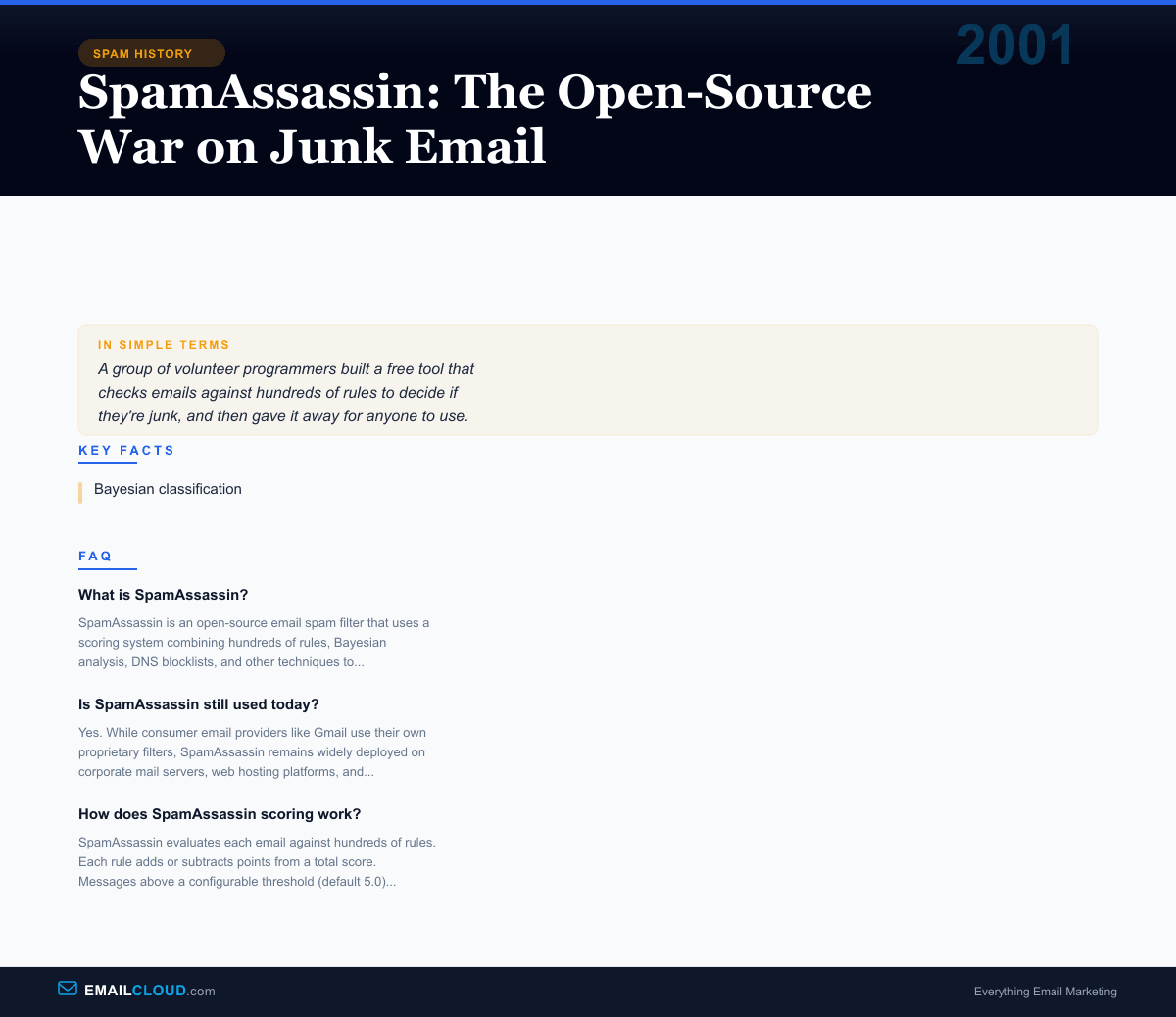
What is SpamAssassin?
SpamAssassin is an open-source email spam filter that uses a scoring system combining hundreds of rules, Bayesian analysis, DNS blocklists, and other techniques to classify messages. It's maintained by the Apache Software Foundation.
Is SpamAssassin still used today?
Yes. While consumer email providers like Gmail use their own proprietary filters, SpamAssassin remains widely deployed on corporate mail servers, web hosting platforms, and custom email infrastructure. It continues to receive updates from its open-source community.
How does SpamAssassin scoring work?
SpamAssassin evaluates each email against hundreds of rules. Each rule adds or subtracts points from a total score. Messages above a configurable threshold (default 5.0) are classified as spam. The scoring approach allows fine-tuning to reduce false positives.