1997: Sanford Wallace: The Rise and Fall of the Spam King
Sanford Wallace did not invent spam. But he perfected the art of making the entire internet hate him — and he did it with a persistence that, in any other field, might have been admirable.
The Junk Fax Years
Before Wallace clogged email inboxes, he clogged fax machines. In the mid-1990s, his company Cyber Promotions operated one of the most aggressive junk fax operations in the United States. He sent unsolicited fax advertisements to thousands of businesses, eating up their paper and toner to sell products nobody asked about. When the Telephone Consumer Protection Act of 1991 made junk faxing illegal, Wallace pivoted. He didn’t see a dead end — he saw an opportunity. Email, after all, was basically a free fax machine with no paper costs.
Cyber Promotions: The Email Empire
By 1996, Wallace had transformed Cyber Promotions into one of the largest bulk email operations in the world, operating out of Philadelphia. At its peak, the company was sending an estimated 30 million emails per day. The content was the usual junk mail fare: dubious health products, get-rich-quick schemes, and the assorted detritus of late-1990s internet commerce.
Wallace’s operation was brazen. He didn’t hide behind anonymous servers or forged headers the way later spammers would. He operated openly, argued that spam was protected commercial speech under the First Amendment, and seemed genuinely confused when people objected to receiving his messages.
The objections, however, were loud and well-funded. In 1997, a parade of the era’s biggest internet companies lined up to sue him. CompuServe sued and won an injunction. AOL sued — twice. Earthlink sued. Even the state of California got involved. Each lawsuit produced court orders telling Wallace to stop. Each court order produced a brief pause followed by Wallace finding a new angle.
The Cat-and-Mouse Game
What made Wallace remarkable wasn’t just the volume of his spam — it was his cockroach-like ability to survive legal extermination. When one ISP blocked him, he’d hop to another. When courts ordered him to stop using one company’s network, he’d find a workaround. He forged headers, used open relays, and bounced messages through overseas servers.
In 1998, facing mounting legal costs and a federal court order obtained by Earthlink, Wallace briefly claimed he was getting out of the spam business. He even announced plans to become an anti-spam advocate — a career pivot that lasted about as long as a New Year’s resolution. By 2000, he was back at it, this time promoting his own websites through spam.
The AOL Saga
Wallace’s battles with AOL were particularly colorful. AOL, then the nation’s largest internet provider with over 20 million subscribers, became his white whale — or perhaps he was theirs. AOL blocked his messages. Wallace used their network anyway. AOL sued for violation of the Computer Fraud and Abuse Act. Wallace argued in court that AOL’s members had a right to receive his messages. The court disagreed, calling his arguments “not supported by any authority” — legal-speak for “you can’t be serious.”
In 1998, a federal judge ordered Wallace to pay AOL and several other ISPs damages. The total judgments against him across multiple suits ran into the millions. Wallace declared bankruptcy.
The Facebook Chapter
Most people would have taken the hint. Wallace was not most people.
After several years of relative quiet, Wallace resurfaced in 2008 — this time on Facebook. He created a phishing application that compromised user accounts and used them to post spam messages to victims’ friends’ walls. Between November 2008 and March 2009, he sent approximately 27 million spam messages through Facebook.
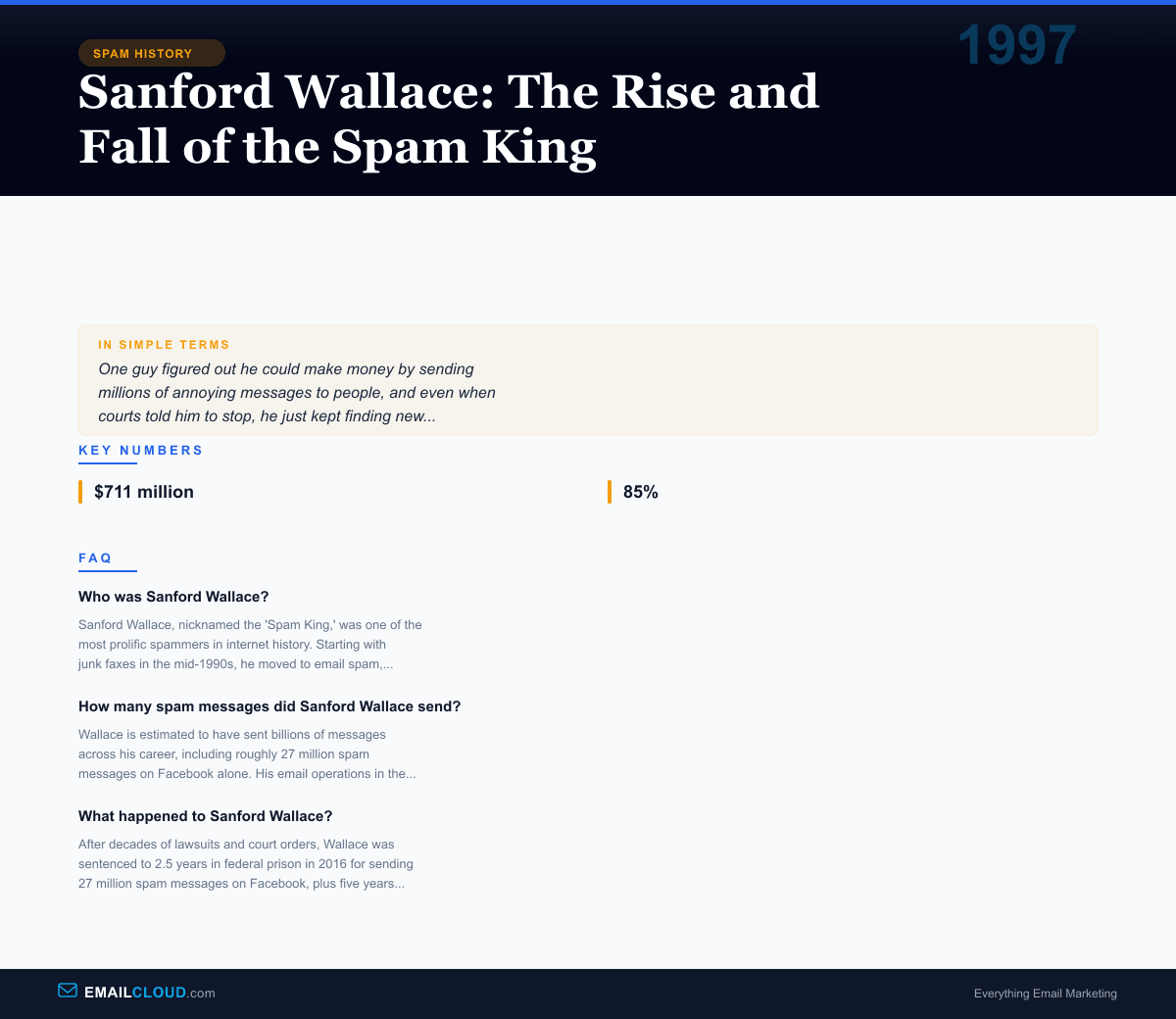
Facebook sued him in 2009, and a court awarded the company $711 million in damages — a largely symbolic figure, since Wallace didn’t have anywhere near that amount. More importantly, the court issued an order banning him from Facebook entirely. Wallace responded by accessing Facebook again. Because of course he did.
Prison
The Facebook scheme finally crossed a line that earlier civil suits hadn’t. In 2011, a federal grand jury indicted Wallace on fraud charges and criminal contempt. He pled guilty in 2015 to electronic mail fraud, intentional damage to a protected computer, and criminal contempt of court.
On August 24, 2016, U.S. District Judge Lawrence Stengel sentenced Sanford Wallace to two and a half years in federal prison, five years of supervised release, and ordered restitution. Wallace was 47 years old. He had been spamming, in one form or another, for over 20 years.
What Wallace Represented
It would be easy to dismiss Sanford Wallace as a small-time grifter who got what he deserved. But his story illuminates something important about the economics of spam. For over two decades, despite lawsuits, court orders, restraining orders, federal indictments, and the unified opposition of the largest technology companies in the world, Wallace kept going — because the economics worked. Sending bulk messages cost almost nothing, and even a microscopic response rate generated revenue.
Wallace was the most visible spammer, but he was far from the only one. At the height of the spam era in 2008-2009, unsolicited messages accounted for over 85% of all email sent worldwide. Wallace was a symptom of a systemic problem: email’s original protocols had no authentication, no sender verification, and no mechanism for consent. The protocols trusted everyone. People like Wallace proved that was a mistake.
The anti-spam infrastructure we have today — SPF, DKIM, DMARC, Bayesian filters, reputation scoring — exists in large part because people like Sanford Wallace forced the industry to build it. Every time you send a legitimate email and it arrives in the inbox instead of the spam folder, you’re benefiting from defenses that were constructed, brick by brick, to stop the Spam King and his imitators.
Want to make sure your own emails don’t trigger those hard-won spam filters? Run your content through our Spam Word Checker before you hit send.
Infographic
Share this visual summary. Right-click to save.
Related Events
Frequently Asked Questions
Who was Sanford Wallace?
Sanford Wallace, nicknamed the 'Spam King,' was one of the most prolific spammers in internet history. Starting with junk faxes in the mid-1990s, he moved to email spam, then Facebook spam, sending billions of unwanted messages over two decades.
How many spam messages did Sanford Wallace send?
Wallace is estimated to have sent billions of messages across his career, including roughly 27 million spam messages on Facebook alone. His email operations in the late 1990s and 2000s reached volumes in the tens of millions daily.
What happened to Sanford Wallace?
After decades of lawsuits and court orders, Wallace was sentenced to 2.5 years in federal prison in 2016 for sending 27 million spam messages on Facebook, plus five years of supervised release and restitution.