2002: Paul Graham's Bayesian Spam Filter: The Essay That Changed Everything
In August 2002, Paul Graham — a programmer, essayist, and future co-founder of Y Combinator — published a 3,500-word essay on his personal website that would fundamentally alter how the world fights junk email. The essay was titled “A Plan for Spam,” and it proposed something radical: instead of humans trying to write rules to catch spam, let computers figure it out using statistics.
The Problem With Rules
Before Graham’s essay, spam filters worked mostly on hand-crafted rules. A human would look at spam, identify patterns — “FREE!!!” in the subject line, mentions of Viagra, ALL CAPS — and write rules to catch them. The most prominent system, SpamAssassin, maintained an elaborate scoring system where each rule added points, and messages above a threshold got flagged.
The problem was obvious: spammers could read the same rules. If a filter caught “FREE,” spammers wrote “FR33” or “F.R.E.E.” If a filter caught “Viagra,” spammers wrote “V1agra” or “Via_gra.” It was an arms race where the defenders were always one step behind, and every new rule required a human to notice a new trick and write a countermeasure.
Graham found this approach absurd. In his characteristic style — confident, lucid, slightly provocative — he argued that the solution was already 250 years old.
Thomas Bayes, Meet the Inbox
The Reverend Thomas Bayes was an 18th-century English statistician and Presbyterian minister who developed a theorem for calculating conditional probability — the likelihood of an event based on prior knowledge of related conditions. Bayes’ Theorem, published posthumously in 1763, is elegant in its simplicity: it lets you update the probability of a hypothesis as you receive new evidence.
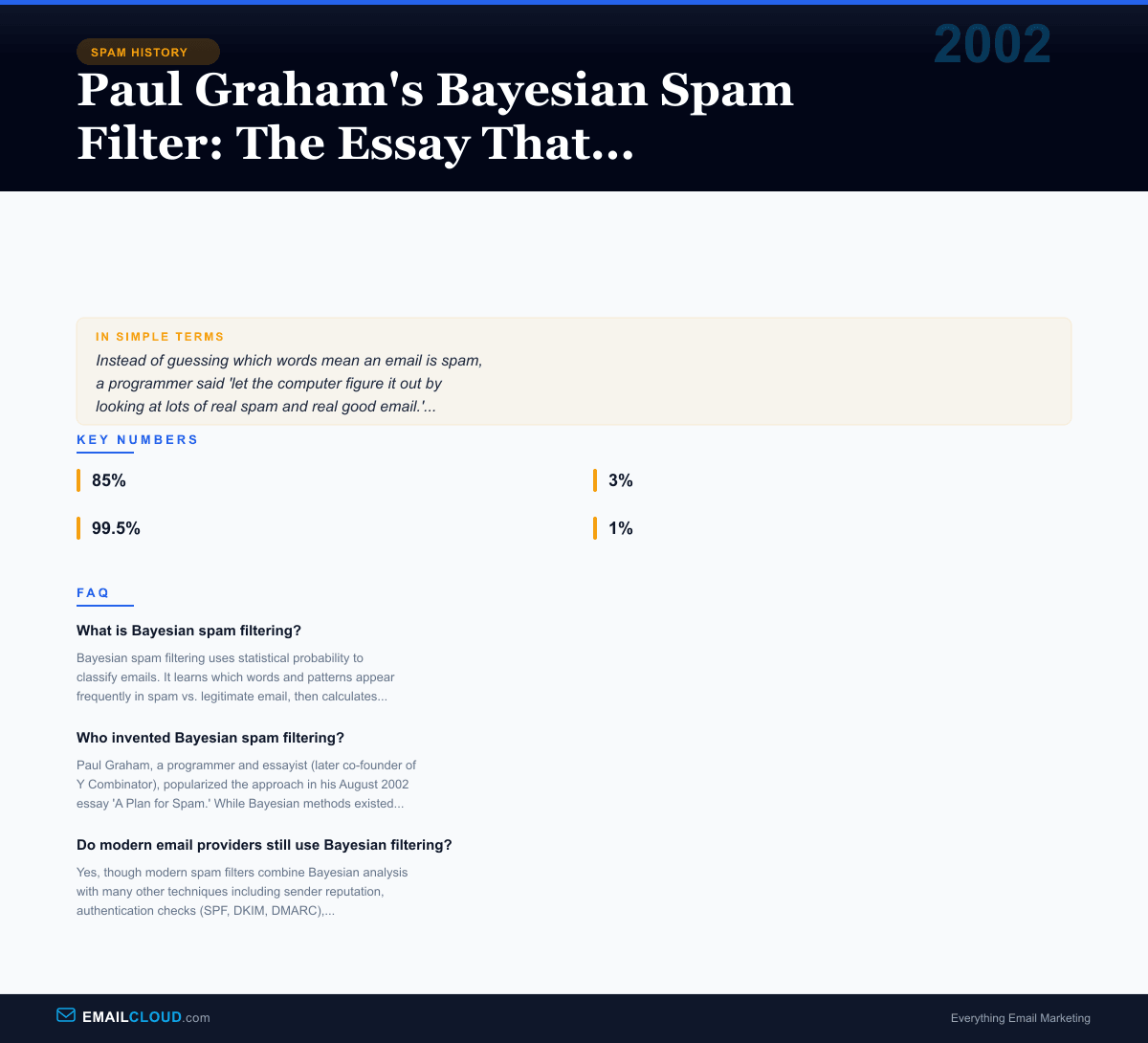
Graham’s insight was that spam filtering is fundamentally a classification problem. Given a set of words in an email, what’s the probability that the email is spam? If you’ve seen the word “mortgage” appear in 85% of spam emails but only 3% of legitimate emails, that word’s presence should heavily tilt the probability toward spam. Conversely, a word like “meeting” that appears frequently in legitimate email but rarely in spam should tilt the probability the other way.
The beauty was that the system learned from actual email. Each user’s filter could be trained on their own mail, adapting to what was and wasn’t spam for that specific person. No human had to write rules. The math did the work.
The Results Were Stunning
Graham didn’t just theorize. He built a working filter and tested it on his own email. His first implementation caught 99.5% of spam with zero false positives — meaning it never incorrectly flagged a legitimate email as spam. In the spam-filtering world, false positives are the cardinal sin, because a missed spam is annoying but a missing legitimate email can be catastrophic.
Those numbers got the tech community’s attention. The essay spread across Slashdot, developer blogs, and mailing lists. Within months, programmers around the world were implementing their own Bayesian filters. SpamAssassin added Bayesian classification to its toolkit. Mozilla incorporated Bayesian filtering into its Thunderbird email client. Apple built it into Mail.app.
Why It Worked So Well
The genius of Bayesian filtering was that it turned spammers’ evasion tactics against them. The misspellings and obfuscations that let spam slip past rule-based filters — “V1agra,” “m0rtgage,” “fr33” — became strong spam signals in a Bayesian system. Legitimate emailers don’t write “V1agra.” So the very tricks spammers used to dodge old filters became red flags for the new ones.
Even better, the system was self-updating. As spammers evolved their tactics, users could mark new spam as spam, and the filter would learn the new patterns. No waiting for a human to write a new rule and push an update. The filter adapted in real time.
Graham described this advantage with characteristic directness: “I think Bayesian filtering will be the way to go, because it’s the way evolution has already gone. Our brains are Bayesian spam filters.”
The Ripple Effects
The impact of Graham’s essay went far beyond email. The concept of using statistical classification to separate wanted from unwanted content became a foundational technique in software engineering. Content recommendation systems, comment moderation tools, fraud detection systems, and document classifiers all owe a debt to the popularization of Bayesian methods that Graham kickstarted.
Graham himself went on to co-found Y Combinator in 2005, the startup accelerator that would fund companies like Airbnb, Dropbox, Stripe, and Reddit. He has said that working on spam filtering taught him important lessons about how to identify problems worth solving — lessons he applied to evaluating startups.
The Cat-and-Mouse Continues
Bayesian filtering didn’t end spam, of course. Spammers adapted by embedding text in images (which early Bayesian filters couldn’t read), by using short messages with links (reducing the word count available for analysis), and by compromising legitimate email accounts to send spam with a “clean” sender reputation.
Modern spam filters have evolved far beyond pure Bayesian analysis. Gmail, Outlook, and other major providers use dozens of signals including sender reputation, authentication records (SPF, DKIM, DMARC), recipient engagement patterns, and advanced pattern recognition. But Bayesian classification remains a foundational layer. The core insight — let the data tell you what’s spam instead of trying to codify it in rules — was genuinely transformative.
Today, the average email user sees spam rates of under 1% in their primary inbox, down from the 85%+ of all traffic that was spam in 2009. That dramatic improvement started with a programmer who looked at a 250-year-old statistics theorem and asked, “What if we used this on email?”
If you’re a marketer worried about your messages triggering spam filters, the best defense is knowing what those filters look for. Our Spam Word Checker tests your content against the same categories of trigger words that Bayesian and modern filters flag — so you can fix problems before you hit send.
Infographic
Share this visual summary. Right-click to save.
Related Events
Frequently Asked Questions
What is Bayesian spam filtering?
Bayesian spam filtering uses statistical probability to classify emails. It learns which words and patterns appear frequently in spam vs. legitimate email, then calculates the probability that a new message is spam based on its content.
Who invented Bayesian spam filtering?
Paul Graham, a programmer and essayist (later co-founder of Y Combinator), popularized the approach in his August 2002 essay 'A Plan for Spam.' While Bayesian methods existed in statistics for centuries, Graham was the first to effectively apply them to email filtering.
Do modern email providers still use Bayesian filtering?
Yes, though modern spam filters combine Bayesian analysis with many other techniques including sender reputation, authentication checks (SPF, DKIM, DMARC), behavioral analysis, and machine learning. Bayesian filtering remains a foundational layer.