2023: Klaviyo: How an Email Platform Built a $10 Billion Business
On September 20, 2023, Klaviyo rang the opening bell at the New York Stock Exchange. The Boston-based email marketing platform debuted at $30 per share, valuing the company at approximately $9.2 billion. Within weeks, the market cap would push past $10 billion. For a company that sold email marketing software — not self-driving cars, not cryptocurrency, not virtual reality — this was a remarkable number.
But anyone paying attention to ecommerce over the previous decade wouldn’t have been surprised. Klaviyo had quietly become the infrastructure layer that powered email marketing for hundreds of thousands of online stores, from side-hustle Shopify merchants to publicly traded DTC brands. The company’s story is a masterclass in finding a specific problem, solving it obsessively, and riding the wave of a massive market shift.
The Founding Story
Andrew Bialecki and Ed Hallen founded Klaviyo in 2012 with a frustration that many ecommerce operators shared: existing email marketing tools were built for generic newsletters, not for data-driven commerce. Mailchimp could send a blast to your entire list. Constant Contact could manage your contacts. But neither could easily answer the question every online store owner asks: “Can I automatically email the person who looked at this product three times but didn’t buy it?”
Bialecki, a former software engineer at Applied Predictive Technologies, saw the gap between the data that ecommerce platforms collected and what email marketing tools could actually use. Shopify, Magento, and WooCommerce knew everything about customer behavior — what they browsed, what they added to cart, what they purchased, when they last visited. But the email tools of 2012 treated all subscribers the same.
Klaviyo was built to close that gap. From day one, the platform was designed to ingest customer data from ecommerce platforms and use it to drive automated, personalized email campaigns. Not just “Dear {first_name}” personalization, but genuine behavioral targeting: abandoned cart emails sent within an hour, post-purchase sequences tailored to what was bought, win-back campaigns triggered by inactivity, product recommendations based on purchase history.
The Shopify Marriage
Klaviyo’s growth trajectory changed permanently in the mid-2010s when Shopify’s own growth accelerated. Shopify was making it trivially easy for anyone to start an online store. Those new merchants needed marketing tools, and Klaviyo’s Shopify integration was the best in the market.
The integration was deep. One click connected a Shopify store to Klaviyo, syncing customer profiles, order history, product catalogs, and browsing behavior. A merchant who’d never written a line of code could have a sophisticated abandoned cart email sequence running within an hour of signing up. Pre-built templates and flows meant that even the most non-technical store owner could deploy marketing automation that previously required an enterprise marketing team.
This created a powerful flywheel. More Shopify merchants used Klaviyo. More Shopify merchants succeeding with Klaviyo attracted more merchants. Klaviyo’s revenue grew alongside Shopify’s merchant base, and the two companies’ fortunes became deeply intertwined. In 2022, Shopify made the relationship official by investing $100 million in Klaviyo, eventually owning approximately 11% of the company at IPO.
The Revenue Engine
What made Klaviyo special in the eyes of Wall Street wasn’t just growth — it was the nature of that growth. Klaviyo’s revenue model was usage-based: customers paid based on the number of contacts in their database. As stores grew their customer lists, they automatically paid more. And because Klaviyo’s emails were directly responsible for revenue (abandoned cart recovery alone generates significant sales for most stores), merchants could see a clear, measurable return on their Klaviyo spend.
By the time of the IPO, Klaviyo had over 130,000 paying customers and was generating over $580 million in annual recurring revenue. The company’s net revenue retention rate — a measure of how much existing customers increase their spending over time — was consistently above 115%, meaning the average customer spent 15% more each year without Klaviyo needing to sell them anything new.
The numbers told a simple story: ecommerce email marketing works, merchants who use it grow, and when they grow they send more emails. Klaviyo had positioned itself as the toll booth on a highway that was only getting busier.
What Klaviyo Changed
Klaviyo’s impact on the email marketing industry went beyond its own business metrics. The company helped establish several ideas that are now taken for granted.
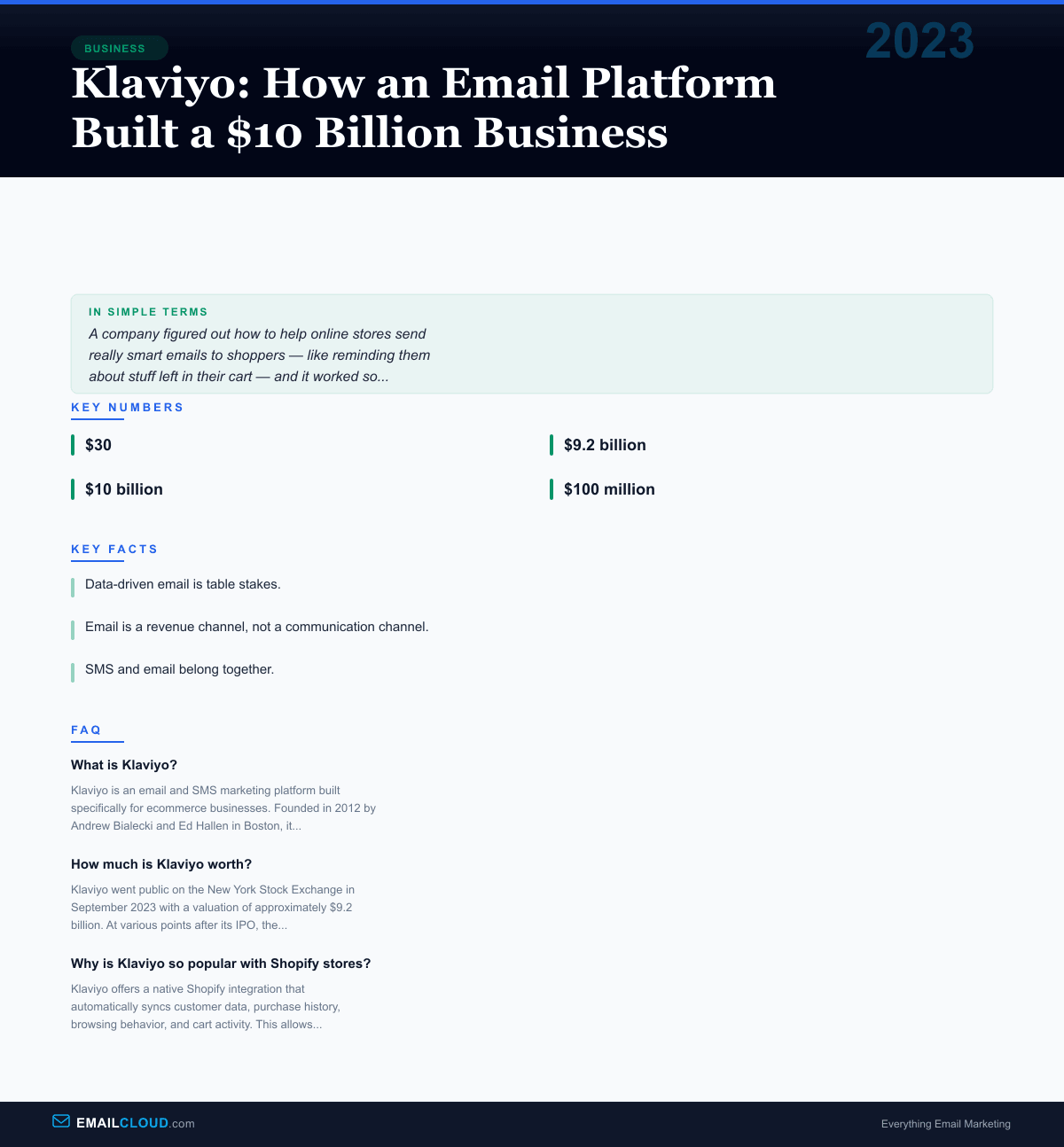
Data-driven email is table stakes. Before Klaviyo popularized behavioral email for small merchants, most small ecommerce businesses sent batch newsletters. Klaviyo made segmentation, triggers, and automation accessible to one-person businesses. Now every email marketing platform, from Mailchimp to Omnisend to Drip, offers similar capabilities.
Email is a revenue channel, not a communication channel. Klaviyo’s reporting dashboard emphasizes revenue attribution — how much money each email flow generated. This framing shifted how merchants think about email from “staying in touch” to “making money.” The mental model changed from marketing expense to revenue engine.
SMS and email belong together. Klaviyo added SMS marketing capabilities, allowing merchants to build flows that combined email and text messages. A customer might get an abandoned cart email after one hour and a text message after 24 hours. This multichannel approach became standard in the ecommerce marketing playbook.
The IPO and Beyond
Klaviyo’s September 2023 IPO was notable for several reasons. It was one of the largest tech IPOs of 2023, a year when the IPO market was largely frozen. It demonstrated that email marketing — often dismissed as boring or outdated — could support a multi-billion-dollar business. And it validated the idea that ecommerce infrastructure companies could be just as valuable as the platforms they served.
The IPO also marked a moment of industry recognition. Email marketing had produced a $10 billion company. Not social media marketing, not influencer marketing, not whatever the latest trend happened to be. Email. The oldest digital marketing channel was still producing the biggest outcomes.
For the broader email marketing ecosystem, Klaviyo’s success sent a clear signal: there is enormous value in helping businesses send better emails. The channel is growing, the tools are getting smarter, and the businesses that master email marketing outperform those that don’t. Klaviyo proved that with a $10 billion exclamation point.
Infographic
Share this visual summary. Right-click to save.
Related Events
Frequently Asked Questions
What is Klaviyo?
Klaviyo is an email and SMS marketing platform built specifically for ecommerce businesses. Founded in 2012 by Andrew Bialecki and Ed Hallen in Boston, it integrates deeply with Shopify, WooCommerce, and other ecommerce platforms to send highly personalized marketing messages based on customer behavior and purchase data.
How much is Klaviyo worth?
Klaviyo went public on the New York Stock Exchange in September 2023 with a valuation of approximately $9.2 billion. At various points after its IPO, the company's market capitalization has exceeded $10 billion. Shopify owns approximately 11% of the company.
Why is Klaviyo so popular with Shopify stores?
Klaviyo offers a native Shopify integration that automatically syncs customer data, purchase history, browsing behavior, and cart activity. This allows Shopify merchants to build highly targeted email and SMS flows — abandoned cart sequences, post-purchase follow-ups, win-back campaigns — without any custom development.