2024: ConvertKit to Kit: The Expensive Rebrand Nobody Asked For
On September 10, 2024, email marketing platform ConvertKit officially became Kit. The rebrand was the culmination of months of planning, a substantial financial investment, and a strategic bet by founder Nathan Barry that the company needed to shed its original name to grow into something bigger. The creator community’s response was immediate, loud, and deeply divided. Some applauded the fresh start. Many more wondered why you’d rename a successful company with strong brand recognition to a generic four-letter word already occupied by a thousand other things.
The Original Name
ConvertKit was founded in 2013 by Nathan Barry, a designer and author who had built an audience through blogging and self-published books. The name was descriptive and functional: a kit for converting — turning website visitors into email subscribers, and subscribers into customers. It was clear, it was specific to what the product did, and it positioned the tool squarely in the email marketing space.
Barry had bootstrapped ConvertKit from zero to significant scale, building it into one of the most popular email marketing platforms for creators. By 2024, the company served over 600,000 creators and generated tens of millions in annual recurring revenue. The name was well-known in the creator economy — bloggers, podcasters, YouTubers, course creators, and newsletter writers knew ConvertKit and what it stood for.
The brand had equity. People associated “ConvertKit” with email marketing for creators. It was the anti-Mailchimp: focused, creator-first, and built by someone who understood the creator world from the inside.
The Case for Change
Barry’s argument for the rebrand centered on growth constraints. ConvertKit had evolved beyond a pure email marketing tool. The company had added commerce features (selling digital products directly through the platform), a creator network (recommending creators to each other’s audiences), and sponsorship opportunities (connecting creators with advertisers). The name “ConvertKit” — with its emphasis on conversion — felt too narrow for the broader platform the company was becoming.
There was also a practical issue. “ConvertKit” was frequently confused with “conversion rate optimization” tools and was occasionally associated with aggressive marketing tactics that didn’t align with the company’s creator-friendly ethos. The word “convert” had connotations beyond marketing — religious conversion, currency conversion — that muddied the brand.
Barry pointed to precedent. Many successful technology companies had rebranded as they outgrew their original names: Research In Motion became BlackBerry, Apple Computer became Apple, Facebook became Meta. The argument was that ConvertKit’s original name was holding back its evolution.
The Choice of “Kit”
The new name — Kit — was chosen for its simplicity and versatility. Barry described it as a “toolkit” reference: a kit is a collection of tools, and the platform offered creators a kit for building their business. The name was short, memorable, and easy to spell.
Critics pointed out several problems. “Kit” is an extremely common word with no inherent association with email marketing, creator tools, or any specific product category. It’s the name of a popular coding framework, a character in “Knight Rider,” a brand of chocolate bar, and countless other things. In a crowded market, distinctive names are valuable, and “Kit” was not distinctive.
Search engine optimization was another concern. Ranking for the search term “Kit” — a four-letter common English word — would be dramatically harder than ranking for “ConvertKit,” a distinctive compound word with no competition for search rankings. The SEO value of the original brand name was significant and not easily replaceable.
The domain question was also notable. Kit.com was already owned by someone else when the rebrand was announced. The company launched on kit.com after acquiring the domain, reportedly at significant cost.
The Rollout
The rebrand was executed comprehensively. The website, app interface, documentation, marketing materials, social media accounts, and email templates were all updated. Existing ConvertKit URLs were redirected to Kit equivalents. The transition was technically smooth — users’ accounts, data, and integrations continued to work without disruption.
Barry chronicled the rebrand journey publicly, sharing the decision-making process, the brand development work, and the rollout details with the creator community. This transparency was consistent with ConvertKit’s culture of building in public, and it generated substantial attention — both positive and negative.
The Community Response
The creator community’s response was polarized. Supporters praised the fresh identity and the vision of a broader creator platform. They argued that the company had outgrown its name and that the rebrand signaled ambition.
Detractors had several objections. The most common was brand equity destruction: ConvertKit had spent eleven years building recognition and trust under its original name, and the rebrand erased that equity overnight. For a bootstrapped company without the marketing budget of a Meta or a Google, brand recognition was a hard-won asset.
Others questioned the timing. The email marketing and creator economy spaces were increasingly competitive, with Beehiiv, Substack, Ghost, Mailchimp, and others all competing for creator attention. Investing millions in a rebrand instead of product development seemed strategically questionable to some observers.
The comparison to Meta’s rebrand was frequently invoked — and not favorably. Facebook’s rename to Meta was widely regarded as a distraction from the company’s problems rather than a genuine strategic move. While ConvertKit’s situation was different (the company was healthy and growing, not managing a PR crisis), the association with Meta’s widely mocked rebrand was not helpful.
The Broader Pattern
ConvertKit’s rebrand to Kit fits a broader pattern in the technology industry where companies rebrand to signal strategic evolution. The pattern works best when the new name is as distinctive as the old one and when the strategic shift is clear to customers. It works poorly when the new name is generic and the strategic shift is abstract.
The email marketing space has seen several rebrands: Infusionsoft became Keap, Drip was acquired by Leadpages, and various other platforms have renamed or repositioned over the years. These rebrands are typically driven by a desire to escape category limitations — “we’re not just email marketing, we’re a platform” — but they risk losing the clarity that the original name provided.
The Verdict (So Far)
As of early 2026, the Kit rebrand is still settling. The company continues to grow, the product continues to evolve, and the creator community has largely adjusted to the new name. Whether the rebrand was a visionary move or an expensive mistake will take years to determine — brand transitions play out over long timescales.
What’s clear is that the rebrand was a significant bet. Changing the name of a successful, well-known company is always risky, and doing so in a competitive market raises the stakes. Kit will need to build the same recognition and trust that ConvertKit earned over eleven years, and it will need to do it with a name that’s harder to differentiate. The email marketing world is watching.
Infographic
Share this visual summary. Right-click to save.
Related Events
Frequently Asked Questions
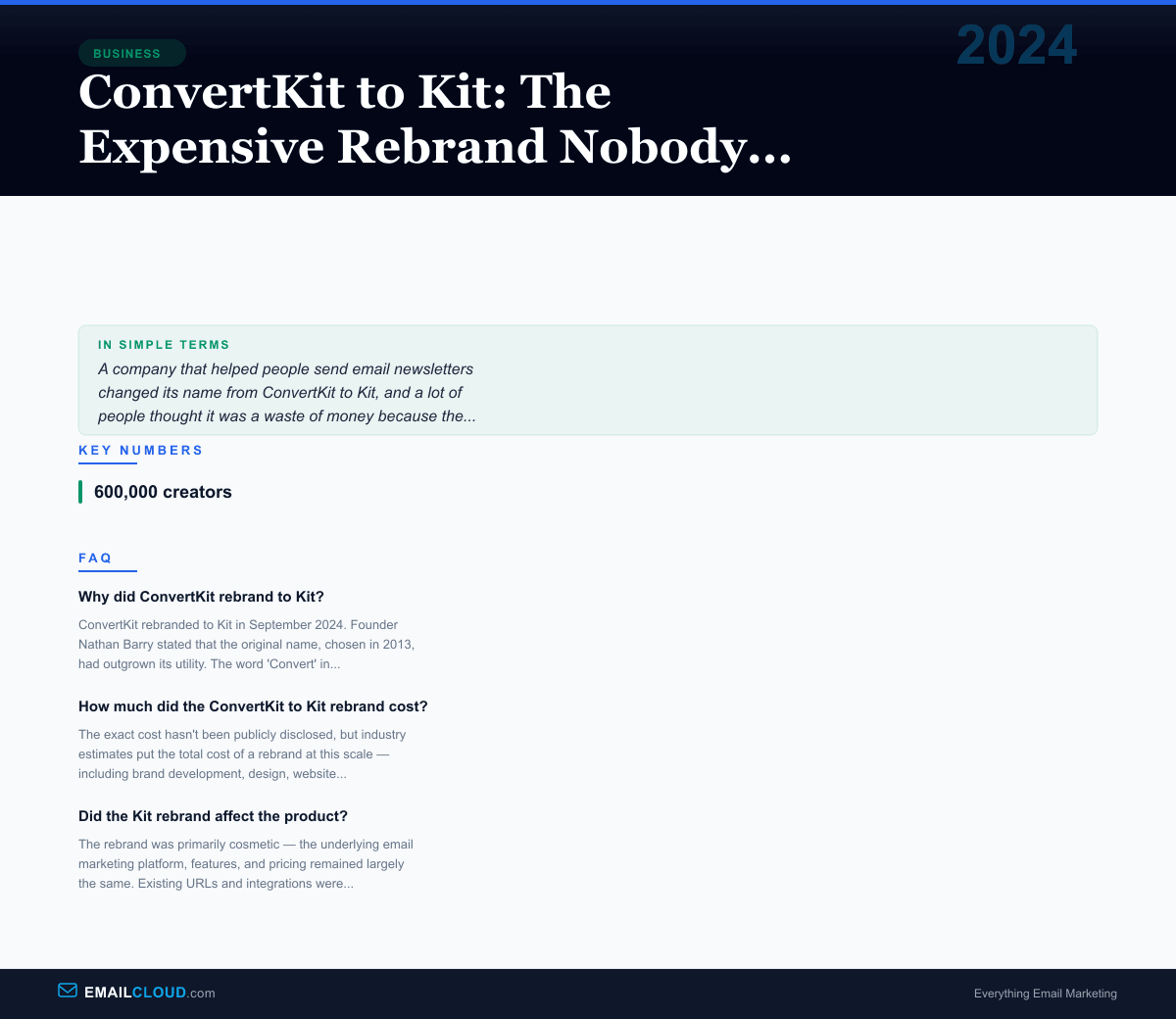
Why did ConvertKit rebrand to Kit?
ConvertKit rebranded to Kit in September 2024. Founder Nathan Barry stated that the original name, chosen in 2013, had outgrown its utility. The word 'Convert' in ConvertKit felt too focused on conversion optimization, and the company wanted a name that better represented its broader vision as a creator platform. The new name 'Kit' was intended to feel simple, versatile, and creator-friendly.
How much did the ConvertKit to Kit rebrand cost?
The exact cost hasn't been publicly disclosed, but industry estimates put the total cost of a rebrand at this scale — including brand development, design, website overhaul, marketing materials, legal trademark work, and customer communication — at several million dollars. The company reportedly spent significantly on the new brand identity and rollout campaign.
Did the Kit rebrand affect the product?
The rebrand was primarily cosmetic — the underlying email marketing platform, features, and pricing remained largely the same. Existing URLs and integrations were redirected. However, the rebrand coincided with the company's push to expand beyond email marketing into a broader creator platform, including commerce features, a creator network, and an app ecosystem.