1998: Constant Contact at 25: A Quarter-Century of Small Business Email
In 1998, “email marketing” wasn’t a phrase most small business owners had ever heard. The internet was five years past its commercial debut. Most small businesses didn’t have websites. The idea that the owner of a local bakery or a neighborhood yoga studio should be regularly emailing customers was, frankly, weird.
Into this world stepped a company called Roving Software, founded by Randy Parker in Brookline, Massachusetts. The pitch was simple: help small businesses send professional emails to their customers without requiring any technical knowledge. The company would later change its name to Constant Contact, go public, build a customer base of over 600,000 businesses, and sell for $1.1 billion. Twenty-five years later, it’s still helping small businesses send emails — a longevity that’s remarkable in an industry that reinvents itself every few years.
Built for the Non-Technical
Constant Contact’s founding insight was that the barrier to email marketing for small businesses wasn’t cost or desire — it was complexity. In the late 1990s, the tools that existed were built for marketers who understood HTML, list management, and email protocols. A dentist who wanted to send appointment reminders to patients had no path from “that sounds useful” to actually doing it.
Roving Software built a web-based tool that abstracted away every technical detail. Pick a template. Type your message. Upload your contact list. Click send. The templates were pre-designed so emails looked professional regardless of the sender’s design skills. The contact management was point-and-click. The sending was handled entirely by the platform.
This wasn’t technically impressive by the standards of what enterprise email systems could do. But it was revolutionary for the target audience. For the first time, a person with zero technical skills could send a polished email newsletter to hundreds of customers in 15 minutes.
The Seminar Strategy
While Silicon Valley startups were chasing viral growth coefficients, Constant Contact was doing something deeply unglamorous: running seminars at public libraries.
The company built a network of “Local Experts” — independent marketing consultants who evangelized email marketing to small businesses in their communities. These experts held workshops at Chambers of Commerce, Rotary Clubs, community colleges, and small business development centers. The format was consistent: explain what email marketing is, show why it matters, demonstrate how Constant Contact makes it easy.
This was hand-to-hand combat customer acquisition. One business at a time, one handshake at a time. It was slow. It was expensive per acquisition. But it built something digital marketing couldn’t: trust. A restaurant owner who learned about email marketing from a real person at a local workshop was far more likely to become a long-term, paying customer than someone who clicked a banner ad.
The Local Expert strategy was perfectly matched to Constant Contact’s customer base. These weren’t tech-forward startup founders reading TechCrunch. They were florists, plumbers, nonprofits, and churches — people who trusted recommendations from people they knew, not advertisements from companies they’d never heard of.
The Rebrand and IPO
In 2004, Roving Software renamed itself Constant Contact — a name that better communicated the company’s value proposition: helping businesses stay in constant contact with their customers. The rebrand coincided with accelerating growth as email marketing awareness increased among small business owners.
The company went public on NASDAQ in October 2007, raising $107 million at a valuation of roughly $500 million. It wasn’t a headline-grabbing IPO, but it validated a business model built on modest subscription fees from hundreds of thousands of small accounts.
Growth continued steadily. By 2015, Constant Contact served over 600,000 customers with annual revenue exceeding $330 million. The customer base was remarkably diverse — restaurants, retail shops, religious organizations, real estate agents, fitness studios, and nonprofits of every size. What they shared was a need for simple, affordable marketing tools and a preference for a product that didn’t assume they knew what “segmentation” or “A/B testing” meant.
The Mailchimp Challenge
Constant Contact’s comfortable position as the default small business email tool was disrupted in 2009 when Mailchimp introduced its Forever Free plan. Suddenly, small businesses could try email marketing at zero cost with a competitor that had a friendlier brand, a cooler logo (Freddie the chimp), and an interface that younger business owners found more intuitive.
Mailchimp’s free tier was a direct assault on Constant Contact’s business model. Constant Contact had always charged from day one — typically $20 to $75 per month depending on list size. The value proposition was “pay for quality, support, and simplicity.” Mailchimp’s counter-argument was devastating: “Try it for free and decide for yourself.”
Constant Contact never offered a comparable free plan, maintaining that its product quality and support justified the cost. This was a principled position but a commercially difficult one as “free to start” became the industry standard.
The Acquisition
In late 2015, Endurance International Group — a conglomerate best known for web hosting brands like Bluehost and HostGator — announced it would acquire Constant Contact for approximately $1.1 billion. The deal closed in February 2016.
The acquisition was met with mixed reactions. Endurance was a portfolio company, not a product visionary, and there were legitimate concerns about Constant Contact becoming just another product in a sprawling corporate catalog rather than an independently driven company.
Under Endurance (later renamed Newfold Digital), Constant Contact continued operating but lost some of its distinctive energy. The Local Expert program scaled back. The product continued evolving — adding social media tools, a website builder, and ecommerce features — but the scrappy, community-driven identity that defined the company’s first 18 years was harder to sustain inside a corporate parent.
The Legacy at 25
Constant Contact’s most enduring contribution isn’t any specific feature. It’s the proof of concept that email marketing works for businesses of all sizes — including the very smallest. Before Constant Contact, email marketing was something corporations did with expensive enterprise software. After Constant Contact, a one-person business could maintain professional customer communication for less than the cost of a daily coffee.
The drag-and-drop email builder, the pre-designed template library, the simple contact management — features that every email marketing platform now offers as table stakes — were popularized by Constant Contact’s relentless focus on accessibility. The company didn’t invent email marketing, but it democratized it.
Twenty-five years after its founding, Constant Contact is still serving small businesses. It’s no longer the dominant player it once was — Mailchimp, Klaviyo, and dozens of other competitors have fragmented the market. But for a certain type of customer — the local business owner who wants reliable, simple email marketing with human support — Constant Contact remains a solid, unpretentious choice. That consistency, sustained over a quarter century, is an achievement in its own right.
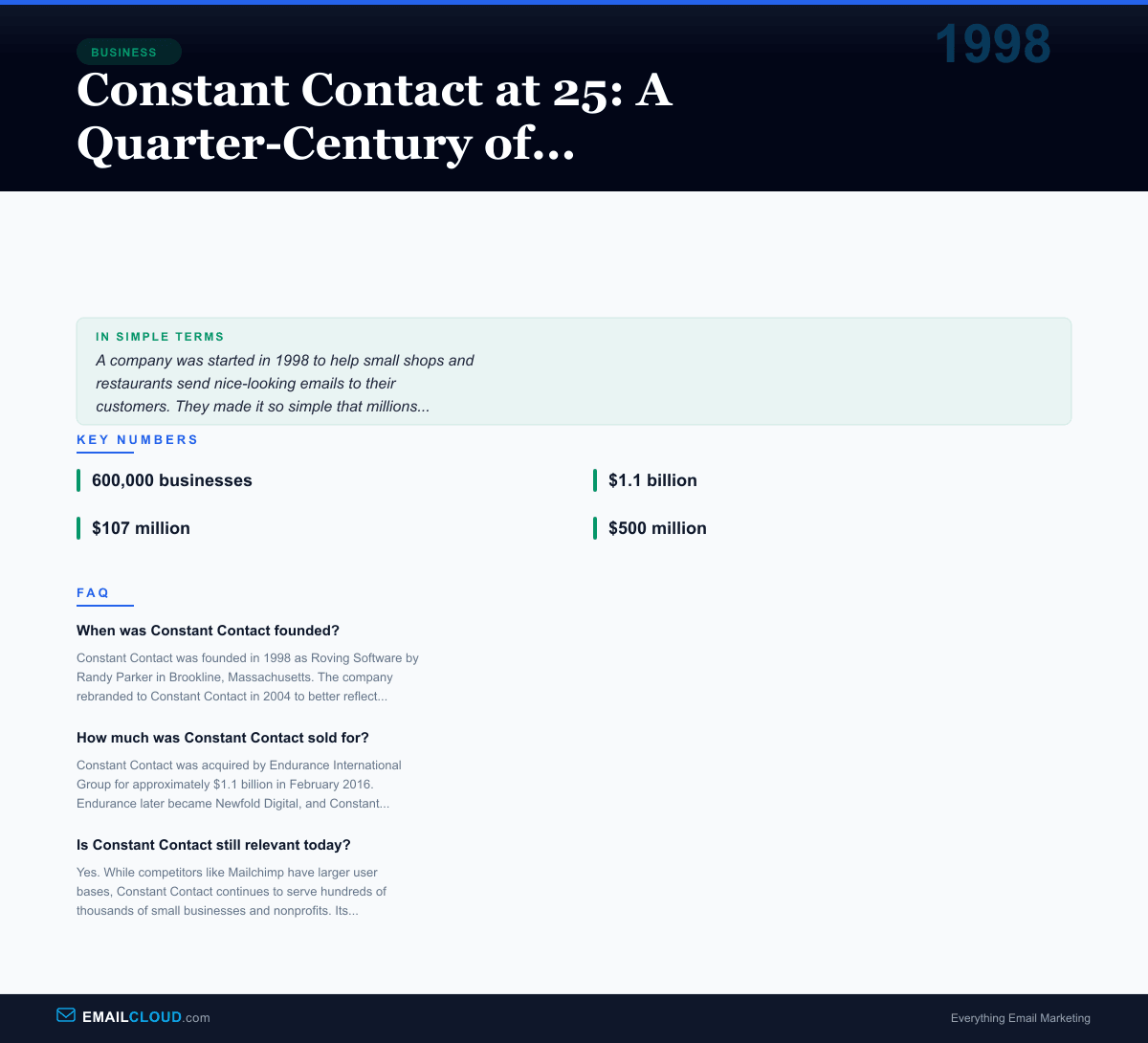
Infographic
Share this visual summary. Right-click to save.
Related Events
Frequently Asked Questions
When was Constant Contact founded?
Constant Contact was founded in 1998 as Roving Software by Randy Parker in Brookline, Massachusetts. The company rebranded to Constant Contact in 2004 to better reflect its mission of helping small businesses maintain consistent customer communication.
How much was Constant Contact sold for?
Constant Contact was acquired by Endurance International Group for approximately $1.1 billion in February 2016. Endurance later became Newfold Digital, and Constant Contact continues to operate as a standalone product under that umbrella.
Is Constant Contact still relevant today?
Yes. While competitors like Mailchimp have larger user bases, Constant Contact continues to serve hundreds of thousands of small businesses and nonprofits. Its strength remains simplicity and customer support, particularly for non-technical users who need email marketing without complexity.