1995: Classmates.com Pioneers Email Marketing to Millions
In November 1995, a software engineer named Randy Conrads launched Classmates.com with a simple premise: help people find their old high school and college classmates. The internet was young, social media didn’t exist, and the idea of using the web to reconnect with people you’d lost touch with was genuinely novel.
What Conrads built wasn’t just one of the earliest social networking sites. Classmates.com was also one of the first companies to discover the raw power of email marketing at scale — a discovery that would influence how every online business marketed itself for the next three decades.
The Hook
The genius of Classmates.com’s email strategy was psychological, not technical. When you signed up for the site and listed your high school and graduation year, the system noted every other registered user from the same school and era. Then it sent emails — not to you, but to them.
“Someone from the Class of 1985 at Roosevelt High School has joined Classmates.com!”
That was the hook. The email didn’t say who. It didn’t provide details. It created a gap — a gap that could only be filled by visiting the site and, crucially, upgrading to a paid membership to see who was looking for you.
The psychology was brilliant. Nostalgia is a powerful motivator. Curiosity is an even more powerful one. The combination — “someone from your past is looking for you, but you have to pay to find out who” — was almost irresistible to millions of people. Open rates on these notification emails were reportedly astronomical, far exceeding what typical commercial emails achieved.
Scale Before Anyone Knew What Scale Meant
By the late 1990s, Classmates.com was sending millions of these notification emails every month. The volume was staggering for the era. Most businesses were still figuring out whether they should have a website at all, let alone whether email could be a marketing channel. Classmates.com was already running an email operation that rivaled major publishers.
The company grew rapidly. By 2000, Classmates.com had over 30 million registered members, making it one of the largest websites on the internet. Much of that growth was driven directly by email. Each new member triggered a wave of notification emails to former classmates, which drove sign-ups, which triggered more emails, which drove more sign-ups. It was a viral loop before anyone had coined the term.
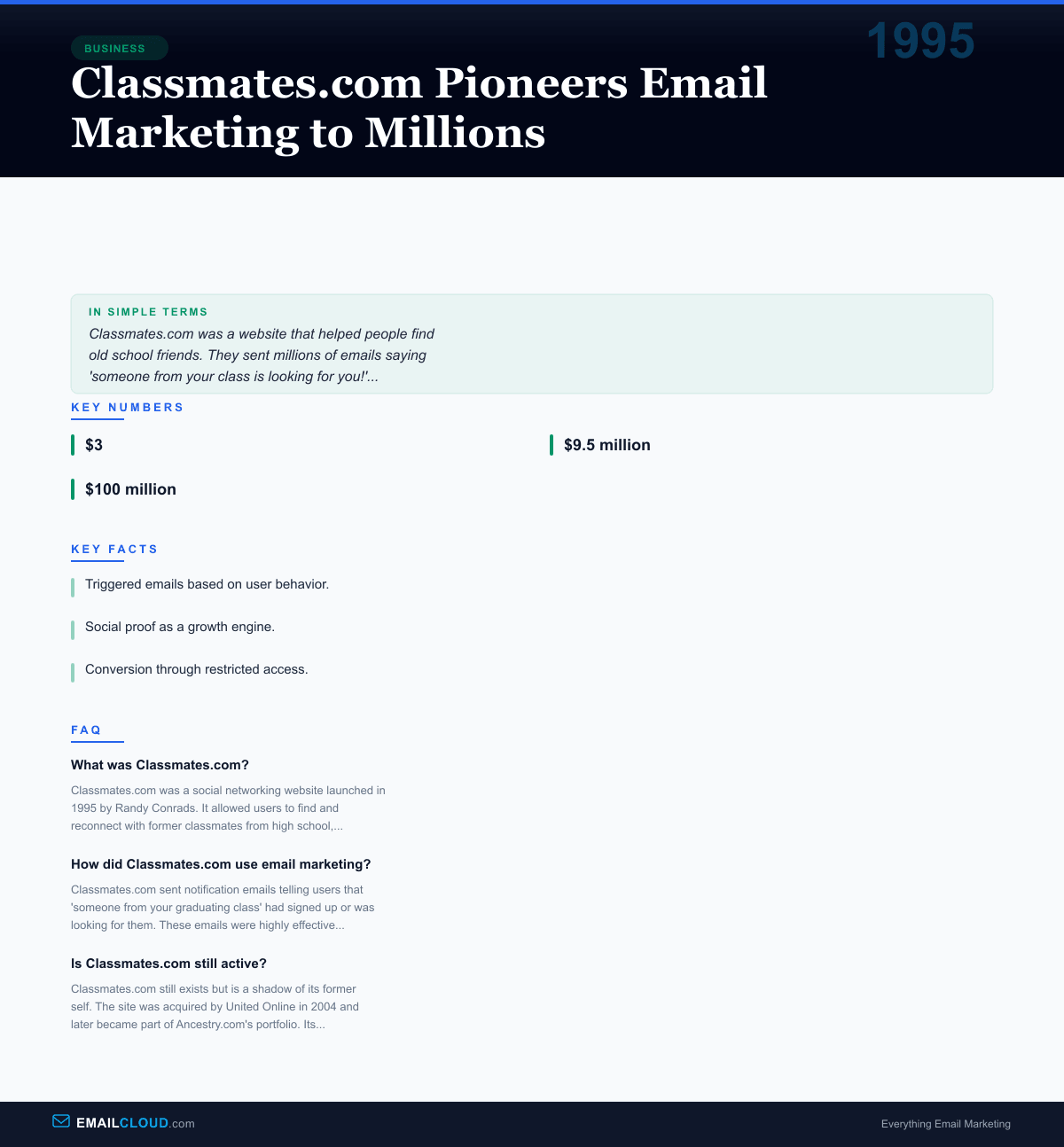
The business model was freemium before that word existed, either. Basic membership was free, but seeing who had viewed your profile or sending messages to classmates required a paid “Gold” membership, typically around $3 per month. The email notifications were the engine that converted free members to paid: “Someone is looking for you — upgrade to find out who.”
The Template for Email Marketing
Classmates.com’s email strategy, whether intentionally or not, established templates that email marketers would refine for decades.
Triggered emails based on user behavior. Classmates.com didn’t send the same email to everyone. Emails were triggered by specific events — a new member joining from your school, someone viewing your profile, a classmate updating their information. This event-driven approach predated the marketing automation industry by years.
Curiosity gaps. Telling someone “you have a message” without revealing the message, or “someone is looking for you” without saying who, exploited the psychological principle that incomplete information creates irresistible motivation to close the gap. This technique became a staple of email subject lines across every industry.
Social proof as a growth engine. Every notification email implied that people you knew were using the platform — which made it feel both safe and exciting. “Your classmates are here” was social proof that drove adoption.
Conversion through restricted access. Free users could see that activity existed but needed to pay to access the details. This gating strategy — showing the envelope but charging to open it — became a standard freemium conversion tactic.
The Controversy
Classmates.com’s aggressive email practices weren’t universally praised. Critics accused the company of sending misleading emails — the notifications implied someone specific was looking for you, when in reality the “someone” might simply be a new member who happened to attend the same school. The emotional manipulation of nostalgia for commercial purposes was questioned.
In 2008, Classmates.com settled a $9.5 million class-action lawsuit alleging that its emails were deceptive. The suit claimed that paid upgrade prompts — “Someone is searching for you!” — created the false impression that a specific person was actively looking for the recipient when that often wasn’t the case.
The settlement highlighted a tension that email marketing still navigates: where is the line between compelling and manipulative? Classmates.com’s emails worked because they triggered genuine emotions. The question was whether triggering those emotions to drive paid upgrades crossed an ethical boundary.
The Rise and Decline
Classmates.com peaked in the early 2000s with over 50 million members and significant revenue from paid subscriptions. United Online acquired the company in 2004 for $100 million. But the rise of Facebook (2004), LinkedIn (2003), and MySpace (2003) gradually eroded Classmates.com’s value proposition. Why pay to find old classmates when Facebook let you do it for free?
By the 2010s, Classmates.com was a relic. The site continued to operate — and continued to send emails — but the user base shrank as social media absorbed its core use case. The company that had pioneered email-driven growth was overtaken by platforms that offered everything it did, and more, for free.
The Lasting Impact
Classmates.com’s contribution to email marketing history is underappreciated. The company demonstrated, at scale, that email could drive user acquisition, engagement, and revenue. It showed that triggered notifications outperformed mass blasts. It proved that psychological hooks — nostalgia, curiosity, social belonging — could make emails irresistible.
Every “You have a new notification” email from Facebook, every “Someone viewed your profile” notification from LinkedIn, every “You have items in your cart” reminder from an ecommerce store — all of them trace their ancestry, in part, to the emails Classmates.com was sending in the late 1990s. The execution was sometimes questionable. The insight was undeniable. Email, used strategically, could build a business — and Classmates.com proved it years before the rest of the internet caught on.
Infographic
Share this visual summary. Right-click to save.
Related Events
Frequently Asked Questions
What was Classmates.com?
Classmates.com was a social networking website launched in 1995 by Randy Conrads. It allowed users to find and reconnect with former classmates from high school, college, and military service. It was one of the earliest social networking sites and one of the first companies to use email marketing at massive scale.
How did Classmates.com use email marketing?
Classmates.com sent notification emails telling users that 'someone from your graduating class' had signed up or was looking for them. These emails were highly effective because they triggered nostalgia and curiosity, driving users back to the site where they were prompted to upgrade to paid memberships.
Is Classmates.com still active?
Classmates.com still exists but is a shadow of its former self. The site was acquired by United Online in 2004 and later became part of Ancestry.com's portfolio. Its core function — reconnecting former classmates — was largely absorbed by Facebook and LinkedIn.