2006: BlackBerry: The Device That Made Email Addictive
In 2006, President Barack Obama had a problem. The Secret Service wanted him to give up his BlackBerry for security reasons. Obama — then a newly elected senator, later a presidential candidate — refused. He was, by his own admission, addicted. “They’re going to have to pry it from my hands,” he told reporters. The most powerful person in the world couldn’t give up his email device. That was the peak of BlackBerry’s power.
The Push That Changed Everything
Research In Motion (RIM), the Waterloo, Ontario company behind BlackBerry, didn’t invent mobile email. But they made it work in a way that nobody else had. The key innovation was “push” email — instead of the device periodically checking the server for new messages (which drained the battery and introduced delays), BlackBerry’s servers pushed messages to the device instantly. Your email arrived on your BlackBerry at the same moment it arrived on your desktop. This seems obvious now. In 2003, it was revolutionary.
The BlackBerry 5810, released in 2002, was among the first devices to combine a phone with email capabilities. But it was the BlackBerry 7230 (2003) and subsequent models that perfected the formula: a compact device with a full QWERTY keyboard, push email, exceptional battery life (days, not hours), and a secure connection to corporate Exchange servers through BlackBerry Enterprise Server (BES).
The physical keyboard was crucial. In an era before touchscreen typing was refined, BlackBerry’s small but tactile keyboard let users type emails quickly and accurately. Power users developed a distinctive thumb-typing technique that could produce messages at impressive speed. The keyboard became so associated with the brand that it was literally the device’s identity — you could identify a BlackBerry user from across a room by their posture and thumbwork.
CrackBerry Nation
The cultural impact was immediate and slightly alarming. By 2005, the term “CrackBerry” had entered the lexicon, comparing the device’s addictive pull to crack cocaine. Webster’s New World Dictionary named it the “Word of the Year” in 2006. The comparison wasn’t entirely hyperbolic — studies showed that BlackBerry users checked their devices an average of 70-80 times per day, and many reported feeling anxiety when separated from their phones.
BlackBerry ownership became a status symbol in corporate America and Washington, D.C. Lawyers, bankers, executives, lobbyists, and politicians all carried BlackBerries. The blinking red LED notification light became a Pavlovian stimulus — a tiny red flash that meant “you have email” and triggered an irresistible urge to check immediately.
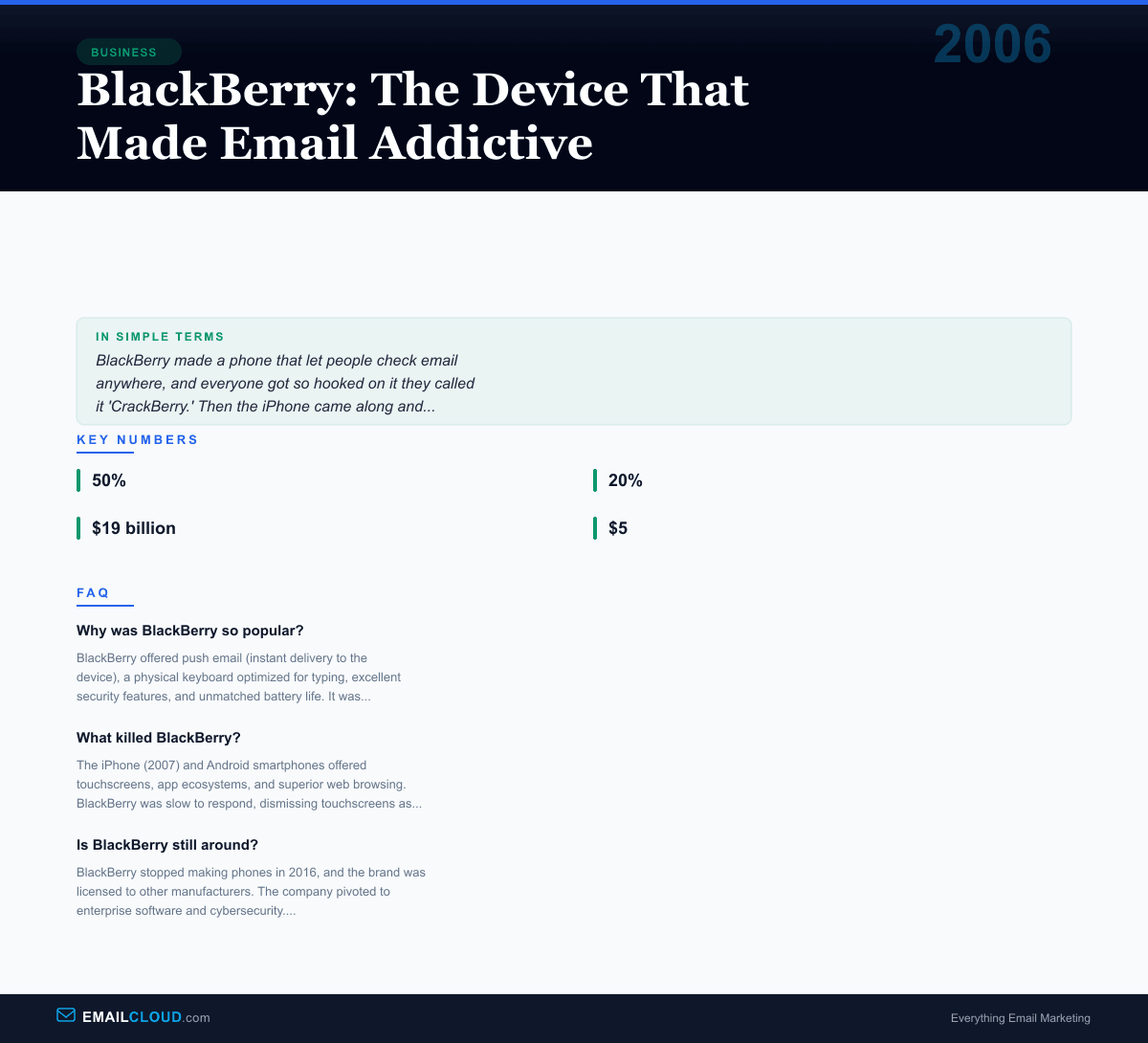
At its peak in 2009-2010, RIM commanded over 50% of the U.S. smartphone market and roughly 20% globally. The company had over 80 million subscribers. Revenue exceeded $19 billion in fiscal year 2011. The stock price, which had been under $5 in 2003, peaked at over $140 in 2008. Founders Mike Lazaridis and Jim Balsillie were worth billions.
The iPhone Arrives
On January 9, 2007, Steve Jobs walked onto a stage at Macworld and introduced the iPhone. RIM’s leadership was not impressed. Lazaridis reportedly watched the keynote and said it was impossible to build a device with that kind of battery life. Balsillie dismissed the threat: “It’s OK — we’ll be fine.”
They were not fine.
The iPhone didn’t compete with BlackBerry on email. It competed on everything else — web browsing, media, applications, and a user interface that made BlackBerry’s look like it was designed by engineers (which, of course, it was). When Apple launched the App Store in 2008, the comparison became stark. BlackBerry had email. iPhone had an ecosystem.
RIM’s response was sluggish and confused. The company launched the BlackBerry Storm in late 2008, a touchscreen device meant to compete with the iPhone. It was widely regarded as a disaster — the touchscreen used a bizarre “clickable” mechanism that felt like pressing a giant button, the software was buggy, and the app selection was negligible. Returns were reportedly as high as 50%.
The Collapse
The numbers tell the story with brutal clarity:
- 2010: 50%+ U.S. smartphone market share
- 2011: 25% (Android surpasses BlackBerry)
- 2012: 10% (iPhone and Android dominate)
- 2013: Under 5%
- 2014: Under 1%
RIM (renamed BlackBerry Ltd. in 2013) launched the BlackBerry 10 platform in January 2013, a modern operating system that was technically competent but arrived years too late. Both Lazaridis and Balsillie had already left the company. The new CEO, John Chen, eventually made the pragmatic decision to abandon hardware and pivot to enterprise software.
BlackBerry stopped manufacturing its own phones in 2016. The brand was licensed to TCL Communication, which produced several Android-based BlackBerry phones with physical keyboards. These sold modestly to nostalgic loyalists but never approached mainstream relevance. TCL’s license expired in 2020, and after a brief attempt by OnwardMobility to revive the brand, BlackBerry phones effectively ceased to exist.
The Legacy
BlackBerry’s contribution to email culture was profound. The company proved that people didn’t just want email at their desk — they wanted it everywhere, all the time, instantly. The always-connected, always-available work culture that BlackBerry enabled (for better or worse) didn’t disappear when BlackBerry did. It simply migrated to iPhones and Android devices.
The “CrackBerry” addiction that seemed novel in 2006 became the default mode of modern life. The compulsive checking, the anxiety of unanswered messages, the erosion of boundaries between work and personal time — BlackBerry didn’t cause these things, but it was the first device to make them possible. Every smartphone notification that pulls you out of dinner, every late-night email check, every “just let me respond to this one thing” — that’s BlackBerry’s legacy, running on someone else’s hardware.
RIM’s failure was not a failure of technology. It was a failure of imagination. The company saw itself as being in the email device business. Apple saw itself as being in the everything-in-your-pocket business. The email device was better at email. The everything device won.
Infographic
Share this visual summary. Right-click to save.
Related Events
Frequently Asked Questions
Why was BlackBerry so popular?
BlackBerry offered push email (instant delivery to the device), a physical keyboard optimized for typing, excellent security features, and unmatched battery life. It was the first device that made email truly mobile, and it dominated the corporate market from 2003 to 2010.
What killed BlackBerry?
The iPhone (2007) and Android smartphones offered touchscreens, app ecosystems, and superior web browsing. BlackBerry was slow to respond, dismissing touchscreens as a fad. By 2013, its market share had collapsed from over 50% to under 5% in North America.
Is BlackBerry still around?
BlackBerry stopped making phones in 2016, and the brand was licensed to other manufacturers. The company pivoted to enterprise software and cybersecurity. BlackBerry-branded phones made by TCL were discontinued in 2020.