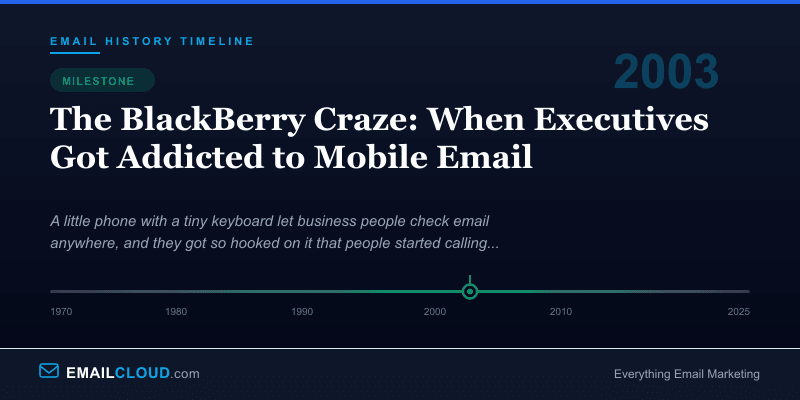
2003: The BlackBerry Craze: When Executives Got Addicted to Mobile Email
In the early 2000s, a peculiar behavior emerged in corporate America’s executive suites. During board meetings, at restaurant dinners, and in the back rows of their children’s school plays, senior executives began hunching over small, pager-like devices, thumbs working furiously over tiny keyboards, faces illuminated by a pale blue glow. They were checking email. And they couldn’t stop.
The Device That Changed the Relationship
Research In Motion, a Canadian company founded by Mike Lazaridis and Jim Balsillie in Waterloo, Ontario, had been making two-way pagers since 1999. But it was the introduction of the BlackBerry 5810 and its successors in 2002-2003, with integrated cellular voice and — critically — push email through the BlackBerry Enterprise Server, that created a cultural phenomenon.
The key innovation wasn’t the hardware, though the physical QWERTY keyboard was genuinely excellent for thumb-typing. The breakthrough was push email. Before BlackBerry, checking email on a mobile device meant actively logging in and refreshing — pull-based retrieval. BlackBerry reversed the paradigm. New emails appeared on your device the moment they hit your server, announced by a blinking red LED that BlackBerry users learned to watch the way Pavlov’s dogs watched for the bell.
This was the moment email became truly ambient. It was no longer something you did at your desk. It was something that happened to you, everywhere, all the time.
The CrackBerry Epidemic
The addiction was immediate, visible, and joked about even as people surrendered to it. The nickname “CrackBerry” entered the popular lexicon so rapidly that Webster’s New World Dictionary named it the 2006 Word of the Year. Clinical psychologists began studying the behavioral patterns, noting that the intermittent reinforcement of random email arrival — sometimes important, sometimes trivial — created the same variable-ratio reward schedule that makes slot machines compelling.
President Barack Obama famously fought the Secret Service to keep his BlackBerry after taking office in 2009, making him the first U.S. president with an email device. Capitol Hill was littered with BlackBerry-clutching senators and representatives. In Silicon Valley, Wall Street, and the City of London, the BlackBerry became the ultimate status symbol — a visible signal that you were important enough to receive emails that couldn’t wait.
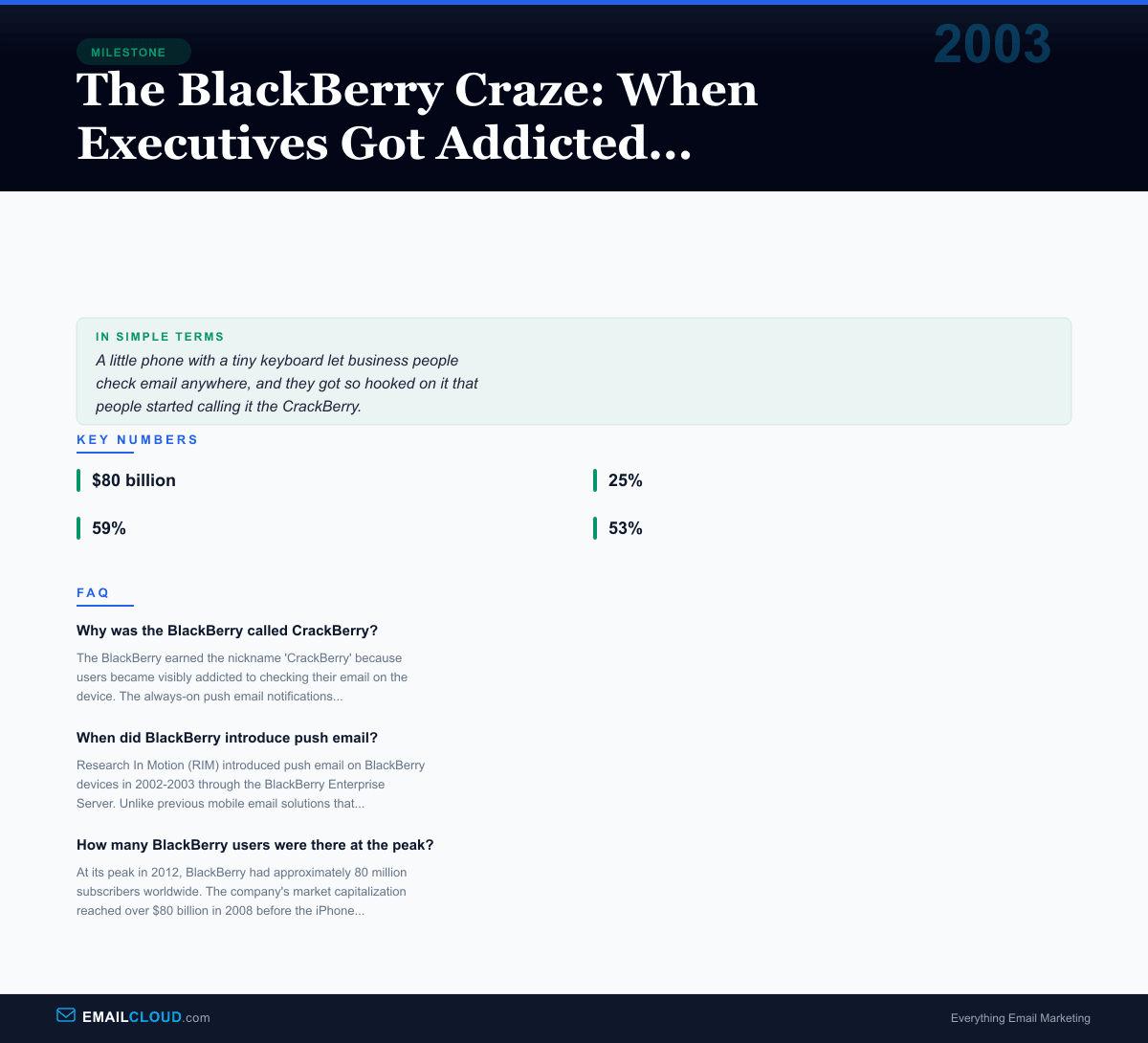
RIM’s subscriber base grew exponentially. From roughly 1 million users in 2003, the number climbed to 8 million by 2006, 28 million by 2008, and peaked at approximately 80 million in 2012. At its height in 2008, RIM’s market capitalization exceeded $80 billion.
What It Did to Work-Life Balance
The BlackBerry didn’t just change when people read email. It changed how much email people sent. Research from the Radicati Group estimated that global email traffic grew by approximately 25% between 2003 and 2005, and mobile email adoption was a significant driver. When executives could respond to emails at 11 PM from their bedroom, they did. And when they did, they set an implicit expectation that their direct reports should also be available at 11 PM.
The concept of “business hours” began its long, slow erosion. A 2007 survey by AOL found that 59% of BlackBerry users checked email in bed, 53% checked it in the bathroom, and 37% admitted to checking it while driving. Companies began grappling — mostly unsuccessfully — with the question of whether always-on email connectivity was a productivity boost or a health hazard.
In some cases, the addiction created real consequences. A small but growing number of car accidents were attributed to email-distracted drivers. Some companies, notably Volkswagen in Germany, eventually implemented policies that shut down BlackBerry email delivery to employees after business hours, forwarding only truly urgent messages.
The Transformation of Email Marketing
For email marketers, the BlackBerry era introduced a reality that would only intensify over the following decade: emails were now being read on small screens. Subject lines needed to be shorter. Preheader text suddenly mattered. The preview pane on a BlackBerry showed only a few lines of text, making the opening of every email critical.
The BlackBerry also changed when emails were read. Morning open-rate spikes, previously driven by people checking email when they arrived at the office, began spreading earlier as executives checked their devices before getting out of bed. Evening send times became viable for the first time. The data on optimal email send times, which had been relatively stable for years, started fragmenting.
The Rise and Fall
RIM’s dominance lasted roughly a decade. The iPhone arrived in 2007, and while BlackBerry loyalists initially scoffed at its lack of a physical keyboard and its consumer-oriented design, the touchscreen revolution proved irresistible. Android followed in 2008. By 2013, BlackBerry’s market share in smartphones had plummeted below 3%. The company stopped manufacturing its own phones in 2016 and ceased supporting the BlackBerry operating system entirely in January 2022.
But the BlackBerry’s impact on email culture was permanent. It proved — beyond any doubt — that people wanted email to follow them everywhere. It established the expectation of instant response that every subsequent smartphone has amplified. It created the behavioral patterns — the compulsive checking, the phantom vibrations, the inability to leave the inbox alone — that define our relationship with email to this day.
Mike Lazaridis built a device that solved a problem. But the problem it solved — “I can’t check my email right now” — turned out to be one of the few things protecting people from the tyranny of the always-full inbox. The BlackBerry didn’t just put email in people’s pockets. It put the office there, too.
Now that every email is read on a mobile screen, crafting the perfect subject line is more important than ever. Test yours with our free Subject Line Grader to make sure those first few words earn the tap.
Infographic
Share this visual summary. Right-click to save.
Related Events
Frequently Asked Questions
Why was the BlackBerry called CrackBerry?
The BlackBerry earned the nickname 'CrackBerry' because users became visibly addicted to checking their email on the device. The always-on push email notifications created compulsive behavior — people would check their BlackBerry during meetings, at dinner, in bed, and even at weddings. The term became so widespread that Webster's New World Dictionary named it the 2006 Word of the Year.
When did BlackBerry introduce push email?
Research In Motion (RIM) introduced push email on BlackBerry devices in 2002-2003 through the BlackBerry Enterprise Server. Unlike previous mobile email solutions that required manually checking for new messages, push email delivered messages to the device instantly as they arrived, creating the always-connected experience that made BlackBerry iconic.
How many BlackBerry users were there at the peak?
At its peak in 2012, BlackBerry had approximately 80 million subscribers worldwide. The company's market capitalization reached over $80 billion in 2008 before the iPhone and Android smartphones rapidly eroded its market share.