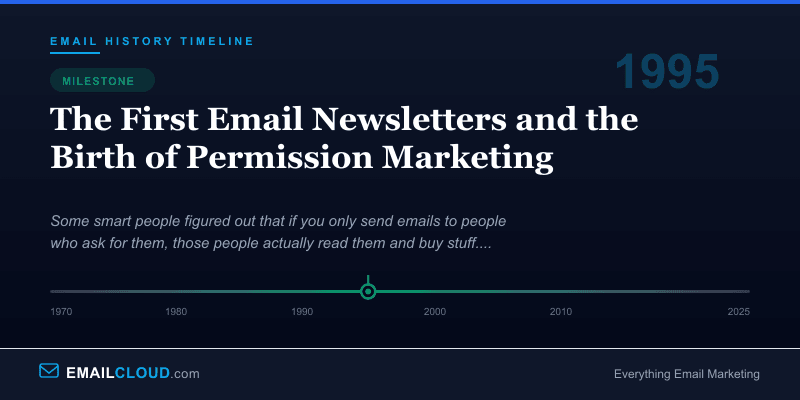
1995: The First Email Newsletters and the Birth of Permission Marketing
In the mid-1990s, as the commercial internet was still figuring out how to make money, a handful of entrepreneurs and publishers stumbled onto a discovery that seems obvious in retrospect: people will actually read emails they asked to receive. That observation — which would later be formalized as “permission marketing” — saved email from becoming nothing more than a delivery mechanism for junk and established it as the most effective direct marketing channel in history.
The Pioneering Newsletters
The exact “first email newsletter” is impossible to pin down, since the concept evolved gradually from academic mailing lists into commercial publications. But several early entrants deserve credit for demonstrating the model.
The Motley Fool began as an AOL-based investment community in 1993, founded by brothers David and Tom Gardner. Their email newsletter, which offered stock tips and financial commentary in a deliberately irreverent tone, was among the earliest to build a large subscriber base for commercial purposes. The Gardners understood something intuitive: people subscribed because they wanted the content, and that voluntary relationship made the audience orders of magnitude more valuable than any list of addresses you could buy.
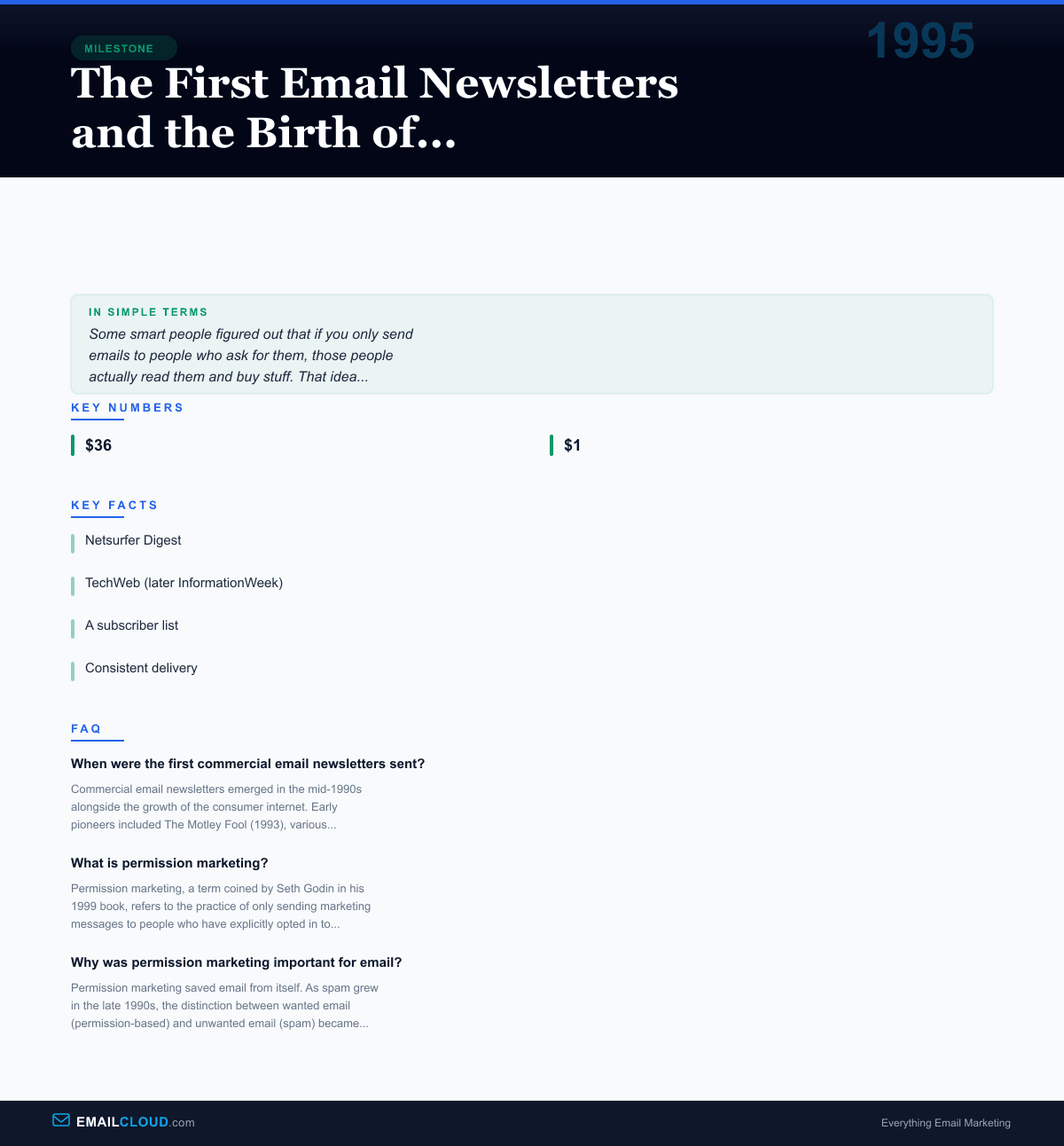
Netsurfer Digest, launched in 1994 by Arthur Bebak, was one of the internet’s first curated content newsletters. Each issue highlighted interesting websites and online resources — a format that would later become standard in newsletter publishing. At its peak, Netsurfer Digest had tens of thousands of subscribers, a remarkable number for a medium that most people hadn’t heard of.
TechWeb (later InformationWeek) and various trade publications began distributing content via email in 1995-1996, recognizing that their business and technology audiences were early internet adopters who checked email frequently. These publications discovered that email subscribers engaged more deeply with content than casual website visitors — they opened, they read, they clicked through.
Seth Godin and the Philosophy
The practice of sending emails to willing recipients was happening before anyone gave it a name. That changed in 1999 when Seth Godin published Permission Marketing: Turning Strangers Into Friends, and Friends Into Customers. Godin, who had served as VP of Direct Marketing at Yahoo, articulated a framework that gave intellectual rigor to what early newsletter publishers had learned through trial and error.
Godin’s argument was simple but powerful. Traditional marketing (which he called “interruption marketing”) worked by forcing messages onto unwilling recipients — TV ads that interrupt your show, magazine ads that interrupt your article, direct mail that clutters your mailbox. This approach was becoming less effective as consumers gained more control over their media consumption and developed sophisticated ad-avoidance skills.
Permission marketing inverted the model. Instead of interrupting, you offered something valuable — a newsletter, free content, useful information — and asked people to opt in. Once they did, you had their permission to continue the conversation. Each message reinforced the relationship, building trust and familiarity that eventually led to commercial action.
The email newsletter was the perfect vehicle for permission marketing. The opt-in was explicit: the subscriber actively entered their email address and clicked a confirmation link. The delivery was direct: the email arrived in their inbox without algorithmic filtering. The unsubscribe was easy: one click to revoke permission. The entire system was built on consent, which made it both ethical and effective.
The Opt-In Double-Opt-In Debate
The early newsletter era established a debate that continues to this day: single opt-in versus double opt-in.
Single opt-in means a subscriber enters their email address and is immediately added to the list. It’s frictionless and maximizes list growth, but it’s vulnerable to typos (subscribing the wrong person), bots (inflating subscriber counts), and questionable consent (someone entering another person’s email).
Double opt-in adds a confirmation step: after entering their address, the subscriber receives a verification email and must click a link to confirm. This ensures the address is valid and the owner actually wants to subscribe. It reduces list size but improves list quality — confirmed subscribers are more engaged and less likely to mark messages as spam.
The debate reflects a fundamental tension in email marketing: quantity versus quality. Early newsletter publishers learned, sometimes painfully, that a small list of engaged subscribers outperforms a large list of disengaged ones. The double opt-in became best practice in most markets, though single opt-in remains common in e-commerce and other contexts where confirmation friction reduces conversion rates.
The Business Model Emerges
By the late 1990s, the email newsletter business model had taken shape. The components were:
Content that was valuable enough to warrant a subscription. This could be original reporting, curated links, expert analysis, entertainment, or any combination.
A subscriber list built through opt-in mechanisms — website signup forms, content upgrades, event registrations, and word-of-mouth referrals.
Monetization through advertising (selling ad slots within the newsletter), sponsorships (brands paying for sponsored content or mentions), affiliate commissions (earning a percentage on recommended products), or — eventually — paid subscriptions.
Consistent delivery on a predictable schedule. Weekly newsletters became the standard cadence, though daily, bi-weekly, and monthly frequencies all found success depending on the content and audience.
This model proved remarkably durable. The newsletters of the mid-1990s and the newsletters of the mid-2020s operate on essentially the same principles. The tools have gotten better, the designs have gotten prettier, and the analytics have gotten more sophisticated, but the core loop — create value, earn permission, deliver consistently, monetize thoughtfully — has been unchanged for 30 years.
The Legacy of Permission
Permission marketing’s lasting impact extends beyond newsletters. The concept influenced the development of the CAN-SPAM Act (2003), GDPR (2018), and virtually every email regulation worldwide. The principle that people should only receive marketing messages they’ve agreed to receive is now codified in law across most of the developed world.
The irony is that permission marketing was always the more profitable approach anyway. The highest ROI in email marketing — that famous $36 return per $1 spent — comes from permission-based lists. Unsolicited email generates resistance, complaints, and spam reports. Permission-based email generates opens, clicks, and conversions. The ethical approach and the profitable approach turned out to be the same approach, which is the kind of alignment that gives marketers hope for their profession.
Infographic
Share this visual summary. Right-click to save.
Related Events
Frequently Asked Questions
When were the first commercial email newsletters sent?
Commercial email newsletters emerged in the mid-1990s alongside the growth of the consumer internet. Early pioneers included The Motley Fool (1993), various trade publications, and marketing-focused newsletters from companies exploring the new medium.
What is permission marketing?
Permission marketing, a term coined by Seth Godin in his 1999 book, refers to the practice of only sending marketing messages to people who have explicitly opted in to receive them. It stands in contrast to 'interruption marketing' — unsolicited ads that disrupt the recipient's day.
Why was permission marketing important for email?
Permission marketing saved email from itself. As spam grew in the late 1990s, the distinction between wanted email (permission-based) and unwanted email (spam) became critical for the channel's legitimacy as a marketing tool.