2012: When Email Subject Lines Got Colorful With Emoji
Somewhere around 2012, something new started appearing in email inboxes alongside the usual sale announcements and newsletter subject lines: tiny, colorful pictures. A star here. A fire emoji there. A pointing finger drawing attention to a “limited time offer.” Email marketing, a medium that had been almost exclusively text-based for its entire existence, was getting its first visual upgrade in the subject line — and marketers were going wild.
The introduction of emoji into email subject lines was one of those small tactical changes that, for a brief window, felt like a cheat code. It worked. Then everyone copied it. Then it stopped working as well. The story of emoji in email is a perfect case study in how marketing tactics follow a predictable lifecycle: discovery, exploitation, saturation, and normalization.
The Technical Unlock
Emoji had existed in Japanese mobile culture since the late 1990s, but they entered the Western mainstream through a specific technical event: Apple added an emoji keyboard to the iPhone in 2011 (first in Japan, then globally). Google followed with native emoji support in Android. Suddenly, hundreds of millions of smartphone users had easy access to emoji in their everyday typing.
Email clients followed. Gmail, Yahoo Mail, and Apple Mail began rendering emoji in subject lines as colorful inline graphics rather than empty boxes or question marks. The technical barrier was gone. If you put an emoji in your subject line, most recipients would see it exactly as intended.
Marketers noticed. The ones who were paying close attention noticed fast.
The Early Advantage
The first brands to experiment with emoji in subject lines discovered something remarkable: open rates jumped. Studies from the 2012-2014 period showed increases of 15-30%, depending on the industry and audience. A subject line that said “Summer Sale Starts Now” performed well. A subject line that said “Summer Sale Starts Now” with a sun emoji performed significantly better.
The reason was pure visual psychology. An inbox full of black text subject lines is visually monotonous. A single emoji broke the pattern, drawing the eye the way a red sign stands out on a street of gray buildings. It was a pattern interrupt — something different in a sea of sameness.
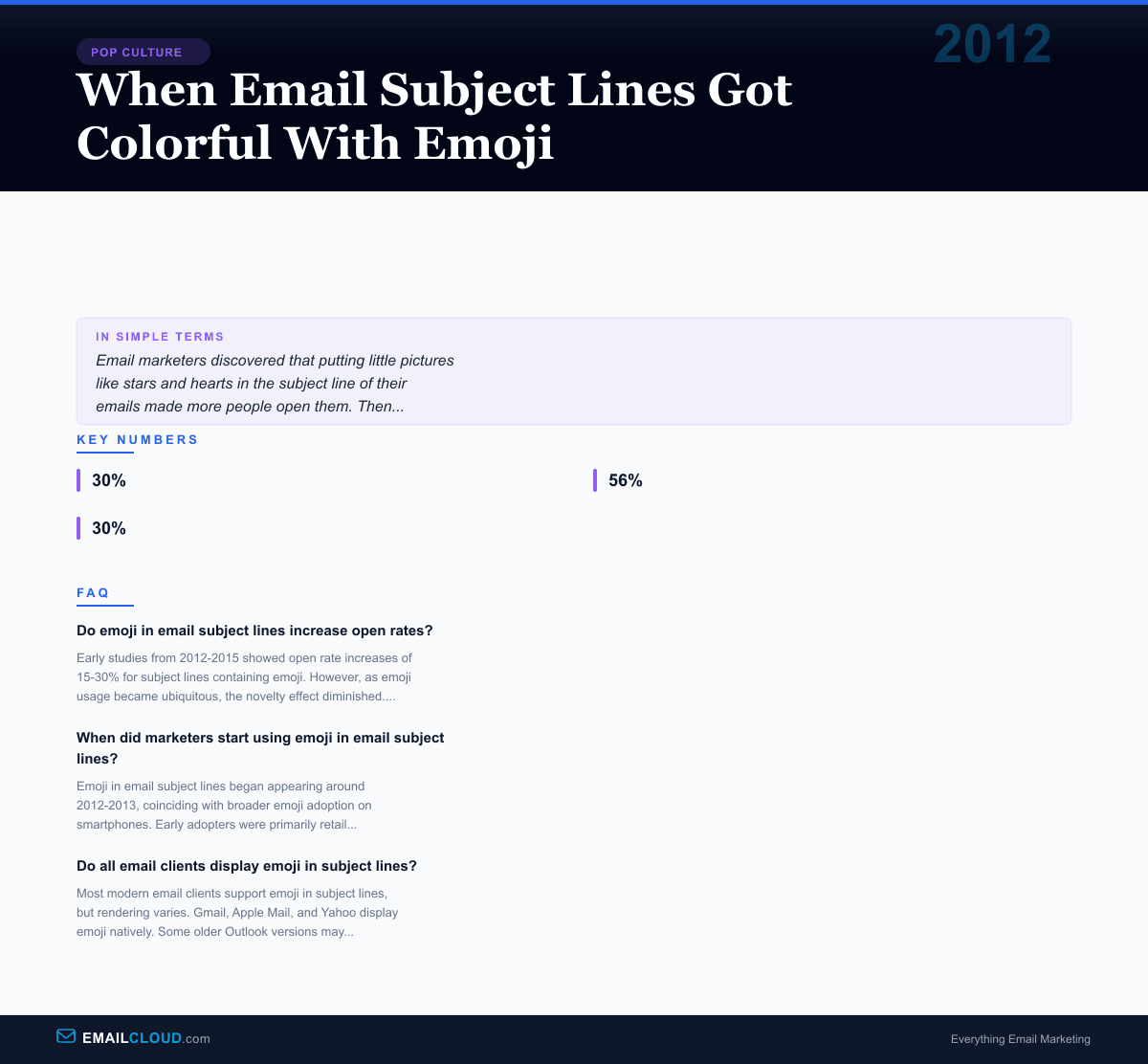
Experian published widely cited research in 2012 showing that 56% of brands using emoji in subject lines had higher open rates than those using text only. The data was catnip for email marketers always hungry for a low-effort, high-impact tactic.
The Gold Rush
By 2014-2015, the floodgates opened. Retailers, travel companies, food brands, media publishers, and B2B companies all started sprinkling emoji into their subject lines. What had been a novel differentiator became standard practice.
The emoji of choice varied by industry. Retail leaned on shopping bags, gift boxes, and celebration confetti. Travel brands favored airplanes, palm trees, and suitcases. Food companies used pizza slices, coffee cups, and cooking pots. Holiday emails became emoji festivals — Christmas trees in December, hearts in February, American flags in July.
Some brands went overboard. Subject lines with three, four, or five emoji became common, turning subject lines into visual noise rather than visual highlights. The line between “eye-catching” and “visually assaulting” was thin, and many brands crossed it enthusiastically.
The Diminishing Returns
By 2016-2017, the emoji advantage had largely evaporated. Not because emoji stopped working entirely, but because the mechanism — pattern interruption — requires something to interrupt. When every email in the inbox has emoji in the subject line, no single emoji stands out. The tactic became a victim of its own success.
Research from the later period showed a much more nuanced picture. Emoji still provided a slight visual advantage in crowded inboxes, but the 15-30% open rate lift of the early days settled to low single digits or even zero in many tests. Some studies found that emoji actually decreased open rates for certain audiences — particularly older demographics and B2B contexts where emoji felt unprofessional.
The lesson was clear: emoji weren’t magic. They were a visual device that worked when they were novel and that normalization rendered ordinary. The marketers who continued to use them strategically — a single well-chosen emoji that reinforced the subject line’s message — still saw modest benefits. The ones who treated emoji as a guaranteed open rate booster were disappointed.
The Rendering Problem
Beyond the novelty question, emoji in email presented a persistent technical headache: inconsistent rendering across email clients and platforms.
Apple rendered emoji in Apple’s style. Google rendered them in Google’s style. Samsung had its own emoji set. Outlook on Windows displayed some emoji as black-and-white line drawings or didn’t display them at all. A smiley face that looked warm and friendly on an iPhone could look clinical or broken on a Windows desktop.
This inconsistency meant that the carefully chosen emoji in your subject line might not look the way you intended for a significant portion of your audience. Some email marketers adopted the practice of placing emoji at the beginning or end of the subject line (never as a replacement for key words) so that if the emoji failed to render, the text still made sense.
Where Emoji Stand Today
In the mid-2020s, emoji in email subject lines are neither revolutionary nor harmful. They’re a standard tool in the email marketer’s kit, used by most brands at least occasionally and viewed as neither particularly creative nor particularly annoying.
Best practices have settled into a consensus: use one emoji, max two. Place it where it reinforces the message rather than replacing text. Test emoji versus non-emoji versions with your specific audience. Avoid emoji in professional, B2B, or sensitive contexts where they feel inappropriate. Never use emoji as a substitute for a compelling subject line — an emoji can’t rescue bad copy.
The broader lesson of the emoji era is about marketing tactics in general. Any tactic that works because it’s different stops working when everyone does it. The advantage is always temporary. The marketers who win long-term aren’t the ones who find the latest trick — they’re the ones who write subject lines compelling enough that no trick is needed.
Infographic
Share this visual summary. Right-click to save.
Related Events
Frequently Asked Questions
Do emoji in email subject lines increase open rates?
Early studies from 2012-2015 showed open rate increases of 15-30% for subject lines containing emoji. However, as emoji usage became ubiquitous, the novelty effect diminished. By the 2020s, emoji still provided a slight visual advantage in crowded inboxes but no longer produced the dramatic lift seen in earlier years.
When did marketers start using emoji in email subject lines?
Emoji in email subject lines began appearing around 2012-2013, coinciding with broader emoji adoption on smartphones. Early adopters were primarily retail and ecommerce brands, particularly those targeting younger demographics. By 2015, the practice was mainstream across most consumer email marketing.
Do all email clients display emoji in subject lines?
Most modern email clients support emoji in subject lines, but rendering varies. Gmail, Apple Mail, and Yahoo display emoji natively. Some older Outlook versions may display emoji as empty boxes or question marks. Marketers typically test emoji rendering across clients before including them in campaigns.