2017: Substack Challenges Traditional Media with Email Newsletters
In 2017, three co-founders — Chris Best, Hamish McKenzie, and Jairaj Sethi — launched a platform built on a premise that seemed almost quaint: what if writers could make a living by sending emails? Not marketing emails, not transactional notifications, but substantive writing delivered directly to subscribers’ inboxes. And what if some of those subscribers would pay for the privilege?
The platform was called Substack, and within a few years, it would spark a genuine reckoning in the media industry about the economics of journalism, the value of individual voices, and the enduring power of email as a distribution channel.
The Premise
Substack’s core insight was that the infrastructure for paid newsletters already existed — email delivery, payment processing, subscriber management — but assembling those pieces was too difficult for individual writers. WordPress plus Mailchimp plus Stripe plus custom integration was technically feasible but practically daunting for someone who just wanted to write.
Substack made it frictionless. A writer could create a newsletter in minutes, start publishing immediately, and add paid subscriptions with a few clicks. Substack handled everything: email delivery, website hosting, payment processing, subscriber management, and analytics. In exchange, Substack took a 10% cut of paid subscription revenue (plus payment processing fees).
The business model was deliberately creator-friendly. Writers owned their subscriber list and could export it at any time. There was no lock-in, no algorithmic feed determining who saw their work, no advertising model pressuring them to optimize for clicks. The relationship was direct: writer to reader, via email.
The Slow Build
Substack’s early years were modest. The first cohort of writers were mostly technology commentators and niche experts — people with established audiences but limited monetization options. The platform grew steadily but didn’t attract mainstream attention until 2019-2020, when a combination of factors aligned to create explosive growth.
The media industry was in financial crisis. Layoffs at digital media companies — BuzzFeed News, Vice, HuffPost — left experienced journalists looking for alternatives. Newspaper revenues continued their long decline. The advertising-supported business model that had sustained digital media was concentrated in Facebook and Google, leaving crumbs for publishers.
At the same time, trust in mainstream media was declining, and audiences were increasingly interested in individual voices and perspectives rather than institutional brands. People didn’t subscribe to a newspaper’s opinion section — they followed specific columnists. Substack offered those columnists a way to take their audience with them.
The Star System
Substack’s growth accelerated when it began attracting high-profile writers from established media outlets. The departures generated enormous attention and debate.
Glenn Greenwald, who had co-founded The Intercept, left for Substack in October 2020, citing editorial disputes. Matt Taibbi, formerly of Rolling Stone, moved his work to Substack. Andrew Sullivan, a pioneering political blogger, launched The Weekly Dish on Substack after leaving New York Magazine. These were not marginal writers — they were prominent voices with dedicated followings, and their moves to Substack legitimized the platform as a serious alternative to institutional media.
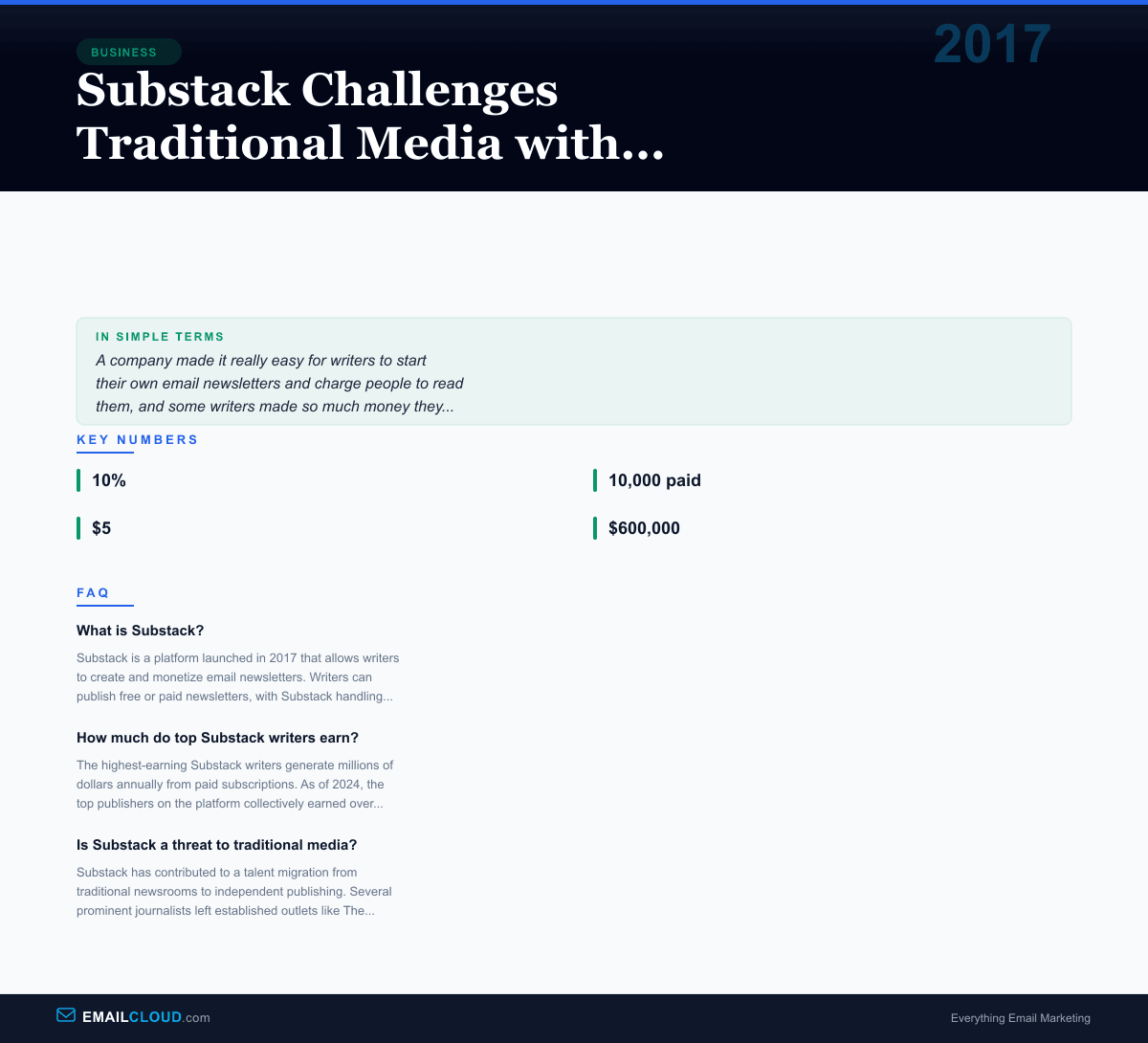
The economics were compelling. A writer with 10,000 paid subscribers at $5 per month would earn $600,000 annually (before Substack’s 10% cut). Some top Substack writers exceeded this substantially. The financial incentive was clear: a successful Substack could pay more than all but the highest-profile positions at traditional media outlets, with the added benefits of editorial independence and ownership.
The Controversy
Substack’s rise was not without controversy. Critics raised several concerns.
The platform’s content moderation policies were debated intensely. Substack took a relatively hands-off approach to content, drawing criticism from some who argued that the platform was hosting misinformation, hate speech, and harmful content. Others defended the approach as necessary for editorial freedom. The tension between free expression and content moderation — the same tension that plagued every platform — followed Substack from its earliest days.
The economics drew scrutiny too. While top writers earned substantial incomes, the distribution was extremely uneven. The vast majority of Substack writers earned little or nothing. Critics pointed out that Substack’s promotional efforts disproportionately benefited already-prominent writers, creating a winner-take-all dynamic that replicated the inequalities of the media industry it claimed to disrupt.
Substack also offered substantial advances — upfront payments to lure high-profile writers to the platform. These advances were not publicly disclosed, leading to accusations that Substack was subsidizing certain writers while presenting the platform as a meritocratic marketplace. The company defended the practice as standard business development.
The Platform Evolution
Substack evolved beyond pure email newsletters over time. The company added features — a reader app, community discussion threads, a social network-like “Notes” feature, podcast hosting, and a recommendation system — that expanded it from an email delivery platform into something more resembling a media ecosystem.
This evolution created tension with the platform’s original identity. Email newsletters were decentralized by nature — each writer’s newsletter existed independently, delivered to subscribers’ existing email clients. The app and Notes features pulled activity toward Substack’s own platform, creating the kind of centralized, algorithmically-mediated experience that many writers had come to Substack specifically to escape.
Some writers expressed concern that Substack was becoming the thing it had defined itself against: a platform that sat between writers and their audiences, with the power to amplify or diminish their work.
Impact on Email
Substack’s most significant contribution was proving — at scale — that email remains the most valuable distribution channel for content creators. In an era dominated by social media algorithms that determine what content users see, email delivered a guarantee: your message goes directly to your subscriber’s inbox. No algorithm decides whether they see it. No platform can throttle your reach.
This direct relationship between writer and reader, mediated by nothing more than email protocols, is what makes newsletters so valuable. A Twitter follower might never see your tweet. An Instagram follower might miss your post. But an email subscriber receives your work directly, every time.
Substack also helped rehabilitate email’s reputation among content creators. For years, email had been perceived as a corporate communication tool and a marketing channel — functional but unglamorous. Substack reframed email as a creative medium, a place for substantive writing and genuine connection.
The Broader Landscape
Substack was the most visible player in the newsletter boom, but it wasn’t alone. Ghost, Beehiiv, ConvertKit (now Kit), Buttondown, and others offered competing platforms with different features, pricing models, and philosophies. The newsletter platform category became one of the most competitive in the creator economy.
The competition was healthy for writers. Multiple platforms meant choices, and the ability to export subscriber lists meant that writers weren’t locked in. The underlying technology — email — was an open standard that no single platform controlled.
Why It Matters
Substack demonstrated that email’s oldest function — delivering text content to inboxes — remains economically powerful in the social media age. The platform proved that audiences will pay for quality writing delivered by email, that the direct writer-reader relationship enabled by email is more durable than algorithmic social media relationships, and that email’s simplicity is a feature, not a bug.
Whether Substack itself endures as the dominant newsletter platform is uncertain. But the model it popularized — independent writers building businesses on email — has reshaped the media landscape permanently.
Infographic
Share this visual summary. Right-click to save.
Related Events
Frequently Asked Questions
What is Substack?
Substack is a platform launched in 2017 that allows writers to create and monetize email newsletters. Writers can publish free or paid newsletters, with Substack handling the email delivery, payment processing, and subscriber management. Substack takes a 10% cut of paid subscription revenue. The platform has attracted journalists, authors, and experts who use it as an independent publishing vehicle.
How much do top Substack writers earn?
The highest-earning Substack writers generate millions of dollars annually from paid subscriptions. As of 2024, the top publishers on the platform collectively earned over $100 million per year. Individual writers like political commentators, technology analysts, and cultural critics have built subscriber bases generating six- and seven-figure annual incomes.
Is Substack a threat to traditional media?
Substack has contributed to a talent migration from traditional newsrooms to independent publishing. Several prominent journalists left established outlets like The New York Times, The Atlantic, and Rolling Stone for Substack, attracted by higher earnings and editorial independence. However, most Substack writers earn modest incomes, and the platform supplements rather than replaces traditional media for most users.