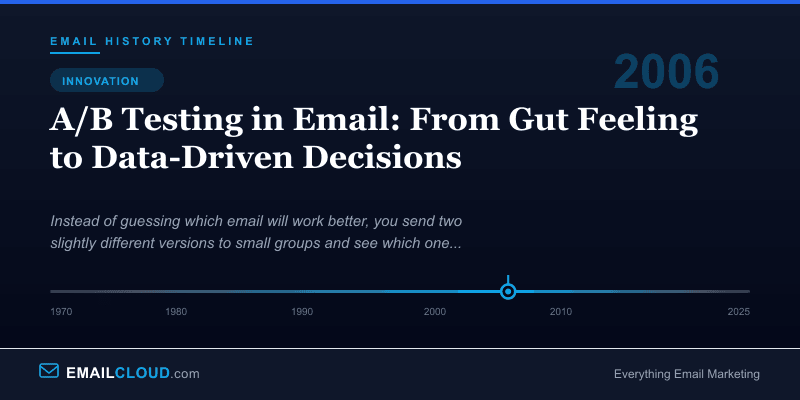
2006: A/B Testing in Email: From Gut Feeling to Data-Driven Decisions
Before A/B testing came to email marketing, there was a common method for deciding which subject line, design, or offer to use in an email campaign. It was called “whatever the highest-paid person in the room thinks.” The process was elegant in its simplicity: the marketing director would look at two options, nod sagely, and declare one the winner based on experience, intuition, and the confidence that comes from never having to measure whether previous decisions were right.
This worked about as well as you’d expect.
The Origins: Direct Mail’s Gift to Email
A/B testing didn’t originate in email. The concept has roots in controlled experiments dating back centuries, but its direct marketing application was pioneered by direct mail companies in the mid-20th century. Catalog companies like Sears, J. Crew, and L.L.Bean had long tested different catalog covers, layouts, offers, and copy by mailing different versions to matched samples of their customer list and measuring which version generated more orders.
The methodology was sound but slow and expensive. A direct mail A/B test required printing two versions, splitting a mailing list, waiting weeks for results, and analyzing physical response cards or phone orders. A single test might take six weeks from conception to results and cost thousands of dollars in printing and postage.
Email made A/B testing fast and virtually free. Send two versions of an email. Wait a few hours. Check the open and click rates. You have your answer. The time and cost barriers that had limited testing to large direct mail operations evaporated, opening the practice to any company with an email list and a platform that supported it.
The Mid-2000s: Tools Catch Up
While the concept of A/B testing email had been discussed since the early 2000s, the practice became mainstream around 2006-2008 as major email marketing platforms built testing capabilities directly into their products.
Mailchimp introduced its A/B testing feature as part of its platform evolution, allowing users to test subject lines, from names, send times, and content variations. The tool would automatically send each variant to a configurable percentage of the list, wait a specified time, then send the winner to the remainder. It was testing for people who’d never run a controlled experiment in their lives.
Campaign Monitor, AWeber, Constant Contact, and other platforms followed with their own testing tools. By 2010, A/B testing was a standard feature that users expected from any credible email marketing platform.
What Gets Tested
The beauty of email A/B testing is that virtually anything can be tested, but some elements have more impact than others:
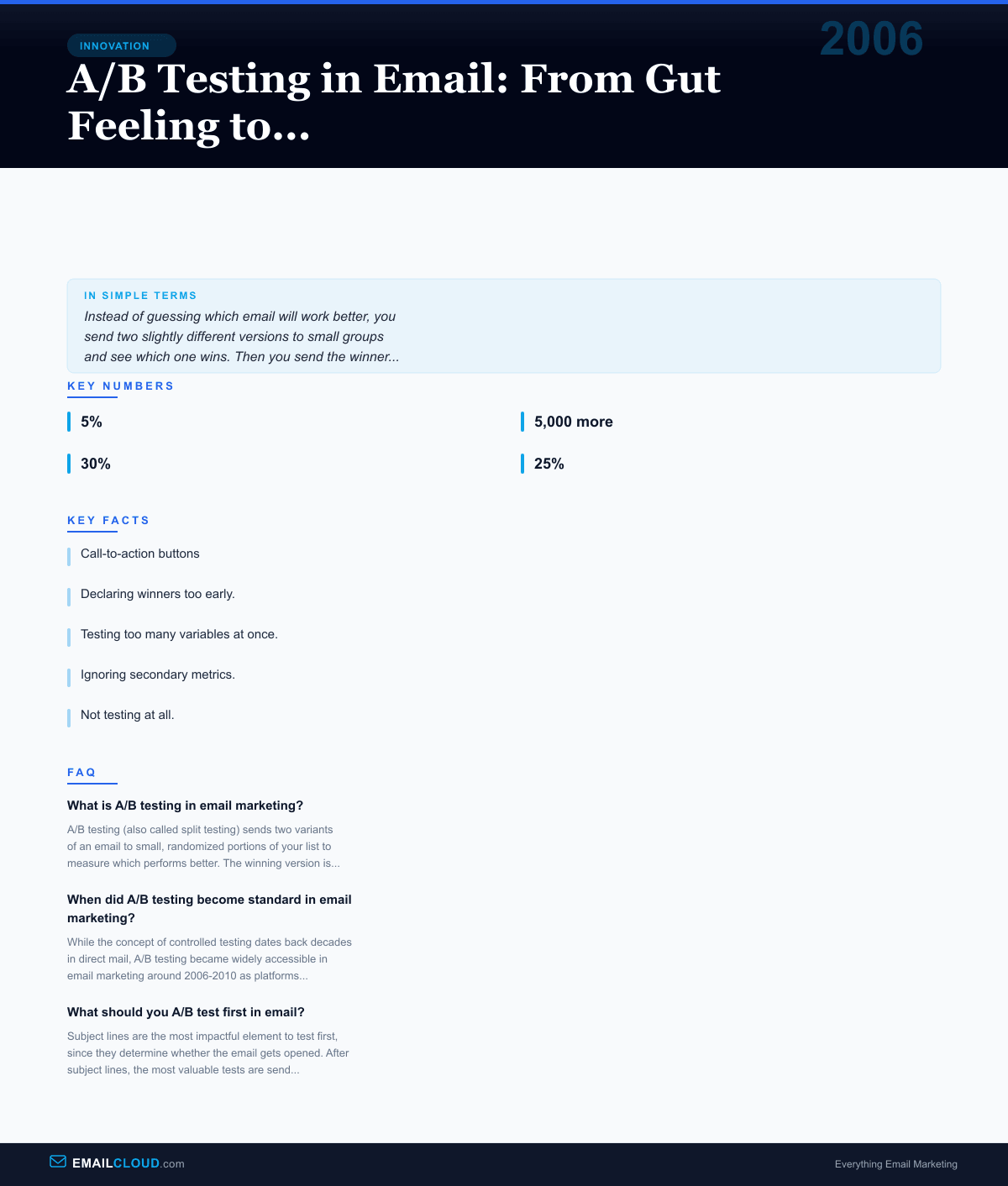
Subject lines are the highest-impact element to test because they determine whether the email gets opened at all. A 5% difference in open rate between two subject lines, applied to a 100,000-subscriber list, means 5,000 more people seeing your message. Subject line testing became so common that it generated its own body of knowledge: questions outperform statements (sometimes). Numbers increase opens (usually). Personalization helps (depends on the audience). Length matters (shorter for mobile, longer for B2B). Urgency works (until it doesn’t).
Send time is the second-most-tested variable. Does your audience open more email at 8 AM or 10 AM? Tuesday or Thursday? The answers vary by audience, industry, and geography, which is exactly why testing matters — general best practices are less reliable than data from your own subscribers.
Call-to-action buttons — their text, color, size, and placement — are frequently tested because small changes can produce surprisingly large differences in click rates. “Buy Now” versus “Shop the Sale” versus “Get Your Discount” versus “See What’s New” can produce click rate variations of 20-30%.
From name tests whether subscribers are more likely to open an email from a person (“Sarah at EmailCloud”) or a brand (“EmailCloud Team”). The answer varies by brand relationship and audience, and it’s often counterintuitive.
Email design variations — single column versus multi-column, image-heavy versus text-heavy, long versus short — are tested less frequently because they require more effort to create. But when tested, design changes often produce the largest impact on click-through rates.
The Counterintuitive Results
The most valuable thing about A/B testing is that it regularly proves experts wrong. Some examples from published case studies:
A major e-commerce retailer tested a simple text-based email against a beautifully designed HTML template for a product promotion. The plain text version generated 25% more clicks. The design team was not pleased.
A B2B software company tested a short, punchy email (under 100 words) against a detailed, feature-rich email (500+ words) for a webinar promotion. The long email won by 40% in registrations. The conventional wisdom about “keep it short” didn’t apply to their technically curious audience.
An online publisher tested adding an emoji to their subject line. Open rates went up 10% among subscribers under 35 and down 8% among subscribers over 50. Segmented testing would have caught this; aggregate testing would have called it a wash.
These results aren’t universal rules — that’s exactly the point. What works for one audience may not work for another. What worked last quarter may not work this quarter. A/B testing replaces assumptions with evidence, and the evidence is often surprising.
Statistical Significance and Common Mistakes
As A/B testing became ubiquitous, so did the mistakes. The most common:
Declaring winners too early. A test showing 22% vs. 19% open rate after 500 opens is not statistically significant. Random chance could easily produce that difference. Reliable results require sufficient sample sizes — typically at least 1,000 recipients per variant, though the exact number depends on the expected effect size.
Testing too many variables at once. If you change the subject line, the design, and the CTA simultaneously, you can’t determine which change caused the difference in performance. Change one thing at a time.
Ignoring secondary metrics. An open-rate-winning subject line that produces lower click-through rates or higher unsubscribes isn’t actually winning. The best tests track downstream metrics — clicks, conversions, revenue — not just opens.
Not testing at all. Despite the availability of testing tools in virtually every email platform, a surprising number of marketers still skip testing entirely, sending every campaign based on instinct rather than evidence. The most expensive test is the one you didn’t run.
The Permanent Impact
A/B testing didn’t just improve individual email campaigns — it changed the culture of email marketing. Before testing, email marketing was a creative discipline where success was attributed to talent and experience. After testing, it became an empirical discipline where success was attributed to evidence and iteration.
This shift democratized expertise. A junior marketer with good testing habits will consistently outperform a senior marketer relying on outdated assumptions. Data doesn’t care about your title, your experience, or your opinions. It cares about what actually works.
Test your subject lines before you send them to a single subscriber. Our Subject Line Grader scores your lines against proven performance factors — giving you a data-informed starting point before your A/B test even begins.
Infographic
Share this visual summary. Right-click to save.
Related Events
Frequently Asked Questions
What is A/B testing in email marketing?
A/B testing (also called split testing) sends two variants of an email to small, randomized portions of your list to measure which performs better. The winning version is then sent to the remaining subscribers. Variables tested include subject lines, send times, designs, CTAs, and content.
When did A/B testing become standard in email marketing?
While the concept of controlled testing dates back decades in direct mail, A/B testing became widely accessible in email marketing around 2006-2010 as platforms like Mailchimp, Constant Contact, and Campaign Monitor built testing features into their tools.
What should you A/B test first in email?
Subject lines are the most impactful element to test first, since they determine whether the email gets opened. After subject lines, the most valuable tests are send time, call-to-action button text and placement, email length, and personalization approaches.