2018: GDPR Takes Effect and Changes Email Marketing Forever
At midnight on May 25, 2018, the most consequential privacy regulation in the history of the internet took effect. The European Union’s General Data Protection Regulation — GDPR — had been adopted two years earlier, giving companies a generous transition period to prepare. Many hadn’t. The weeks leading up to the deadline saw a worldwide scramble of consent emails, privacy policy updates, and panicked conversations between marketers and lawyers. For email marketing, nothing would be the same.
Two Years of Warning
GDPR was officially adopted on April 14, 2016, with a two-year implementation period before it became enforceable on May 25, 2018. The regulation replaced the 1995 Data Protection Directive and was designed to harmonize data privacy laws across the EU, give citizens greater control over their personal data, and simplify the regulatory environment for international business.
The warning period should have been enough. Many companies, particularly large multinationals with dedicated legal and compliance teams, spent the two years auditing their data practices, rewriting privacy policies, and rebuilding consent mechanisms. But a significant number of organizations — particularly smaller companies and those outside the EU who had never worried about European privacy law — treated the deadline as a distant problem until it was suddenly imminent.
The Great Re-Permission Flood
In the weeks before May 25, 2018, a tsunami of “we’re updating our privacy policy” emails flooded inboxes worldwide. Companies that weren’t sure whether their existing consent mechanisms met GDPR standards sent re-permission campaigns asking subscribers to re-confirm their opt-in. The volume was staggering. Some people reported receiving dozens of these emails in a single day.
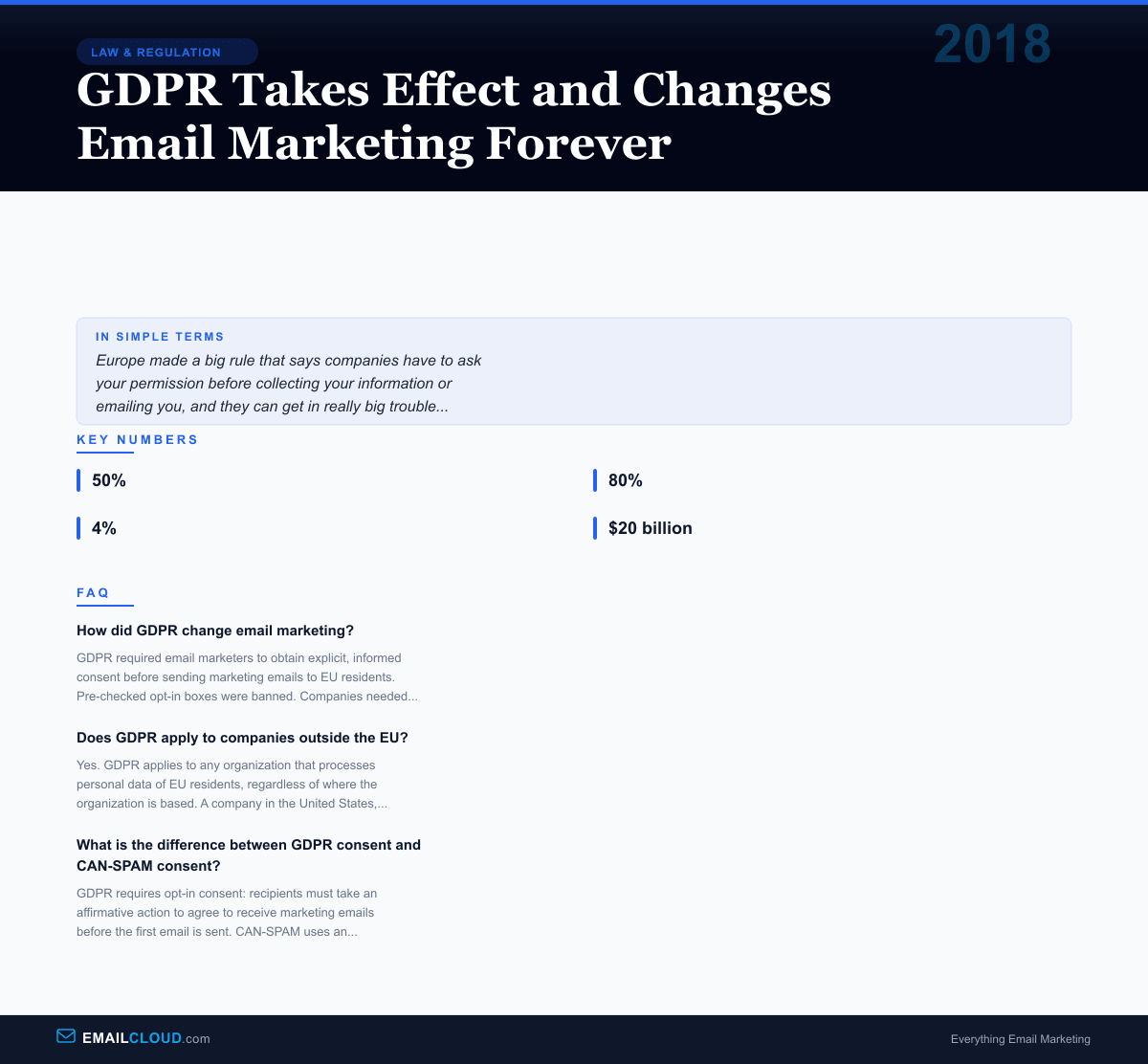
The irony was thick: a regulation designed to reduce unwanted email temporarily generated an enormous wave of it. Many of these re-permission emails went unanswered, and companies that relied on re-confirmation saw their email lists shrink dramatically — in some cases by 50% to 80%.
Smart marketers had been preparing for months, gradually transitioning to compliant consent mechanisms so that when the deadline arrived, their lists were already clean. Others waited until the last minute and paid the price in lost subscribers.
What GDPR Actually Requires
GDPR’s requirements for email marketing center on several key principles.
Lawful basis is foundational. To process personal data (including sending marketing emails), an organization must have a lawful basis. For most marketing email, that basis is consent — freely given, specific, informed, and unambiguous. Consent must involve a clear affirmative action: checking an unchecked box, clicking a subscribe button, or otherwise actively opting in. Pre-checked boxes, bundled consent (hiding email opt-in within a terms-of-service agreement), and assumed consent are all non-compliant.
Data subject rights changed the power dynamic. EU residents gained the right to access their personal data, correct inaccuracies, request deletion (the “right to be forgotten”), restrict processing, object to processing, and port their data to another service. For email marketers, this means that a subscriber can request a copy of all data held about them, demand its deletion, or require that their data be transferred to a competitor.
Data protection by design requires that privacy protections be built into systems from the ground up, not bolted on afterward. For email marketers, this means designing data collection forms, storage systems, and processing workflows with privacy as a core requirement.
Breach notification requires organizations to report data breaches to their supervisory authority within 72 hours and to affected individuals “without undue delay” if the breach poses a high risk to their rights.
The Penalties
GDPR’s enforcement teeth were unprecedented. Maximum fines of 20 million euros or 4% of annual global turnover — whichever is higher — made GDPR violations potentially catastrophic for large companies. For a company like Amazon, a maximum fine could theoretically exceed $20 billion.
Regulators began issuing fines almost immediately. Google was hit with a 50 million euro fine by France’s CNIL in January 2019 for lack of transparency and inadequate consent for ad personalization. British Airways received a 20 million pound fine (reduced from an initially proposed 183 million pounds) for a data breach affecting 400,000 customers. Marriott was fined 18.4 million pounds for a breach of its Starwood guest reservation database.
The fines sent a clear message: GDPR was not a suggestion, and regulators would enforce it against the largest companies in the world.
Impact on Email Marketing
GDPR’s impact on email marketing was transformative. The regulation forced a fundamental shift in how marketers think about their relationship with subscribers.
List quality over list size became the new priority. Under GDPR, adding subscribers without proper consent was a liability, not an asset. Marketers who had previously measured success by list size began focusing on engagement metrics — open rates, click rates, and conversion rates — because a smaller list of properly consented, engaged subscribers was more valuable (and less risky) than a massive list of questionable provenance.
Consent management became a core marketing function. Tools for managing consent — recording when and how consent was obtained, providing easy mechanisms for withdrawing consent, and maintaining audit trails — became standard features in email marketing platforms. Companies that had previously stored consent data haphazardly (or not at all) were forced to build proper systems.
Privacy policies became readable. GDPR’s requirement for transparent, plain-language privacy notices meant that the impenetrable legal documents that had served as privacy policies for years were no longer compliant. Companies rewrote their policies to be understandable by ordinary people — a change that benefited everyone.
The Global Ripple Effect
GDPR’s influence extended far beyond the EU’s borders. Because the regulation applies to any organization processing EU residents’ data, companies worldwide had to comply. Many chose to implement GDPR-level protections globally rather than maintain separate systems for EU and non-EU users.
GDPR also inspired similar legislation worldwide. Brazil’s LGPD (Lei Geral de Protecao de Dados), Japan’s amendments to APPI, South Korea’s PIPA revisions, and California’s CCPA all drew heavily from GDPR’s principles. The regulation effectively set the global standard for data privacy.
Why It Matters
GDPR fundamentally changed the social contract between email marketers and their audiences. Before GDPR, the implicit deal was: you give us your email address (sometimes knowingly, sometimes not), and we send you marketing until you tell us to stop. After GDPR, the deal became: you explicitly agree to hear from us, you can change your mind at any time, and we are responsible for protecting your data.
This shift was painful for marketers accustomed to the old model, but it was overwhelmingly positive for the email ecosystem. Better consent practices lead to more engaged subscribers, higher deliverability, and stronger sender reputations. GDPR didn’t kill email marketing — it forced it to grow up.
Infographic
Share this visual summary. Right-click to save.
Related Events
Frequently Asked Questions
How did GDPR change email marketing?
GDPR required email marketers to obtain explicit, informed consent before sending marketing emails to EU residents. Pre-checked opt-in boxes were banned. Companies needed a lawful basis for processing personal data. Recipients gained the right to access, correct, and delete their data. Non-compliance could result in fines up to 4% of annual global revenue or 20 million euros, whichever is higher.
Does GDPR apply to companies outside the EU?
Yes. GDPR applies to any organization that processes personal data of EU residents, regardless of where the organization is based. A company in the United States, Asia, or anywhere else that sends marketing emails to people in the EU must comply with GDPR. This extraterritorial scope made GDPR a de facto global regulation for any company with international reach.
What is the difference between GDPR consent and CAN-SPAM consent?
GDPR requires opt-in consent: recipients must take an affirmative action to agree to receive marketing emails before the first email is sent. CAN-SPAM uses an opt-out model: companies can send marketing emails to anyone and only need to stop when the recipient unsubscribes. GDPR's standard is significantly stricter and shifts the burden from the recipient to the sender.