2014: CASL: Canada Passes the World's Toughest Anti-Spam Law
On July 1, 2014 — Canada Day, fittingly — the most aggressive anti-spam legislation in the Western world took effect. Canada’s Anti-Spam Legislation, known universally as CASL, didn’t just tighten the rules on commercial email. It rewrote them from scratch. With penalties of up to $10 million per violation for businesses and $1 million for individuals, CASL announced in the clearest possible terms that Canada was done tolerating spam. The email marketing industry noticed. Some panicked.
Why Canada Got Tough
Canada had been ranked among the top spam-producing countries in the world, a distinction that embarrassed lawmakers and frustrated citizens. An Industry Canada task force on spam had been studying the problem since 2004, and their conclusion was blunt: the American approach — the CAN-SPAM Act’s permissive opt-out model — was not working. Canada needed something much stronger.
The result was Bill C-28, introduced in 2010, which would eventually become CASL. The legislation took four years to finalize and implement, partly because of fierce lobbying from business groups who warned that strict opt-in requirements would cripple legitimate marketing. The government compromised on some points but held firm on the core principle: consent first, marketing second.
The Consent Framework
CASL’s defining feature is its consent requirement. Before sending a commercial electronic message (CEM) to anyone, a sender must have either express consent or implied consent from the recipient.
Express consent means the recipient explicitly agreed to receive messages — they checked a box, filled out a form, or otherwise affirmatively said “yes, send me email.” This consent must be documented and retained. Pre-checked boxes do not count. Buried consent buried in terms of service does not count. The consent must be clear, voluntary, and specific.
Implied consent covers certain existing business relationships. If someone purchased something from you within the last two years, or made an inquiry within the last six months, you have implied consent to email them. But implied consent expires. After the defined period, you need express consent or you need to stop emailing.
This was a dramatic shift for marketers accustomed to the U.S. approach, where you could email anyone until they told you to stop. Under CASL, the default is silence: you cannot email until you have permission.
The Penalties
CASL’s enforcement teeth were sharp. The Canadian Radio-television and Telecommunications Commission (CRTC) could impose administrative monetary penalties of up to $10 million per violation for corporations and $1 million for individuals. These were not theoretical numbers. The CRTC began enforcement actions almost immediately.
In 2015, Compu-Finder, a Quebec training company, was fined $1.1 million for sending commercial emails without consent — the first major CASL penalty. Plenty Fish (the dating site) received a $48,000 penalty for non-compliant unsubscribe mechanisms. Porter Airlines was fined $150,000. Each case sent a message: CASL would be enforced, and the fines were real.
The law also included provisions for a private right of action that would allow individuals to sue senders directly for CASL violations. This provision was repeatedly delayed and ultimately suspended indefinitely by the Canadian government in 2017, partly due to concerns about frivolous lawsuits. Even without the private right of action, the CRTC’s enforcement authority was formidable.
The Scramble to Comply
The transition period before CASL’s effective date was chaotic. Canadian inboxes were flooded with “re-permission” emails as companies scrambled to get express consent from their existing mailing lists before the law took effect. The irony was lost on nobody: the anti-spam law generated a massive wave of consent-request spam.
Many companies discovered that their mailing lists were in worse shape than they thought. Lists that had been built over years through purchased databases, trade show badge scans, and dubious sign-up practices couldn’t meet CASL’s consent requirements. Some marketers reported losing 50% to 80% of their Canadian lists during the re-permission process.
International companies faced a particular challenge. CASL applies to any commercial electronic message sent to or accessed on a computer system in Canada, regardless of where the sender is located. A company in New York sending marketing emails to Canadian customers was subject to CASL. This extraterritorial reach forced global companies to either comply with CASL for their entire list or segment their Canadian subscribers for special treatment.
Impact on Email Marketing
CASL’s impact on the email marketing industry was significant and largely positive. Marketers who survived the initial list purge found that their remaining subscribers were more engaged. Open rates improved. Click rates improved. Deliverability improved. It turned out that people who had explicitly opted in to receive your emails were more likely to actually read them. This should have been obvious, but it took legislation to prove it to the industry.
The law also accelerated the adoption of best practices that forward-thinking marketers had already been advocating: double opt-in confirmation, clear consent language, regular list hygiene, and preference centers that gave subscribers control over what they received.
Email service providers adapted their platforms to support CASL compliance. Consent tracking became a standard feature. Automatic sunset policies for implied consent were built into marketing automation tools. The infrastructure for consent-based marketing matured significantly.
CASL’s Broader Influence
CASL was ahead of its time. When the European Union’s GDPR took effect in 2018, many of its consent requirements for email marketing were similar to what CASL had already established. Companies that had already achieved CASL compliance found the transition to GDPR easier than those starting from scratch.
The law also influenced the broader global conversation about digital consent. The principle that consent should be affirmative, specific, and documented — rather than assumed until revoked — became the emerging international standard.
The Ongoing Debate
CASL is not without critics. Small businesses argued that the compliance burden was disproportionate, requiring legal review and documentation systems that larger companies could afford but smaller ones could not. Some pointed out that the worst spammers — criminal operations sending phishing emails and malware — were unaffected by CASL because they were already operating illegally and often from outside Canadian jurisdiction.
But the law’s supporters contend that CASL did what it was designed to do: it set a high standard for legitimate commercial email and gave regulators the tools to enforce it. Canadian email users receive less unwanted commercial email than their American counterparts, and the quality of permission-based marketing in Canada improved measurably after CASL’s implementation.
For anyone building an email list that includes Canadian subscribers, CASL compliance is non-negotiable. Understanding the consent requirements is as fundamental as knowing how to avoid spam filters — and the consequences of getting it wrong are far more expensive.
Infographic
Share this visual summary. Right-click to save.
Related Events
Frequently Asked Questions
What is CASL and when did it take effect?
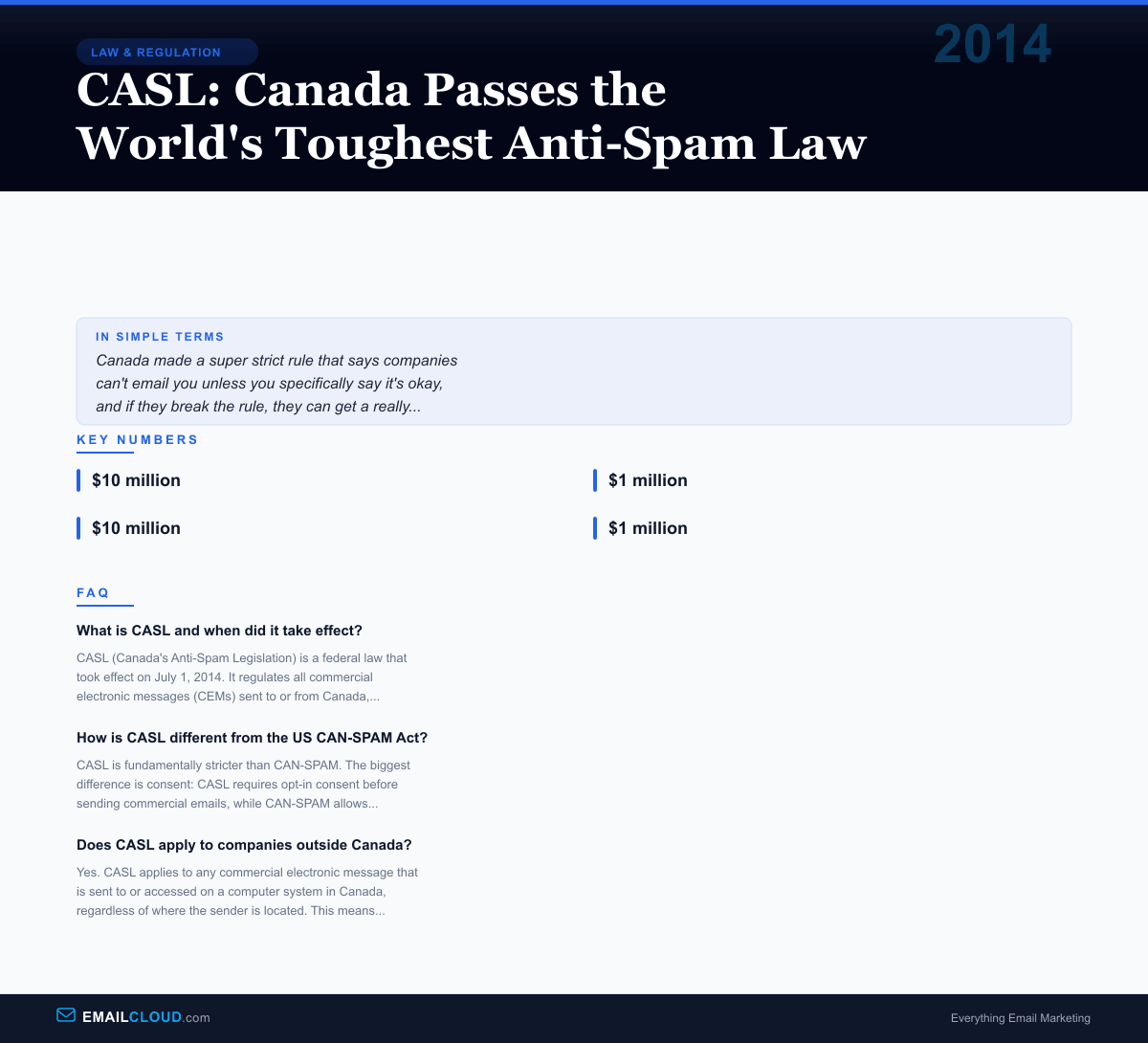
CASL (Canada's Anti-Spam Legislation) is a federal law that took effect on July 1, 2014. It regulates all commercial electronic messages (CEMs) sent to or from Canada, requiring express or implied consent before sending marketing emails. Maximum penalties are $10 million for businesses and $1 million for individuals per violation.
How is CASL different from the US CAN-SPAM Act?
CASL is fundamentally stricter than CAN-SPAM. The biggest difference is consent: CASL requires opt-in consent before sending commercial emails, while CAN-SPAM allows sending until someone opts out. CASL also has much higher penalties ($10M vs. ~$46K per violation), covers all electronic messages (not just email), and includes a private right of action allowing individuals to sue.
Does CASL apply to companies outside Canada?
Yes. CASL applies to any commercial electronic message that is sent to or accessed on a computer system in Canada, regardless of where the sender is located. This means a company in the United States or Europe can be subject to CASL enforcement if its emails are received by Canadian recipients.