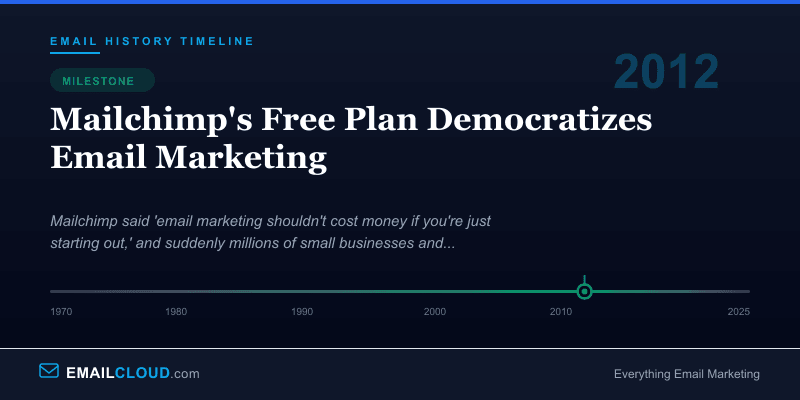
2012: Mailchimp's Free Plan Democratizes Email Marketing
For most of email marketing’s history, sending professional emails to a list cost real money. You needed to pay for software like Constant Contact (founded 1995), subscribe to an email service provider, or run your own mail server — a task roughly as enjoyable as performing your own dental work. Then Mailchimp, a scrappy Atlanta-based company that started as a side project, introduced a free tier that blew the doors open. Suddenly, anyone with an email list and a dream could be an email marketer.
The Origin Story
Mailchimp’s founding story has become startup legend. Ben Chestnut and Dan Kurzius were running a web design agency called the Rocket Science Group in Atlanta in 2001. Their clients kept asking for help sending email newsletters, and the existing tools were expensive and terrible. So Chestnut built an email-sending tool as a side project. They named it Mailchimp, gave it a cartoon chimp mascot named Freddie, and treated it as a secondary revenue stream to their design agency.
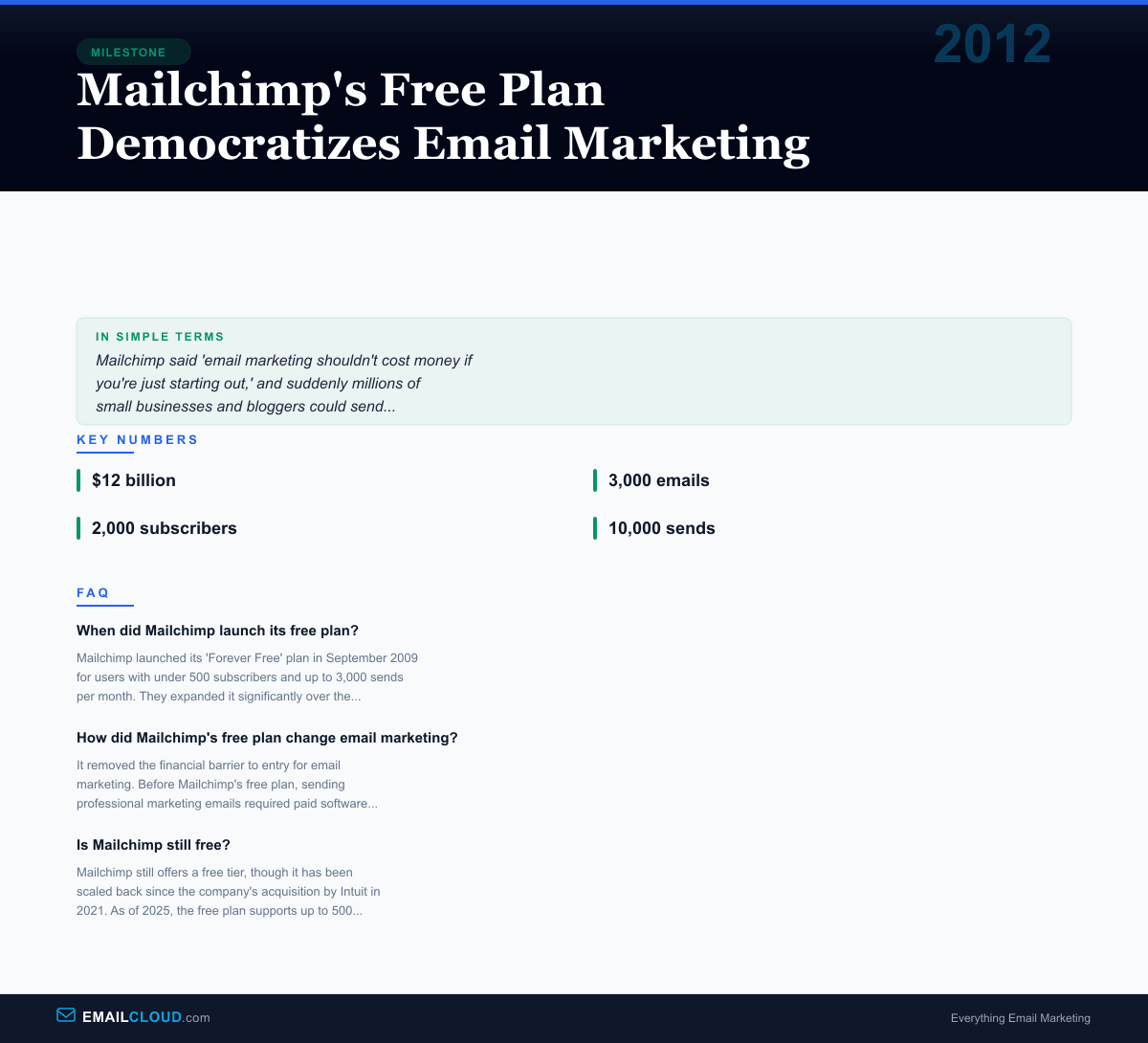
For years, Mailchimp operated in relative obscurity. It was a paid product competing against established players like Constant Contact, AWeber, and ExactTarget. The company was profitable but small. Chestnut and Kurzius never took venture capital funding — a decision that would later prove to be worth approximately $12 billion.
The “Forever Free” Gambit
In September 2009, Mailchimp made a move that its competitors thought was insane: it launched a “Forever Free” plan. Users with fewer than 500 subscribers could send up to 3,000 emails per month at absolutely no cost. No credit card required. No trial period. Free forever.
The plan expanded over time. By 2012, the free tier supported up to 2,000 subscribers and 10,000 sends per month — enough capacity for a serious small business or a growing blog. The Mailchimp brand, already friendly and approachable, became the default recommendation for anyone asking “how do I start email marketing?”
The results were staggering. In the year after launching the free plan, Mailchimp’s user base grew by 150%. Within two years, it had tripled. But here’s the part that made the economics work: a meaningful percentage of free users eventually outgrew the free tier and converted to paid plans. The free plan wasn’t charity — it was the most effective customer acquisition channel in email marketing history.
Impact on Small Business
Before Mailchimp’s free plan, a small business owner who wanted to send a professional newsletter to 500 customers had to spend $20-50 per month on an email service provider. For a sole proprietor or a blogger, that cost was a real barrier. Many simply didn’t bother with email marketing, defaulting to social media instead.
Mailchimp’s free tier changed that calculus. A yoga instructor with 300 students could send beautiful weekly class schedules. A local bakery could email 200 regulars about weekend specials. A blogger could build an audience one subscriber at a time without spending a dime until the audience was large enough to justify the investment.
This democratization of email marketing was enormously significant. It meant that email marketing — previously the domain of companies large enough to afford dedicated tools and staff — became accessible to literally anyone. The playing field, if not exactly leveled, was at least no longer gated by budget.
The Freemium Model Spreads
Mailchimp’s success with the freemium model sent shockwaves through the email marketing industry. Competitors scrambled to introduce their own free tiers. SendinBlue (now Brevo) offered a free plan. MailerLite launched with a generous free tier. ConvertKit (now Kit) eventually added free offerings.
The freemium approach also spread beyond email marketing. It became a defining business model for SaaS companies across every category. While freemium wasn’t new — Skype, Dropbox, and Evernote had used it earlier — Mailchimp’s execution became a case study taught in business schools.
The Creator Economy Connection
Mailchimp’s timing was fortuitous. The early 2010s saw the rise of the “creator economy” — individuals building audiences and businesses around their content, expertise, or personal brand. Bloggers, YouTubers, podcasters, and online course creators all needed a way to communicate directly with their audiences. Social media platforms could change their algorithms overnight (and did, repeatedly), but an email list was yours.
Mailchimp’s free plan made it possible for emerging creators to start building their email lists from day one, without waiting until they could afford marketing tools. Many of today’s most successful online creators — newsletter writers, course builders, independent journalists — started on Mailchimp’s free plan.
The Growth Numbers
Mailchimp’s growth trajectory after the free plan launch was remarkable. By 2014, the company had 7 million users. By 2016, 14 million. By 2019, 20 million. Revenue grew proportionally: Mailchimp reportedly generated $700 million in revenue in 2019 — all while remaining bootstrapped with zero outside investment.
This growth made Mailchimp the dominant brand in email marketing for small businesses. The Freddie the Chimp mascot became one of the most recognizable brand identities in tech. Mailchimp’s sponsorship of the podcast “Serial” in 2014 (with the famously mispronounced “MailKimp” intro) introduced the brand to millions of podcast listeners and became a cultural moment in its own right.
Why It Matters
Mailchimp’s free plan didn’t just grow Mailchimp — it grew the entire email marketing industry. By removing the barrier to entry, it introduced millions of small business owners and creators to email marketing who might otherwise have never tried it. Many of those users eventually moved to Mailchimp’s paid plans, to competitors’ paid plans, or to more sophisticated platforms. But they all started because Mailchimp made starting free.
The lesson for email marketers is timeless: reduce friction, and people will show up. That applies to business models, and it applies to the emails you send. Want to reduce friction in your subscribers’ inboxes? Test your campaigns with our Subject Line Grader and Spam Word Checker to make sure every message earns its place.
Infographic
Share this visual summary. Right-click to save.
Related Events
Frequently Asked Questions
When did Mailchimp launch its free plan?
Mailchimp launched its 'Forever Free' plan in September 2009 for users with under 500 subscribers and up to 3,000 sends per month. They expanded it significantly over the years, reaching up to 2,000 subscribers and 10,000 sends by 2012.
How did Mailchimp's free plan change email marketing?
It removed the financial barrier to entry for email marketing. Before Mailchimp's free plan, sending professional marketing emails required paid software or service subscriptions. The free tier let bloggers, small businesses, and startups begin building email audiences at zero cost.
Is Mailchimp still free?
Mailchimp still offers a free tier, though it has been scaled back since the company's acquisition by Intuit in 2021. As of 2025, the free plan supports up to 500 contacts and 1,000 monthly sends.