1989: Microsoft Mail and cc:Mail Launch the Corporate Email Era
For most of the 1980s, email was something that existed on university campuses and government research networks. The average office worker had never sent one. Memos were typed, photocopied, and distributed by hand. Messages were left on pink “While You Were Out” slips. Urgent communication meant picking up the phone. The corporate world ran on paper, voice, and shoe leather.
That started to change in 1989, when two products brought email to the corporate desktop in a way that ordinary office workers could actually use: Microsoft Mail and Lotus cc:Mail. Neither was the first corporate email system — products like IBM PROFS and DEC’s ALL-IN-1 had served large enterprises since the early 1980s. But Microsoft Mail and cc:Mail were the ones that took email from the mainframe terminal and put it on the PC sitting on every desk.
The LAN Revolution
The key technology that made corporate email possible wasn’t email itself — it was the local area network. Throughout the mid-1980s, companies had been wiring their offices with Ethernet, connecting PCs into networks using Novell NetWare, Banyan VINES, or Microsoft’s own networking software. These LANs were primarily used for file sharing and printer access. But once the network was in place, someone inevitably asked: couldn’t we also use this to send messages?
cc:Mail, originally created by PCC Systems and later acquired by Lotus Development Corporation, was among the first to answer that question convincingly. The product ran on a LAN and provided a straightforward interface for composing, sending, and receiving messages within an organization. No mainframe required. No Unix knowledge needed. If you could use a PC, you could use cc:Mail.
Microsoft entered the market with Microsoft Mail (originally based on technology from a company called Network Courier, acquired by Microsoft in 1988). Microsoft Mail integrated with the Windows environment and offered a graphical interface that felt familiar to anyone who used other Microsoft products.
From Novelty to Necessity
The adoption curve for corporate email followed a pattern that would become familiar in later technology shifts. Early adopters were typically technical departments — IT, engineering, research. They already understood what email was from university experience or early internet exposure. For them, having email at work was natural.
The middle majority came next, usually driven by management mandate or peer pressure. Once a critical mass of people in an office used email, the holdouts found themselves out of the loop. Meeting invitations, project updates, and important announcements migrated to email, and anyone not checking their inbox missed out.
The final wave — the reluctant adopters — came along because they had no choice. By the early 1990s, email was becoming a required business tool in large organizations. Companies developed email policies, IT departments managed email servers, and “what’s your email address?” became as common a business question as “what’s your phone number?”
The speed of this transition was remarkable. A technology that essentially didn’t exist in most offices in 1988 was considered indispensable by 1995. Seven years from novelty to necessity.
The cc:Mail Dominance
Lotus cc:Mail dominated the corporate email market in the early 1990s. At its peak, cc:Mail had an estimated 20 million users worldwide, making it the most widely used email system in the corporate world. The product was reliable, relatively easy to administer, and worked well on the Novell NetWare networks that dominated corporate computing.
cc:Mail’s success was partly timing — it arrived when LANs were proliferating and the demand for office communication tools was exploding — and partly execution. The product was straightforward enough that non-technical office workers could use it with minimal training, and robust enough that IT departments could manage it without constant crisis.
Lotus’s acquisition of cc:Mail in 1991 made strategic sense: Lotus was already a dominant force in corporate computing through Lotus 1-2-3 (the leading spreadsheet) and was developing Lotus Notes as a collaboration platform. cc:Mail fit neatly into the Lotus vision of networked office productivity.
Microsoft’s Long Game
Microsoft Mail was initially less successful than cc:Mail, but Microsoft was playing a longer game. In 1996, Microsoft released Exchange Server, a fundamentally more powerful email and collaboration platform that integrated with Windows NT Server and the growing Microsoft ecosystem. Exchange Server didn’t just replace Microsoft Mail — it set out to replace cc:Mail, Lotus Notes, and every other corporate messaging system.
Exchange Server’s integration with the Windows desktop, the Outlook email client, and the broader Microsoft Office suite gave it enormous advantages. By the early 2000s, Microsoft Exchange had become the dominant corporate email platform worldwide, a position it maintains (now as Microsoft 365 / Exchange Online) to this day.
The cc:Mail to Exchange transition was one of the largest technology migrations in corporate history. Millions of users moved from cc:Mail or Notes to Exchange/Outlook throughout the late 1990s and early 2000s, taking their email habits with them but gaining richer functionality: calendaring, contact management, task lists, and eventually mobile synchronization.
What Corporate Email Changed
The arrival of email in ordinary offices changed how businesses operated in ways that went far beyond replacing memos.
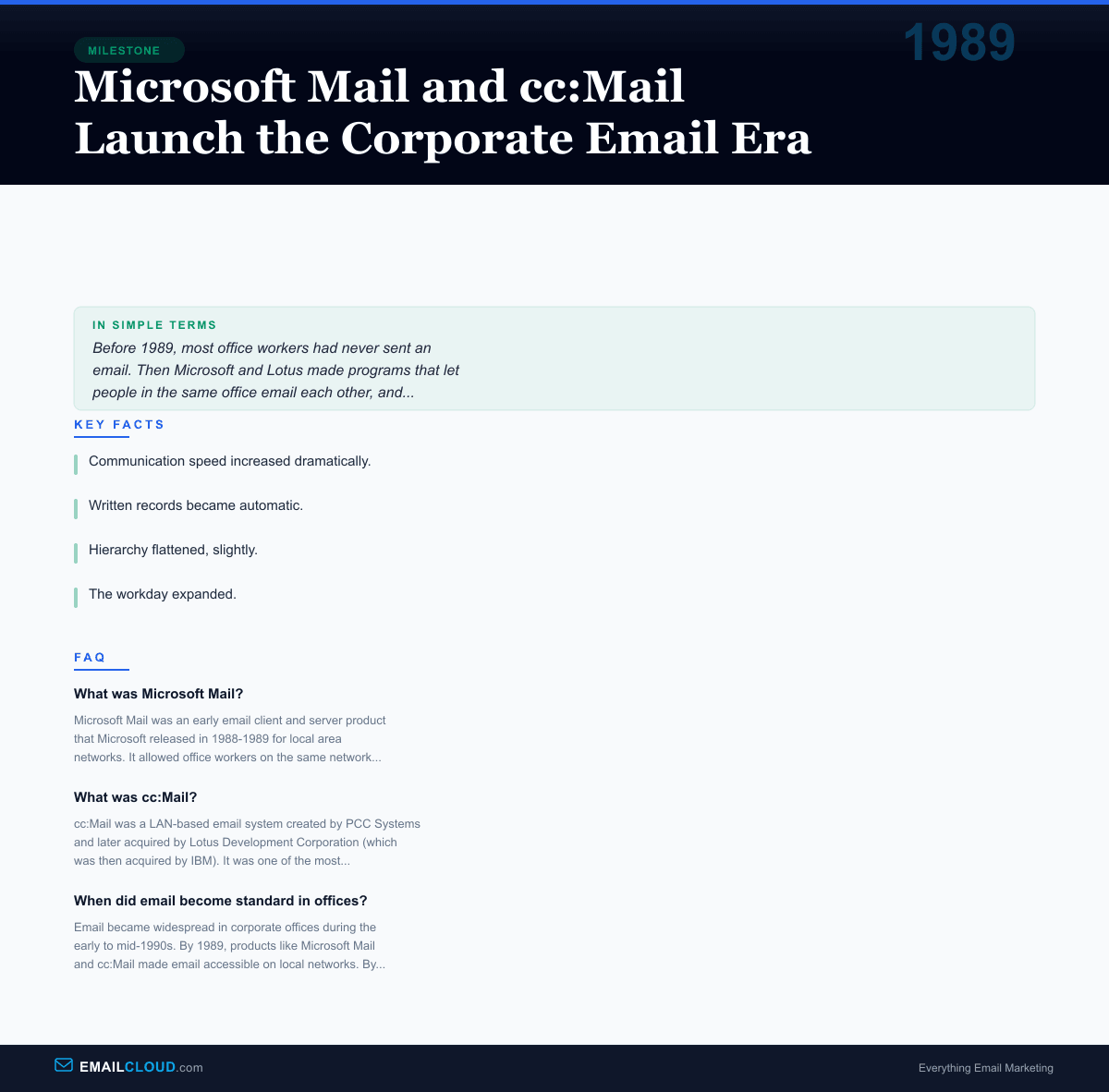
Communication speed increased dramatically. A question that previously required a phone call (requiring both parties to be available) or a memo (requiring physical delivery) could now be answered in minutes. The pace of business accelerated correspondingly.
Written records became automatic. Every email created a paper trail — or rather, a digital trail. This had profound implications for accountability, legal discovery, and institutional memory. Decisions that were previously made in hallway conversations and lost to memory were now documented in email archives.
Hierarchy flattened, slightly. Email made it possible for a junior employee to send a message directly to a senior executive without going through layers of assistants and secretaries. The effect was modest — organizational hierarchies didn’t collapse — but the communication barrier between levels was lowered.
The workday expanded. With email came the expectation of responsiveness, and with responsiveness came the blurring of work hours. By the mid-1990s, checking email in the evening was becoming normal. By the 2000s, it was expected. The always-connected workplace was an unintended consequence of making communication too easy.
The corporate email systems of 1989 were primitive by modern standards — limited to internal networks, lacking internet connectivity, and offering basic text-only messaging. But they planted the seed that grew into the 350+ billion daily emails the world sends today. Every corporate email you’ve ever sent descends from those early LAN-based systems that dared to suggest that maybe, just maybe, office workers might want to communicate by computer.
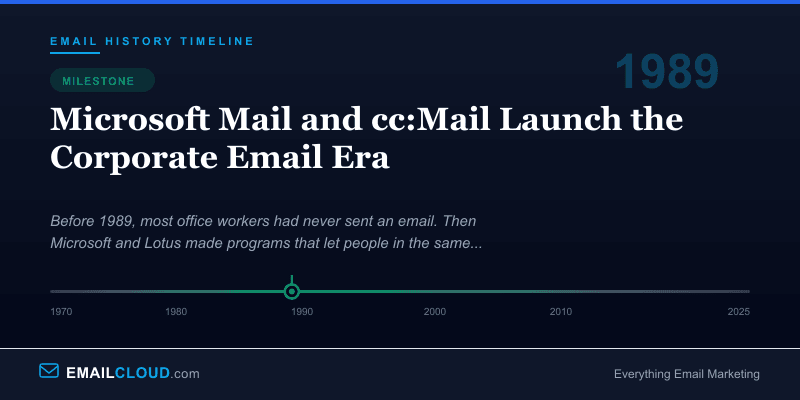
Infographic
Share this visual summary. Right-click to save.
Related Events
Frequently Asked Questions
What was Microsoft Mail?
Microsoft Mail was an early email client and server product that Microsoft released in 1988-1989 for local area networks. It allowed office workers on the same network to send messages and files to each other. It was eventually replaced by Microsoft Exchange Server in 1996.
What was cc:Mail?
cc:Mail was a LAN-based email system created by PCC Systems and later acquired by Lotus Development Corporation (which was then acquired by IBM). It was one of the most popular corporate email systems of the late 1980s and early 1990s, with an estimated 20 million users at its peak.
When did email become standard in offices?
Email became widespread in corporate offices during the early to mid-1990s. By 1989, products like Microsoft Mail and cc:Mail made email accessible on local networks. By the mid-1990s, internet email standards (SMTP/POP3) connected these systems to the broader internet, and email became a universal business tool.