1997: Reply All Disasters: The Worst Corporate Email Storms in History
There is no disaster quite like a reply-all storm. It starts innocently — someone sends a message to a large distribution list, perhaps by accident, perhaps intentionally but misguidedly. Then someone replies to all, asking to be removed. Then someone replies to all, asking people to stop replying to all. Then someone replies to all to agree with the person asking people to stop replying to all. Within minutes, thousands of emails are cascading through the system, servers are groaning under the load, and the entire organization is watching in real-time as a slow-motion email catastrophe unfolds in their inbox. It never stops being darkly entertaining to everyone except the IT department.
The Anatomy of a Storm
Every reply-all storm follows the same script. Phase one: the trigger. A message goes out to a large group — a company-wide distribution list, a department mailing list, or an all-hands announcement. The message itself is usually mundane: a misaddressed request, an accidental test message, or a well-intentioned announcement sent to the wrong list.
Phase two: the initial replies. A few people hit “reply all” to respond, ask a question, or request removal from the list. Each reply goes to every person on the original distribution list. If the list has 10,000 members, each reply generates 10,000 emails.
Phase three: the meta-replies. People start replying to all asking others to stop replying to all. This is the critical inflection point where the storm becomes self-sustaining. Each “please stop replying to all” message is itself a reply-all, generating thousands more messages and prompting more people to reply with their own pleas to stop.
Phase four: the jokes. Once the storm is clearly out of control, a subset of recipients decides to lean into the chaos. Memes, GIFs, philosophical observations about the human condition, and increasingly absurd commentary join the torrent. IT staff begin experiencing stress responses.
Phase five: the lockdown. System administrators intervene, restricting the distribution list, blocking further replies, and sometimes shutting down the mail server entirely to clear the queue. A company-wide announcement follows, requesting that everyone delete the accumulated messages. The IT post-mortem begins.
The Microsoft Bedlam DL3 Incident (1997)
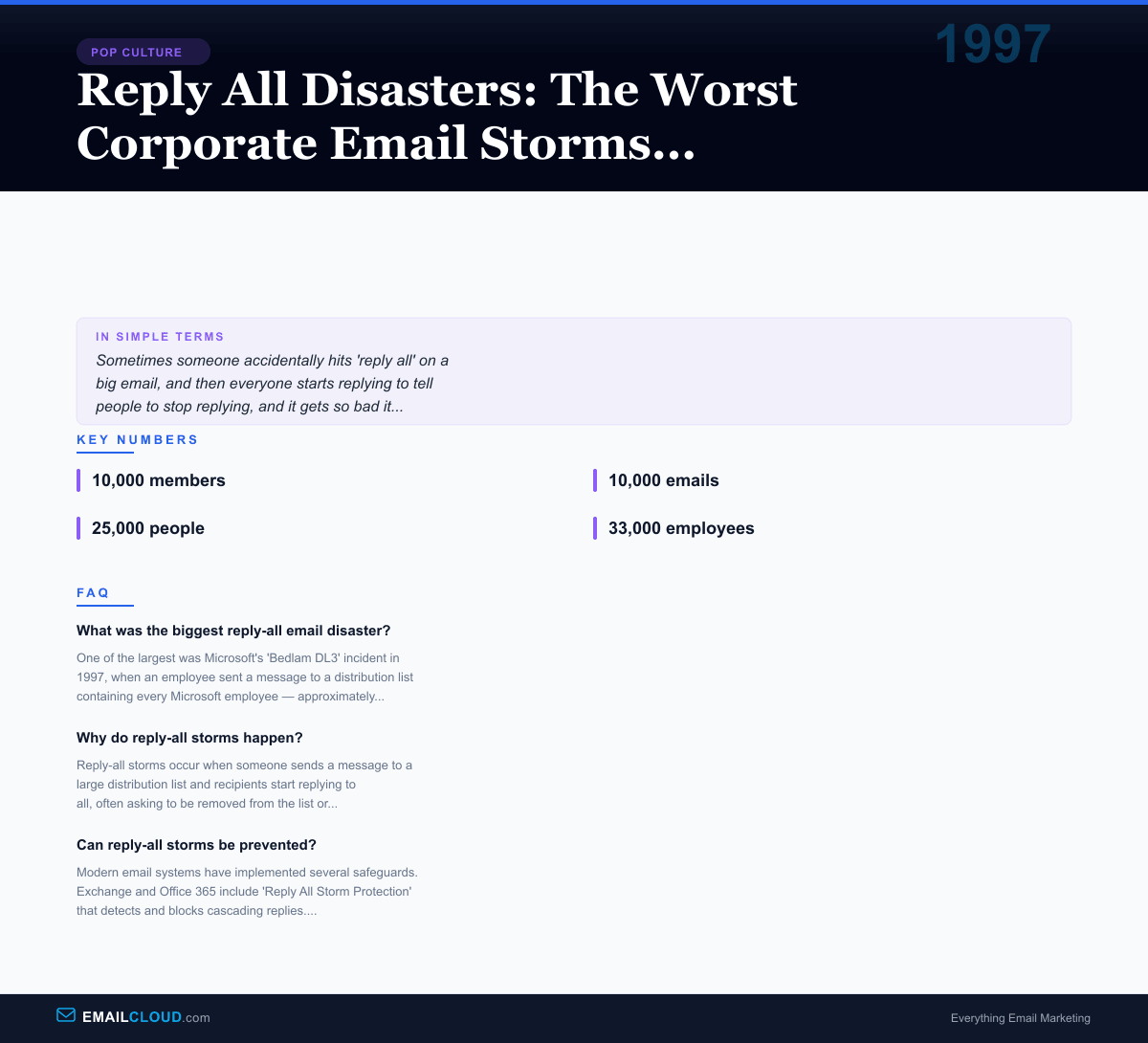
The most famous reply-all storm in history occurred at Microsoft in 1997. An employee sent a message to a distribution list called “Bedlam DL3” — which, due to a configuration error, included every Microsoft employee worldwide, approximately 25,000 people at the time.
The initial message was unremarkable, but the replies were immediate and voluminous. Employees began replying to all, first with legitimate responses, then with requests to stop, then with increasingly frustrated demands that people stop replying. The cascade generated an estimated 15 million email messages in a matter of hours, overwhelming Microsoft’s Exchange servers and disrupting internal communication across the company.
The incident became so legendary within Microsoft that “Bedlam DL3” became shorthand for any email disaster. Microsoft eventually built safeguards into Exchange to prevent similar storms — safeguards that are now standard in enterprise email platforms.
The US State Department Cable (2009)
In 2009, a reply-all storm at the U.S. State Department demonstrated that government agencies were not immune. A routine message about a proposed change to cafeteria menus was sent to a distribution list that reached tens of thousands of State Department employees worldwide. Replies began flowing — opinions about the cafeteria food, requests to be removed from the list, and the inevitable replies asking people to stop replying.
The storm reportedly generated over 2.2 million emails, disrupting State Department communications at a time when diplomatic emails were critical to ongoing operations. The incident prompted a security review of distribution list policies and became a cautionary tale in government IT training.
The Thomson Reuters Storm (2014)
In 2014, a Thomson Reuters employee accidentally sent a test email to a distribution list containing approximately 33,000 employees. The ensuing reply-all storm lasted several hours and generated hundreds of thousands of messages. The incident was notable for the speed at which it was documented on social media — employees live-tweeted the chaos, providing a real-time public chronicle of a corporate email meltdown.
The NHS Reply-All (2016)
In November 2016, a contractor sent an email to approximately 840,000 NHS employees — nearly every worker in England’s National Health Service — asking to be removed from a mailing list. The reply-all responses began immediately, and within hours, approximately 186 million emails had been generated, overwhelming NHS email servers and disrupting communications across the healthcare system.
The timing was particularly bad. Healthcare communication is time-sensitive, and the email storm interfered with legitimate medical communications. The incident led to a thorough review of NHS email distribution list policies and access controls.
Why They Keep Happening
Reply-all storms persist because they exploit a fundamental design tension in email. Email systems are designed to make communication easy — hitting “reply all” should be frictionless because it’s frequently the correct action. But that same frictionlessness makes accidental or misguided reply-alls equally easy.
Large distribution lists compound the problem. A reply-all to a ten-person team generates ten messages. A reply-all to a 50,000-person company list generates 50,000 messages. The same user interface action produces dramatically different outcomes depending on the size of the audience, and most email clients don’t distinguish between the two scenarios with adequate warnings.
Human psychology makes it worse. When people receive unwanted emails, their instinct is to respond — to ask to be removed, to request that the storm stop, to express frustration. Each of these instinctive responses amplifies the problem. It takes genuine self-discipline to realize that the correct response to a reply-all storm is to do absolutely nothing.
Modern Safeguards
The frequency and severity of reply-all storms have decreased thanks to technical safeguards. Microsoft’s Exchange Online introduced “Reply All Storm Protection” in 2020, which automatically detects when a reply-all chain is escalating beyond a threshold and blocks further replies. Google limits the number of recipients per message and applies rate limiting that constrains the speed at which a storm can grow.
Organizations have also learned to restrict sending permissions on large distribution lists. Instead of allowing any employee to email the entire company, most organizations now limit all-staff messages to communications teams or senior leadership.
But reply-all storms haven’t been eliminated entirely. As long as email allows reply-all to large groups, and as long as humans feel compelled to respond to unwanted messages, the conditions for the next great email storm remain in place. Somewhere, right now, a distribution list is waiting.
Infographic
Share this visual summary. Right-click to save.
Related Events
Frequently Asked Questions
What was the biggest reply-all email disaster?
One of the largest was Microsoft's 'Bedlam DL3' incident in 1997, when an employee sent a message to a distribution list containing every Microsoft employee — approximately 25,000 people. The ensuing reply-all storm generated millions of messages, crashed servers, and required emergency intervention to stop. The incident became legendary in tech culture.
Why do reply-all storms happen?
Reply-all storms occur when someone sends a message to a large distribution list and recipients start replying to all, often asking to be removed from the list or requesting that people stop replying. Each reply generates thousands of new messages (one to each person on the list), and the cascade overwhelms both email servers and the patience of everyone involved.
Can reply-all storms be prevented?
Modern email systems have implemented several safeguards. Exchange and Office 365 include 'Reply All Storm Protection' that detects and blocks cascading replies. Administrators can restrict who can send to large distribution lists. Gmail limits the number of recipients per message. But human error and organizational email policies mean reply-all storms still occur occasionally.