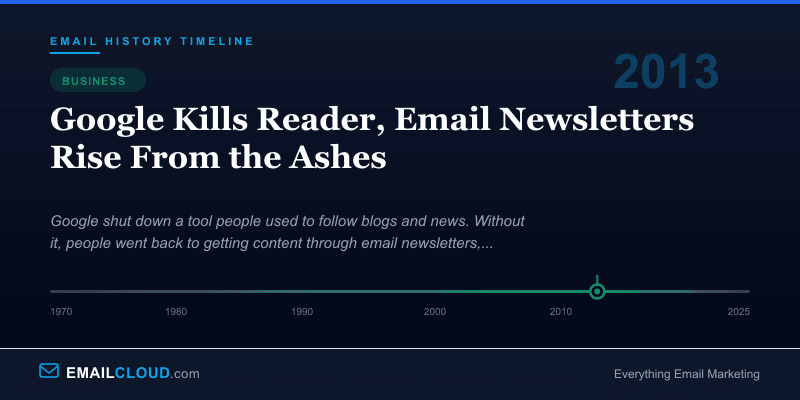
2013: Google Kills Reader, Email Newsletters Rise From the Ashes
On March 13, 2013, Google dropped a blog post that would generate more fury than almost any product decision in the company’s history. The title was characteristically bland: “A second spring of cleaning.” Buried in a list of discontinued products, alongside Google Building Maker and Google Cloud Connect, was a single line that sent the internet into mourning: Google Reader would be shut down on July 1, 2013.
The reaction was volcanic. A petition on Change.org gathered over 100,000 signatures in 48 hours. Tech journalists wrote eulogies. Social media — ironically, the very medium that Google believed had replaced RSS — erupted with outrage. And while the immediate story was about a beloved product’s death, the longer story was about what grew in the void it left.
What Google Reader Was
Google Reader, launched in October 2005, was an RSS feed reader. RSS (Really Simple Syndication) was a protocol that allowed websites to publish a standardized feed of their content. Users subscribed to feeds in a reader application, which aggregated all their subscriptions into a single, chronological stream.
For the internet’s reading class — journalists, bloggers, researchers, and anyone who followed more than a handful of websites — RSS was transformative. Instead of visiting 50 different websites to check for new posts, you opened your reader and everything was there. Google Reader became the dominant RSS client, partly because it was free, fast, and well-designed, and partly because it was Google — people trusted it would stick around.
At its peak, Google Reader had an estimated 24 million users. That number had declined by 2013, which Google used as the justification for shutting it down. But the “declining usage” argument obscured a crucial detail: Google had stopped investing in Reader years earlier, and the decline in usage was at least partly a consequence of neglect. Google had removed Reader’s social features in 2011 to push users toward Google+, stripped out features, and hadn’t updated the interface in years.
The Void
When Reader died, some users migrated to alternative RSS readers. Feedly, which had positioned itself as a Reader alternative months before the shutdown, went from 4 million users to 12 million within two weeks of Google’s announcement. Inoreader, NewsBlur, The Old Reader, and several other services absorbed portions of the diaspora.
But many Reader users — perhaps the majority — simply stopped using RSS. The protocol itself didn’t die (it’s still widely used), but without a default, frictionless client backed by a major company, casual users drifted away. They got their content through other channels: social media, news aggregator apps like Flipboard, and — increasingly — email.
The Newsletter Connection
The connection between Reader’s death and the newsletter boom isn’t a straight causal line, but it’s more than coincidence. Several trends converged in the years following Reader’s shutdown:
Publishers invested in email. Without RSS as a reliable distribution channel, publishers needed another way to reach readers directly. Email newsletters were the obvious answer. They didn’t depend on any platform’s algorithm. They delivered content directly to readers’ inboxes. And unlike RSS, which most publishers had treated as an automatic byproduct of having a blog, email newsletters could be monetized through advertising, sponsorships, and eventually paid subscriptions.
Social media throttled reach. Facebook, which had been a major traffic driver for publishers, began aggressively reducing organic reach starting in 2014. A publisher’s Facebook post that once reached 15-20% of their followers might now reach 2-5%, unless they paid to boost it. Twitter’s algorithmic timeline, introduced in 2016, created similar uncertainty. Email, by contrast, was immune to algorithmic meddling. If someone subscribed, they got the email. Period.
Readers wanted curation. RSS was comprehensive but overwhelming. A power user might subscribe to hundreds of feeds, producing an unmanageable volume of content. Newsletters, by contrast, were curated — a human editor selected the most important stories, added commentary, and delivered a manageable package. This curation was a feature, not a limitation.
The tools got better. Mailchimp’s free tier, launched in 2009, had already lowered the barrier to entry for newsletter creators. By 2013-2015, the email marketing ecosystem was mature enough that anyone could launch a professional newsletter in minutes. Template builders, analytics, subscriber management — everything was accessible.
The Boom
The newsletter boom that followed Reader’s death produced an entirely new category of media. TheSkimm (founded 2012, just before Reader’s death) grew to millions of subscribers by packaging the day’s news into a breezy morning email. Morning Brew (founded 2015) did the same for business news and was acquired by Business Insider for a reported $75 million. The Hustle (founded 2016) built a newsletter-first media company that HubSpot acquired for a reported $27 million.
Then came Substack in 2017, which added a crucial element: paid subscriptions. For the first time, individual writers could earn a living directly from email subscribers without needing advertising or sponsorship revenue. The newsletter shifted from a distribution mechanism to a standalone business model.
The Irony
There’s a deep irony in this story. Google killed Reader because it believed social media was the future of content distribution. Google+ — the social network Reader was sacrificed to promote — was itself shut down in April 2019, a colossal failure that never came close to replacing Facebook, let alone RSS. Meanwhile, the email newsletter industry that Reader’s death helped catalyze grew into a multi-billion-dollar ecosystem.
Google, the company that pushed the world away from RSS and toward social feeds, inadvertently pushed a generation of publishers back to the oldest digital distribution channel of all: email. The inbox outlasted the feed. The newsletter outlasted Google+. And somewhere, a million former Google Reader users are now getting their daily content through the same email system that predates Google itself by two decades.
For publishers thinking about building their audience through newsletters, email remains the most reliable distribution channel available. And it starts with writing subject lines that people actually want to open — try our Subject Line Grader to optimize your first impression.
Infographic
Share this visual summary. Right-click to save.
Related Events
Frequently Asked Questions
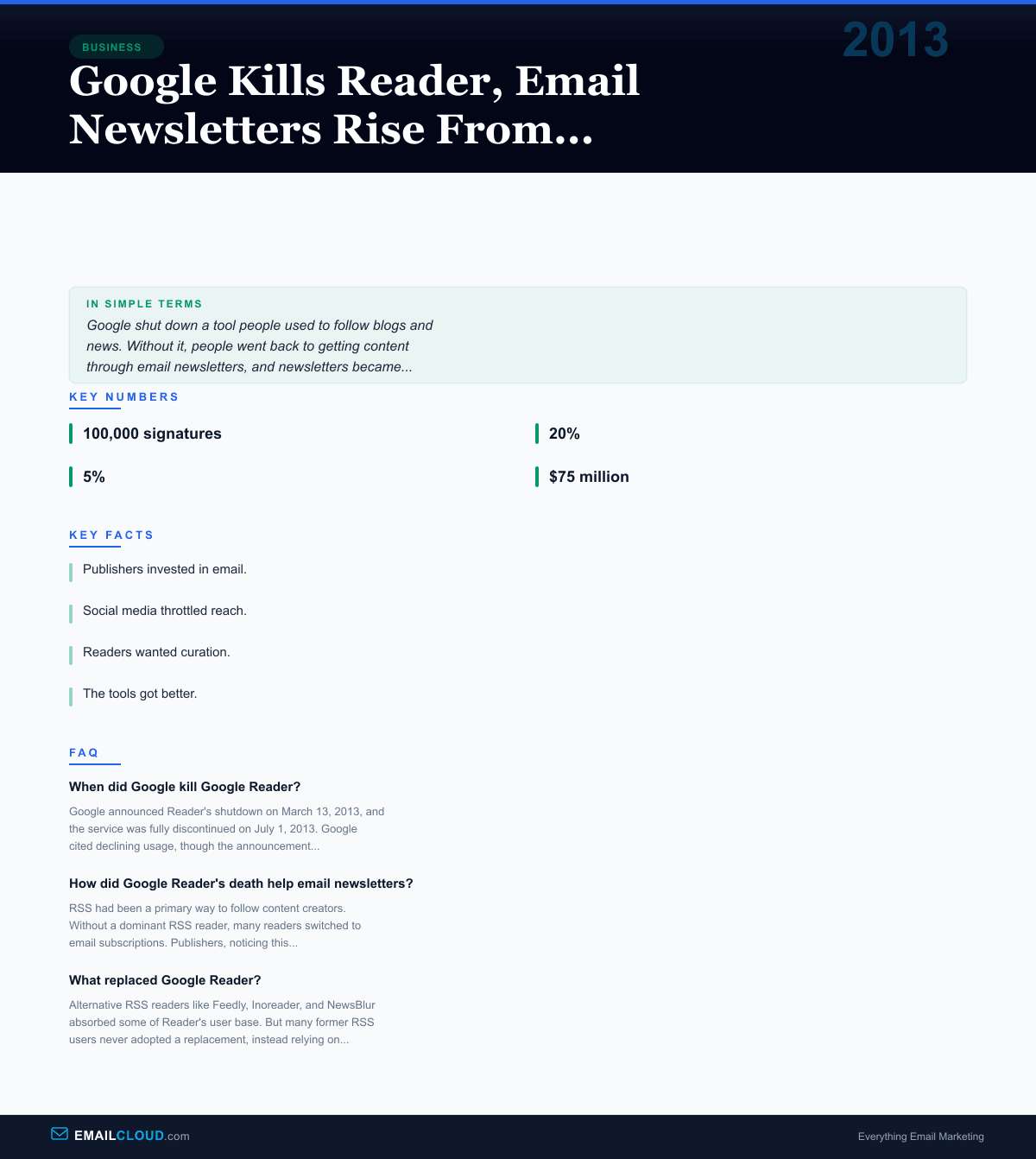
When did Google kill Google Reader?
Google announced Reader's shutdown on March 13, 2013, and the service was fully discontinued on July 1, 2013. Google cited declining usage, though the announcement sparked significant protest from its dedicated user base.
How did Google Reader's death help email newsletters?
RSS had been a primary way to follow content creators. Without a dominant RSS reader, many readers switched to email subscriptions. Publishers, noticing this shift, invested more in email newsletters as a distribution channel, fueling the newsletter renaissance.
What replaced Google Reader?
Alternative RSS readers like Feedly, Inoreader, and NewsBlur absorbed some of Reader's user base. But many former RSS users never adopted a replacement, instead relying on social media and email newsletters for content discovery and consumption.