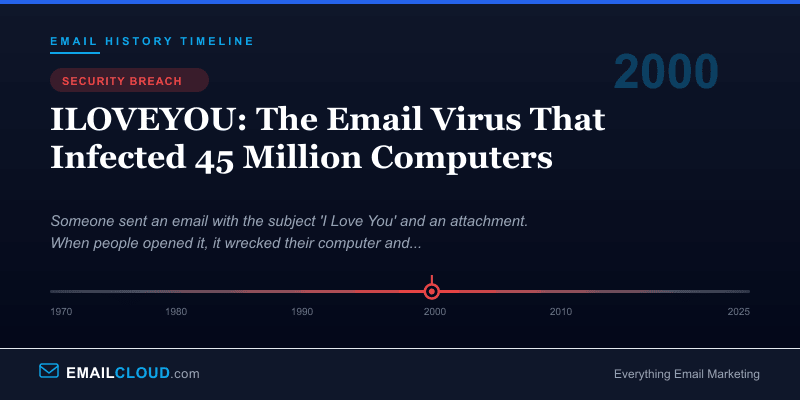
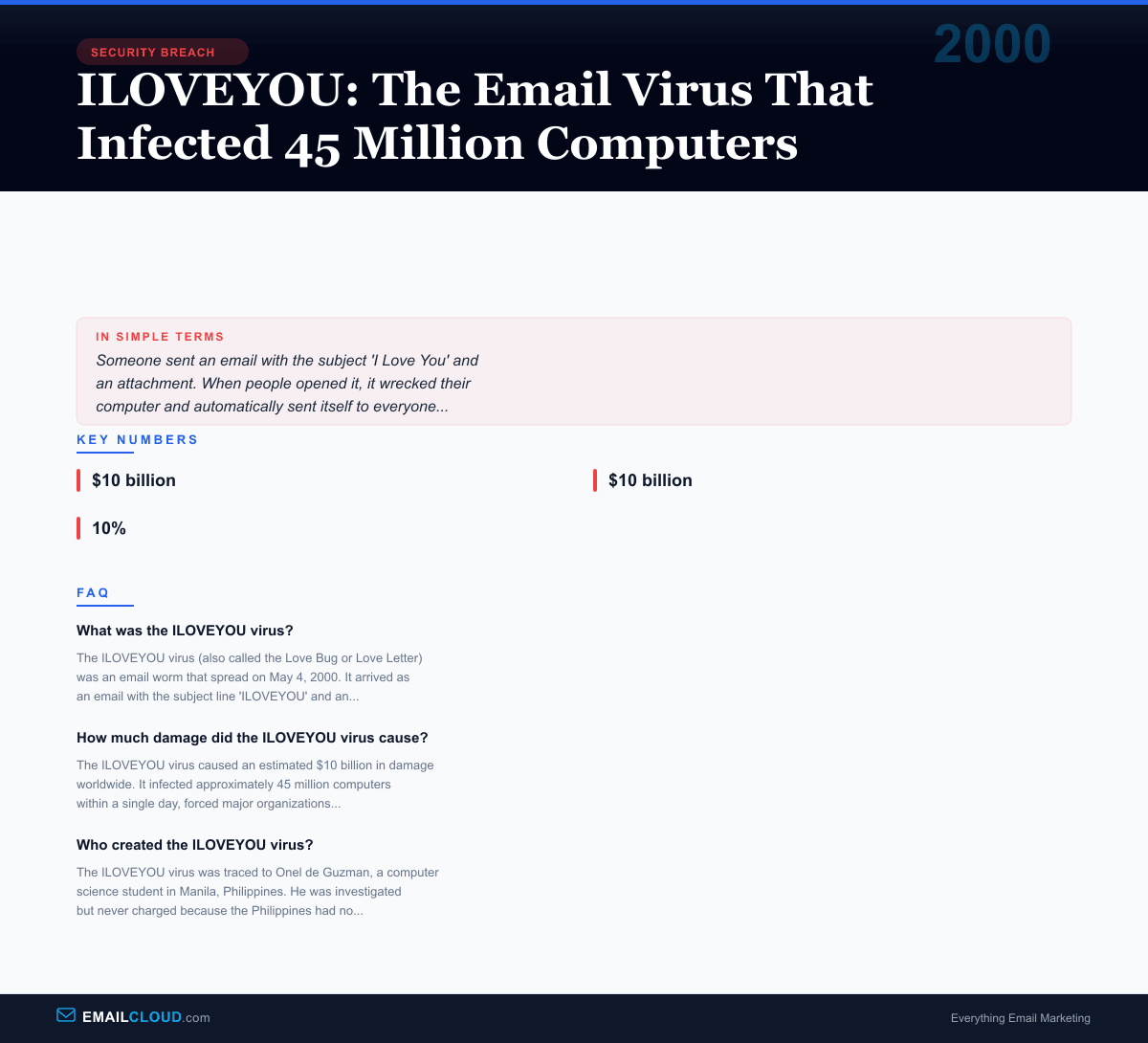
2000: ILOVEYOU: The Email Virus That Infected 45 Million Computers
On the morning of May 4, 2000, millions of people around the world opened their email to find a message from someone they knew — a friend, a colleague, a family member — with the subject line “ILOVEYOU.” Attached was a file called “LOVE-LETTER-FOR-YOU.TXT.vbs.”
Curiosity, vanity, and a touch of hopefulness did the rest. People opened the attachment. And in doing so, they unleashed the fastest-spreading computer virus the world had ever seen.
Within 24 hours, the ILOVEYOU worm had infected an estimated 45 million computers across every continent. The Pentagon shut down its email system. The CIA shut down its email. The British Parliament shut down its email. Ford Motor Company, AT&T, and countless other organizations disconnected from email entirely to stop the bleeding. The estimated damage: $10 billion.
Email had never had a worse day.
How It Worked
The ILOVEYOU worm exploited two things: Microsoft Outlook’s trust model and human psychology. The combination proved devastating.
The technical mechanism was straightforward. The attachment — “LOVE-LETTER-FOR-YOU.TXT.vbs” — appeared to be a text file because Windows hid known file extensions by default. Users saw “LOVE-LETTER-FOR-YOU.TXT” and assumed it was a harmless text document. The hidden “.vbs” extension indicated a Visual Basic Script — executable code that Windows would run without restriction.
When executed, the script did three things. First, it overwrote files on the victim’s hard drive — image files (JPEG, PNG), music files (MP3), and other document types — replacing them with copies of itself. Years of personal photos, music collections, and documents were destroyed in seconds.
Second, it modified the Windows registry to ensure it would run every time the computer started, persisting through reboots.
Third, and most critically, it opened the victim’s Microsoft Outlook address book and sent a copy of itself to every single contact. This was the propagation mechanism that made ILOVEYOU so explosive. Each victim’s computer became a launching pad, sending infected emails to dozens or hundreds of new targets. And because the emails came from people the recipients knew and trusted, the open rate was astronomical.
The Human Factor
The genius — if that word can be applied to malware — was in the social engineering. “ILOVEYOU” as a subject line was practically irresistible. It triggered curiosity (“Who sent this?”), ego (“Someone loves me!”), and a sense of intimacy that overrode caution. A subject line reading “Important Business Document” might have prompted skepticism. “ILOVEYOU” bypassed the rational brain entirely.
The fact that the email came from a known contact amplified the effect. People who might have been suspicious of a message from a stranger opened an “ILOVEYOU” attachment from their boss, their colleague, their college roommate, or their aunt without hesitation. Trust in the sender overrode suspicion about the attachment.
In corporate environments, the spread was particularly explosive. A single infected machine in an office could send the virus to hundreds of colleagues in seconds. Those colleagues’ machines would then send it to hundreds more. An entire organization could be compromised within minutes.
The Global Response
The speed of the outbreak overwhelmed the security community. Anti-virus companies scrambled to identify the virus and distribute definitions, but the worm was spreading faster than updates could be deployed. Many organizations took the drastic step of simply shutting down their email servers entirely — the digital equivalent of pulling the fire alarm and evacuating the building.
The Pentagon’s Joint Task Force for Computer Network Defense shut down all email access. The CIA went offline. The British Parliament stopped email. Major banks, media companies, and government agencies across Europe and Asia disconnected their mail systems. For many organizations, the choice was simple: lose email for a day, or lose your data forever.
The worm hit Asia first (originating in the Philippines on the morning of May 4, local time) and spread westward across time zones as workdays began. European offices were devastated as employees arrived, checked email, and opened the attachment. North American organizations had a few hours’ warning and fared slightly better, though millions were still infected.
The Creator
The ILOVEYOU worm was traced to Onel de Guzman, a 24-year-old computer science student at AMA Computer College in Manila, Philippines. De Guzman had reportedly created the worm as part of a thesis proposal exploring how malware could harvest internet access passwords — a proposal his school had rejected.
Philippine authorities investigated but ultimately could not prosecute de Guzman. The Philippines had no laws against writing or distributing computer viruses in 2000. No cybercrime legislation existed. De Guzman admitted to likely releasing the worm but was never formally charged.
The incident prompted the Philippines to pass the Electronic Commerce Act of 2000, which included provisions against computer crime. Numerous other countries reviewed and strengthened their own cybercrime laws in response. The ILOVEYOU worm didn’t just damage computers — it forced the global legal system to recognize that computer crime was real and needed real laws.
The Legacy
ILOVEYOU was a turning point for email security. Before May 4, 2000, email attachments were generally trusted. After, they were treated with suspicion. The incident catalyzed several changes that shaped modern email security.
Organizations began blocking executable attachments (.vbs, .exe, .bat) at the email server level. Windows changed default settings to display file extensions, making it harder to disguise executable files as documents. Anti-virus software became a standard corporate requirement rather than an optional add-on. Email security awareness training — “don’t open attachments from unknown sources” — became a standard practice.
The ILOVEYOU worm caused $10 billion in damage, affected an estimated 10% of all internet-connected computers worldwide, and forced the largest coordinated email shutdown in history. It demonstrated, with brutal clarity, that email’s greatest strength — its ability to connect anyone to anyone — was also its greatest vulnerability. Twenty-five years later, email security remains an ongoing battle, and the lessons of May 4, 2000 haven’t been forgotten.
Infographic
Share this visual summary. Right-click to save.
Related Events
Frequently Asked Questions
What was the ILOVEYOU virus?
The ILOVEYOU virus (also called the Love Bug or Love Letter) was an email worm that spread on May 4, 2000. It arrived as an email with the subject line 'ILOVEYOU' and an attachment called 'LOVE-LETTER-FOR-YOU.TXT.vbs'. When opened, it overwrote files on the victim's computer and sent copies of itself to every contact in their Outlook address book.
How much damage did the ILOVEYOU virus cause?
The ILOVEYOU virus caused an estimated $10 billion in damage worldwide. It infected approximately 45 million computers within a single day, forced major organizations including the Pentagon, CIA, and British Parliament to shut down their email systems, and destroyed files (particularly images and music) on millions of machines.
Who created the ILOVEYOU virus?
The ILOVEYOU virus was traced to Onel de Guzman, a computer science student in Manila, Philippines. He was investigated but never charged because the Philippines had no cybercrime laws at the time. The incident prompted the Philippines and many other countries to enact computer crime legislation.