Substack Review: Free Newsletter Platform With a 10% Catch
Pros
- Completely free to start — no monthly fee for free or paid newsletters
- Built-in paid subscription system with Stripe integration
- Substack Network provides audience discovery and cross-promotion opportunities
- Clean, distraction-free writing experience focused on content
- Built-in podcast and community features at no additional cost
Cons
- 10% revenue cut on paid subscriptions is significant at scale
- Almost zero email design customization — text-only aesthetic
- No automation, segmentation, or marketing tools
- You do not fully own the relationship with your subscribers
The Quick Verdict
Substack removed every barrier to starting a paid newsletter. No technical setup, no monthly fees, no design decisions — just write and publish. For writers, journalists, and thought leaders testing whether their audience will pay for their work, that frictionless start has enormous value. But Substack is not an email marketing platform. There is no automation, no segmentation, no A/B testing, and almost no design customization. The 10% revenue cut on paid subscriptions becomes a significant cost as revenue grows. Substack is an excellent launchpad for newsletter creators, but it is designed to get you started, not to scale your business.
What Substack Does Well
Zero-Cost Entry for Creators
Substack’s business model is genuinely creator-friendly at the entry level. There is no monthly subscription, no setup fee, and no cost for sending free newsletters to any number of subscribers. You pay nothing until someone pays you — and then Substack takes 10% of that revenue.
This model eliminates the financial risk of starting a newsletter. You do not need to decide whether to invest $9-38/mo in an email platform before you know if anyone wants to read what you write. You can publish for months or years at zero cost, build an audience, and only start paying when that audience proves willing to pay you.
For writers transitioning from traditional media, academics exploring public-facing communication, or subject-matter experts testing whether their knowledge has market value, this risk-free entry is the single most compelling reason to choose Substack.
Built-In Paid Subscriptions
Substack’s paid subscription system is seamless. You set a price (monthly and/or annual), toggle on paid subscriptions, and Substack handles everything else — payment processing via Stripe, subscriber management, access control for paid-only posts, and automatic billing. You can designate individual posts as free (visible to everyone), paid (subscribers only), or founders-only (premium tier).
Setting up paid subscriptions on a self-hosted platform or through a tool like Kit requires configuring Stripe, building paywalled content flows, and managing access tiers. Substack reduces this to a single toggle. For writers who want to focus on writing rather than payment infrastructure, the simplicity is substantial.
Most successful Substack publications price between $5-15/mo or $50-150/year. The platform suggests annual subscriptions as the default, which improves retention rates compared to monthly billing.
The Substack Network
Substack’s discovery and recommendation features are its most underrated advantage. The Substack Network includes:
- Recommendations — writers recommend other Substack publications to their subscribers, creating organic cross-promotion
- Leaderboard — top publications by category are featured on Substack’s website, driving new subscribers
- Notes — a social feed where writers share short-form content and interact with each other’s audiences
- Substack App — a reading app where subscribers discover and follow new publications
For new writers, these discovery mechanisms can generate subscribers that would be impossible to reach through a self-hosted newsletter. When an established writer with 50,000 subscribers recommends your publication, the resulting growth spike would cost thousands in paid acquisition on other platforms.
This network effect is something no dedicated email platform can replicate. MailerLite, Kit, and ActiveCampaign can send emails, but they cannot introduce your work to new audiences. Substack can.
Writing-First Experience
Substack’s editor is deliberately minimal. It supports text, images, embedded media, pull quotes, buttons, and footnotes. There are no color pickers, no font selectors, no column layouts, and no design themes. Every Substack newsletter looks essentially the same — clean black text on a white background with your publication’s logo at the top.
For writers, this constraint is liberating. There are no design decisions to agonize over, no template browsing, no formatting debates. You open the editor, write your piece, add a few images, and publish. The focus stays on the content.
Substack also supports podcasting (audio uploads with their own RSS feed) and community discussion threads. These features transform a newsletter from a one-directional broadcast into a multi-format media channel, all managed from one dashboard.
Where Substack Falls Short
The 10% Cut Adds Up
At small revenue levels, 10% feels like a fair exchange for Substack’s infrastructure and audience discovery. On $500/mo in revenue, Substack takes $50 — reasonable for a fully managed platform.
But the math changes as you scale. On $5,000/mo, Substack takes $500. On $20,000/mo, Substack takes $2,000. On $50,000/mo — a level that several top Substack writers have reached — the platform takes $5,000 every month.
At those levels, you could run your own newsletter on Kit or beehiiv for $100-400/mo and keep the difference. The migration cost (some subscriber churn, technical setup time) is a one-time pain. The savings are permanent and grow as your revenue grows.
This math is why many successful newsletter creators start on Substack and eventually migrate to platforms with flat-fee pricing. Substack’s economics favor it at the beginning and work against it at scale.
No Email Marketing Tools
Substack is a publishing platform, not an email marketing platform. The distinction matters:
- No automation — you cannot set up welcome sequences, drip campaigns, or behavioral triggers
- No segmentation — you cannot send different content to different subscriber groups based on interests or behavior
- No A/B testing — you cannot test subject lines or content variations
- No detailed analytics — you see open rates and subscriber counts, but no click maps, engagement scoring, or funnel analysis
- No landing pages — subscriber acquisition happens through Substack’s own pages or embed codes
For a writer sending a weekly essay to their entire list, these limitations may not matter. But for anyone treating their newsletter as a business — testing headlines, segmenting audiences, nurturing leads, optimizing conversion funnels — Substack provides none of the tools needed for growth optimization.
Limited Design Customization
Every Substack newsletter looks like a Substack newsletter. You can add your logo, choose an accent color, and write a publication description. That is the extent of brand customization.
For personal brands built on writing quality, this uniformity is fine. For businesses, agencies, or brands with established visual identities, the inability to customize email design is a significant limitation. Your brand’s newsletter will look identical to every other Substack publication.
Platform Dependency
When you publish on Substack, your content lives on Substack’s domain (yourname.substack.com or a custom domain pointing to Substack). You can export your subscriber list, but your archive of published posts, your SEO equity, and your established URLs all live on Substack’s infrastructure. If Substack changes its terms, raises its revenue cut, or makes content moderation decisions you disagree with, migrating requires rebuilding your web presence.
This is a different dynamic than using an email platform like Kit or MailerLite, where your website is your own and the email tool only handles delivery. On Substack, the platform is both your email sender and your web publisher.
Pricing Breakdown
Substack’s pricing is simple:
- Free newsletters: $0 — no limits on subscribers or sends
- Paid newsletters: Substack takes 10% of gross revenue, Stripe takes 2.9% + $0.30 per transaction
- Founding member tiers: Same 10% cut on higher-priced premium tiers
Revenue comparison at different scales:
- $1,000/mo gross: Substack takes $100, Stripe ~$59, you keep ~$841
- $5,000/mo gross: Substack takes $500, Stripe ~$295, you keep ~$4,205
- $20,000/mo gross: Substack takes $2,000, Stripe ~$1,180, you keep ~$16,820
Alternative cost comparison: Kit charges $25/mo for 1,000 subscribers with built-in paid newsletter support and takes no revenue cut. beehiiv’s Scale plan at $99/mo includes paid subscriptions with a 0% revenue cut. At approximately $2,500/mo in newsletter revenue, migrating to a flat-fee platform becomes financially advantageous.
Who Should Use Substack
Substack is ideal for:
- Writers and journalists testing the viability of a paid newsletter — the zero-cost entry eliminates financial risk and lets you validate before investing in infrastructure
- Subject-matter experts with established audiences who want the simplest possible path from “I should start a newsletter” to “I have paying subscribers”
- Creators who value the network — if audience discovery and cross-promotion from the Substack ecosystem are valuable to your growth strategy, no other platform offers this
Who Should Look Elsewhere
If you are building a newsletter as a business and want marketing tools — automation, segmentation, A/B testing, detailed analytics — Substack does not provide them. Look at beehiiv for a newsletter-focused platform with business tools, or Kit for creator-focused email marketing with paid subscription support.
Businesses and brands with established visual identities should avoid Substack. The inability to customize email design means your brand’s newsletter will look generic. Any dedicated email platform gives you more control over brand presentation.
The Bottom Line
Substack democratized paid newsletters by removing every friction point — no technical setup, no upfront cost, no design decisions. For writers testing whether their audience will pay for their work, Substack is the fastest path from idea to revenue. The Substack Network provides audience discovery that no dedicated email platform can match. But the 10% revenue cut, total absence of marketing tools, and minimal customization mean that successful newsletter creators will eventually outgrow the platform. Use Substack to prove your concept. Migrate when you are ready to scale.
Our Verdict
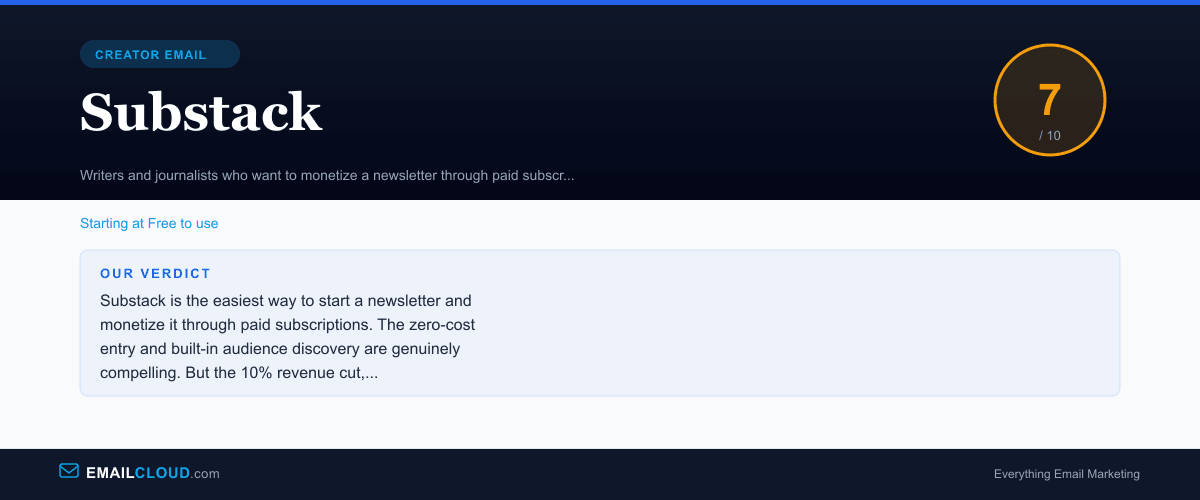
Substack is the easiest way to start a newsletter and monetize it through paid subscriptions. The zero-cost entry and built-in audience discovery are genuinely compelling. But the 10% revenue cut, minimal customization, and lack of marketing tools mean serious newsletter operators will eventually outgrow it. Start on Substack, prove your concept, and migrate when the 10% cut hurts more than the convenience helps.
Review Summary
Share this visual summary. Right-click to save.
Frequently Asked Questions
How much does Substack cost?
Substack is free to use for both free and paid newsletters. The platform takes a 10% cut of paid subscription revenue, and Stripe charges an additional 2.9% + $0.30 per transaction. So on a $10/mo paid subscription, Substack takes $1.00, Stripe takes roughly $0.59, and you keep $8.41. For free-only newsletters, there is no cost at all.
Can I move my subscribers off Substack?
Yes. Substack allows you to export your subscriber list as a CSV file at any time, including email addresses. This means you can migrate to another platform if Substack's terms or pricing change. However, paid subscriptions are managed through Substack's Stripe integration, so migrating paid subscribers requires setting up a new payment system and asking subscribers to re-subscribe — which inevitably results in some churn.
Is Substack or beehiiv better for newsletters?
It depends on your goals. Substack is better for writers who want to monetize through paid subscriptions with zero upfront cost and benefit from the Substack Network for audience discovery. beehiiv is better for newsletter operators who want more customization, better analytics, advertising revenue options, and actual email marketing tools like segmentation and automation. Substack is a publishing platform; beehiiv is a newsletter business platform.