SendGrid Review: Email API and Marketing Platform Combined
Pros
- Generous free plan with 100 emails/day — enough for small apps
- Handles both transactional and marketing email in one platform
- Extensive API documentation with SDKs for major languages
- Massive sending infrastructure — trusted by 80,000+ companies
- Dynamic templates with Handlebars for sophisticated personalization
Cons
- Marketing features are mediocre compared to dedicated platforms
- Support has declined since Twilio acquisition — slow response times
- Dashboard is cluttered and unintuitive for new users
- Deliverability requires more active management than competitors
- Pricing gets complex with separate plans for API and marketing
What is SendGrid?
SendGrid is one of the oldest and most widely used email API services, handling transactional and marketing email for over 80,000 companies worldwide. If you have received a password reset email, order confirmation, or account notification from an internet-connected business in the last decade, there is a reasonable chance it was delivered through SendGrid’s infrastructure.
Founded in 2009 and acquired by Twilio in 2019 for $3 billion, SendGrid occupies a unique position in the email space. It offers both a developer-oriented email API for transactional messages and a marketing campaign platform for newsletters and promotional email. This dual capability means you can handle application-generated email and human-composed marketing campaigns from a single account — a convenience that most competitors do not offer.
The Twilio acquisition brought SendGrid into a broader communications ecosystem (voice, SMS, video, email), but it also introduced the growing pains that come with being absorbed into a large platform company. Product development has slowed, support quality has become inconsistent, and the pricing structure has grown more complex. These are real concerns that merit honest discussion.
We have integrated SendGrid into SaaS applications, ecommerce platforms, and marketing workflows. This review covers both the transactional API and the marketing features, with an honest assessment of where the platform stands after several years under Twilio’s ownership.
Pricing Breakdown
SendGrid’s pricing is split between API/transactional plans and Marketing Campaigns plans:
Email API Plans:
- Free: 100 emails/day, APIs, webhooks, dynamic templates, 1 teammate
- Essentials ($19.95/mo): 50,000 emails/month, ticket support, no daily sending limit, additional analytics
- Pro ($89.95/mo): 100,000 emails/month, dedicated IP, email validation, sub-user management, phone support, 7-day email activity history
- Premier (custom): Custom volume, dedicated success team, SLA, advanced support
Marketing Campaigns Plans (separate from API):
- Free: 6,000 emails/month to 2,000 contacts, single sender, basic templates
- Basic ($15/mo): 5,000 contacts, 15,000 emails/month, A/B testing, segmentation
- Advanced ($60/mo): 10,000 contacts, 50,000 emails/month, automation, dedicated IP, advanced stats
The split pricing is confusing for users who need both transactional and marketing capabilities. You may need both an API plan and a Marketing Campaigns plan, and the costs add up. At the Pro API plan ($89.95) plus Advanced Marketing ($60), you are at $150/mo before you hit volume overages.
For pure transactional use at low volume, the free plan is a genuine differentiator. No other major transactional email provider offers a permanent free tier — Mailgun, Postmark, and Amazon SES all require payment from the start (though SES’s $0.10/1,000 rate is extremely cheap).
Key Features We Tested
Email API
SendGrid’s API is RESTful, well-documented, and supported by official SDKs for Python, Ruby, Java, PHP, Go, C#, and Node.js. The API covers sending, template management, contact lists, segmentation, and analytics. SMTP relay is also available for applications that prefer SMTP over HTTP API calls.
The API supports batch sending with recipient-specific substitution variables, scheduled sends, attachments, and custom headers. Dynamic templates use Handlebars syntax for conditional logic and variable substitution within email content — loops, conditionals, and partial templates create sophisticated personalization without application code.
For most transactional use cases — password resets, order confirmations, account notifications — integration is straightforward. The free tier makes it easy to develop and test without commitment.
Marketing Campaigns
SendGrid’s marketing features include a visual email designer, contact list management, segmentation, A/B testing, and basic automation. The design editor offers drag-and-drop building with pre-built modules, and a code editor for custom HTML templates.
The automation builder supports multi-step workflows triggered by contact list entry, date-based triggers, and engagement events. It is functional for basic marketing campaigns but not competitive with dedicated marketing platforms like ActiveCampaign, GetResponse, or Kit. If sophisticated automation is your primary need, SendGrid’s marketing features will feel like an afterthought — because they largely are.
Segmentation works across engagement data (opens, clicks) and contact properties. The segment builder is adequate for basic targeting but lacks the depth of platforms built specifically for marketing.
Analytics and Reporting
SendGrid provides detailed analytics for both transactional and marketing email. API-level tracking shows delivery rates, bounces, opens, clicks, spam reports, and unsubscribes. The statistics dashboard visualizes trends over time and breaks down performance by category, which is useful for applications that tag transactional emails by type.
The email activity feed shows individual message history — useful for debugging “I never got my email” support tickets. On the Pro plan, this history extends to 7 days. On lower plans, the retention is shorter, which can be limiting for troubleshooting delayed issues.
Webhook support delivers real-time events to your application, enabling immediate response to bounces, spam complaints, and other delivery events. The webhook payload is well-structured and documented.
Dynamic Templates
SendGrid’s dynamic templates deserve specific attention because they are one of the platform’s strongest features. Templates use Handlebars syntax and support:
- Variable substitution ({{variable_name}})
- Conditional content ({{#if condition}})
- Iteration over arrays ({{#each items}})
- Partial templates for reusable components
Templates are versioned and managed in the dashboard or via API. Non-developers can edit template content and design without touching application code, while developers control the data payload. This separation of concerns is well-implemented and reduces the friction between engineering and marketing teams.
Who Should Use SendGrid?
SendGrid works best for teams that need a practical, battle-tested email infrastructure:
- Startups that need transactional email today and want a free plan to start
- Development teams that want one platform for both transactional and basic marketing email
- Applications sending moderate volume (10,000-500,000 emails/month) with reliable delivery requirements
- Companies already in the Twilio ecosystem that benefit from integration with Twilio’s voice, SMS, and other services
Who Should Look Elsewhere?
Teams that need advanced marketing automation should use a dedicated platform. SendGrid’s marketing features exist but do not compete with ActiveCampaign, Kit, or GetResponse on automation depth, segmentation sophistication, or user experience.
Developers who prioritize API documentation and developer experience should evaluate Mailgun, which offers better log search, email validation, and a more developer-centric approach. Postmark is also worth evaluating for teams where transactional delivery speed is the primary metric.
High-volume senders who are cost-sensitive should consider Amazon SES at $0.10/1,000 emails. SendGrid’s Essentials plan at $19.95/mo for 50,000 emails works out to about $0.40/1,000 — less than Mailgun but 4x Amazon SES.
Companies that need enterprise-grade support should carefully evaluate SendGrid’s current support quality. Multiple independent reports confirm that response times and resolution quality have declined since the Twilio acquisition. If reliable support is a priority, Postmark’s consistently praised support team is worth the price premium.
Deliverability
SendGrid’s deliverability infrastructure is robust — the platform sends billions of emails monthly and maintains relationships with major mailbox providers. Dedicated IPs are available on Pro plans and above, giving you control over your sending reputation.
However, deliverability on SendGrid requires more active management than some competitors. The platform’s massive shared infrastructure means that shared IP pools can be affected by other users’ sending practices. Upgrading to a dedicated IP and properly warming it is recommended for any application where deliverability is critical.
SPF, DKIM, and DMARC setup is well-documented. Domain authentication is guided through the dashboard, and the platform provides deliverability insights that help identify and resolve issues.
Before sending marketing campaigns through SendGrid, check your content with our Spam Word Checker to catch trigger words that could impact inbox placement.
The Bottom Line
SendGrid is the Swiss Army knife of email infrastructure — it handles transactional and marketing email in one platform, offers a meaningful free tier, and is backed by infrastructure that processes billions of messages. For startups that need to send email today without budget, the free plan is genuinely useful.
The reality is that SendGrid is not best-in-class at either transactional or marketing email anymore. Postmark delivers transactional email faster with better support. Mailgun offers a better developer experience. ActiveCampaign and Kit offer dramatically better marketing tools. But if you need a single platform that handles both sides reasonably well, SendGrid remains a practical choice — just go in with realistic expectations about the marketing features and support experience.
Our Verdict
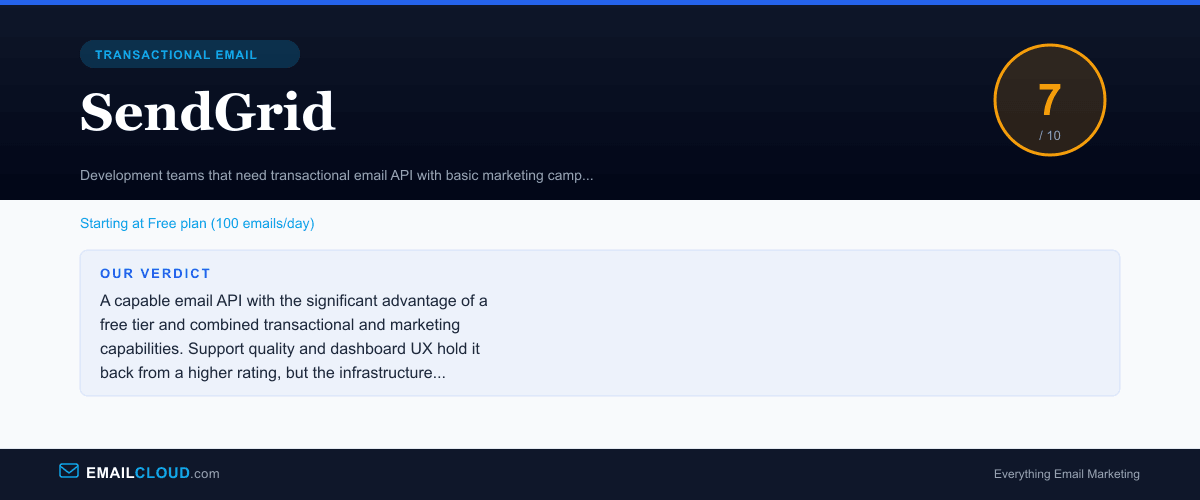
A capable email API with the significant advantage of a free tier and combined transactional and marketing capabilities. Support quality and dashboard UX hold it back from a higher rating, but the infrastructure is sound.
Review Summary
Share this visual summary. Right-click to save.
Frequently Asked Questions
Is SendGrid free?
Yes. SendGrid offers a free plan that includes 100 emails per day (about 3,000/month), a single sender identity, dynamic template editor, and basic analytics. The free plan is permanent — not a trial. For small applications and testing, it is enough. The free plan does not include dedicated IP, advanced analytics, or phone support.
Is SendGrid good for transactional email?
Yes, SendGrid is one of the most widely used transactional email services. The API is well-documented, the infrastructure is battle-tested at massive scale, and the free plan makes it accessible for startups. The main concerns are support quality (which has declined) and the need for active deliverability management. For mission-critical transactional email where speed is paramount, Postmark is the better specialist.
How does SendGrid compare to Mailgun?
SendGrid has a free tier and better marketing email features. Mailgun has better API documentation, stronger log search, and superior email validation tools. For transactional email only, both are solid — Mailgun edges ahead on developer experience, SendGrid wins on free tier access and combined transactional plus marketing capabilities.
Did Twilio buying SendGrid change anything?
The Twilio acquisition in 2019 brought SendGrid into a larger communications platform alongside voice, SMS, and video. The product itself has remained largely stable, but many users report that support quality has declined and product development has slowed. The pricing structure has also become more complex. The infrastructure remains reliable, but the customer experience has been a growing concern.