Moosend Review: Affordable Automation That Quietly Delivers
Pros
- One of the cheapest paid plans in the industry at $9/mo starting
- Automation workflows rival platforms costing three to four times as much
- Clean, modern interface that avoids unnecessary complexity
- Built-in landing pages and subscription forms on all plans
- Solid deliverability with dedicated IP option at higher volumes
Cons
- No permanent free plan — only a 30-day trial
- Template library is smaller than major competitors
- Fewer native integrations than Mailchimp or ActiveCampaign
- Owned by Sitecore since 2021 — future direction is uncertain
The Quick Verdict
Moosend is the email marketing platform that nobody talks about but probably should. While the industry debates Mailchimp versus MailerLite versus ActiveCampaign, Moosend quietly offers automation capabilities that rival mid-tier platforms at a price that undercuts nearly everyone. At $9/mo for 500 subscribers, it costs less than a streaming subscription. The trade-off is a smaller template library, fewer integrations, and some uncertainty about long-term direction under Sitecore’s ownership. But for the core job of sending emails and automating workflows, Moosend punches well above its weight class.
What Moosend Does Well
Automation That Competes With Platforms Three Times the Price
Moosend’s automation builder is the feature that consistently surprises us. The visual workflow builder supports triggers based on subscriber actions (joins list, opens email, clicks link), date-based conditions, custom field changes, and ecommerce events. You can build multi-step sequences with conditional branching, A/B split paths, time delays, and action steps including sending emails, updating subscriber fields, adding tags, and moving contacts between lists.
What makes this notable is the price. At $9/mo, you get automation capabilities that MailerLite restricts to paid plans and that approach the sophistication of ActiveCampaign’s Lite tier at $29/mo. Welcome sequences, lead nurturing flows, re-engagement campaigns, and behavioral triggers are all straightforward to set up.
The pre-built automation templates, called “recipes,” cover common scenarios including welcome series, cart abandonment, upsells based on purchase history, and anniversary reminders. These recipes provide working starting points that you can customize, which reduces setup time significantly for businesses new to automation.
Pricing That Barely Registers
Moosend’s Pro plan starts at $9/mo for up to 500 subscribers and scales reasonably:
- 500 subscribers: $9/mo
- 1,000 subscribers: $16/mo
- 2,500 subscribers: $24/mo
- 5,000 subscribers: $42/mo
- 10,000 subscribers: $64/mo
- 25,000 subscribers: $147/mo
- 50,000 subscribers: $270/mo
At every tier, Moosend is cheaper than Mailchimp’s Standard plan and comparable to MailerLite’s Growing Business plan. The difference is that Moosend includes more automation sophistication at these prices. Unlimited emails are included on all plans.
The Enterprise plan (custom pricing, typically 10,000+ subscribers) adds dedicated IP, migration assistance, a dedicated account manager, SSO, and priority support. For businesses between 10,000 and 50,000 subscribers who need some enterprise features, the Enterprise plan is worth inquiring about as the custom pricing can be competitive.
Clean Interface
Moosend’s dashboard is organized and intuitive. The main navigation is clear — Campaigns, Automations, Lists, Landing Pages, Forms — and each section works as expected without hidden menus or confusing terminology. The email editor uses a modern drag-and-drop approach with content blocks for text, images, buttons, dividers, countdown timers, videos, and product recommendations.
Setting up a campaign follows a logical sequence: choose the list, design the email, set the subject line, preview, and send. There are no unnecessary steps or confusing options. For users migrating from free tools or spreadsheet-based email sending, the learning curve is gentle.
Landing Pages and Forms
All Moosend plans include a landing page builder and customizable subscription forms. The landing page templates are adequate — not as polished as Flodesk’s designs, but functional and mobile-responsive. You can build opt-in pages, coming soon pages, and product showcase pages with the drag-and-drop editor.
Subscription forms include pop-ups, inline forms, floating bars, and full-page takeovers. Targeting options allow you to display forms based on exit intent, time on page, scroll percentage, and page URL. These are features that some competitors charge extra for or restrict to higher-tier plans.
Where Moosend Falls Short
No Permanent Free Plan
The 30-day free trial gives full access to all features, but once it expires, you must upgrade to a paid plan. This is a meaningful disadvantage in a market where MailerLite, Sender, and Mailchimp all offer permanent free tiers. For businesses just starting with email marketing and unsure about their commitment, the lack of a free plan creates unnecessary friction.
That said, at $9/mo, the barrier is minimal. The question is less about affordability and more about psychology — a free plan lets you experiment indefinitely, while a trial creates a deadline that forces a decision before you may be ready.
Smaller Template Library
Moosend offers approximately 80 email templates organized by category (ecommerce, SaaS, agencies, nonprofits, holidays). The designs are clean and professional, but the selection is noticeably smaller than Mailchimp’s 100+ templates or ActiveCampaign’s library. For businesses that rely heavily on pre-designed templates rather than building from scratch, the limited selection may feel constraining.
The landing page template library is similarly modest. You will likely find a workable starting point for most use cases, but do not expect the breadth of options you would find on dedicated landing page platforms.
Fewer Integrations
Moosend integrates natively with major platforms including Shopify, WooCommerce, WordPress, Salesforce, and Zapier. But the total integration count is lower than larger competitors. If your tech stack relies on niche tools — specific CRMs, project management platforms, or industry-specific software — check Moosend’s integration list before committing.
The Zapier integration covers many gaps, but direct native integrations are always more reliable and feature-rich than Zapier connections. For businesses with complex tech stacks, this limitation matters.
Pricing Breakdown
Moosend offers two plans:
- Pro ($9/mo starting): Unlimited emails, automation workflows, landing pages, subscription forms, transactional emails (SMTP server), phone support, 5 team members
- Enterprise (custom pricing): Everything in Pro plus dedicated IP, SSO, SAML, account manager, custom reporting, priority support, migration service
The Pro plan includes all core features with no feature gating. There is no mid-tier “Standard” or “Advanced” plan creating artificial limitations — you either use Pro or you need enterprise-level services. This simplicity is refreshing in an industry that loves to create seven-tier pricing pages.
Annual billing saves approximately 20% compared to monthly.
Who Should Use Moosend
Moosend fits best for:
- Small businesses on tight budgets who need automation capabilities beyond what free plans offer, but cannot justify $29-49/mo for ActiveCampaign or GetResponse
- Marketing teams comfortable with self-service who do not need extensive hand-holding and prefer a clean, straightforward interface
- Growing companies between 1,000 and 25,000 subscribers where Moosend’s pricing advantage is most pronounced relative to competitors
Who Should Look Elsewhere
Businesses that need a permanent free plan should look at MailerLite or Sender. The 30-day trial is generous, but if your budget is genuinely zero, other options exist.
Companies requiring deep ecommerce integration should evaluate Klaviyo or Omnisend instead. Moosend’s ecommerce features are functional but do not approach the depth of purpose-built ecommerce email platforms.
The Bottom Line
Moosend is the email marketing platform equivalent of a well-reviewed sedan — it does not turn heads, but it gets you where you need to go reliably and affordably. The automation capabilities genuinely exceed what the price would suggest, the interface is clean, and the feature set covers the needs of most small to mid-size businesses. The Sitecore acquisition introduces some long-term uncertainty, but as of 2026, the platform remains well-maintained and competitively priced. If you are spending $30-50/mo on a platform and not using its advanced features, Moosend deserves a serious look at $9.
Our Verdict
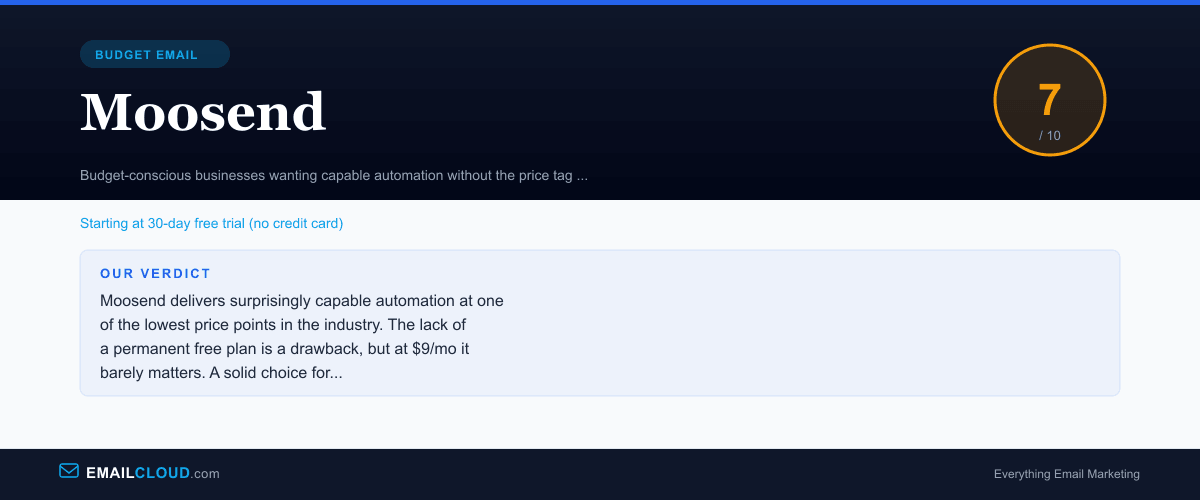
Moosend delivers surprisingly capable automation at one of the lowest price points in the industry. The lack of a permanent free plan is a drawback, but at $9/mo it barely matters. A solid choice for budget-conscious businesses who have outgrown free tools and want real automation without the complexity or cost of enterprise platforms.
Review Summary
Share this visual summary. Right-click to save.
Frequently Asked Questions
Does Moosend have a free plan?
Moosend offers a 30-day free trial with full access to all features, but there is no permanent free plan. After the trial ends, the cheapest option is the Pro plan starting at $9/mo for up to 500 subscribers. If you need a permanent free plan, look at MailerLite (1,000 subscribers free) or Sender (2,500 subscribers free).
Is Moosend good for ecommerce?
Moosend has basic ecommerce features including product recommendation blocks, cart abandonment emails, and integrations with Shopify and WooCommerce. However, it is not purpose-built for ecommerce the way Klaviyo or Omnisend are. For simple ecommerce email needs on a budget it works fine, but stores wanting deep product integration and behavioral segmentation should consider dedicated ecommerce platforms.
Who owns Moosend now?
Moosend was acquired by Sitecore in 2021. Sitecore is an enterprise digital experience platform company. The acquisition raised questions about whether Moosend would shift toward enterprise pricing, but as of 2026 the platform has maintained its affordable positioning. The Sitecore backing has improved infrastructure reliability, though some users report slower feature development since the acquisition.