Iterable Review: Cross-Channel Marketing for Growth Teams
Pros
- Modern, intuitive interface that enterprise teams can actually learn quickly
- Workflow Studio is powerful and significantly easier than Salesforce Journey Builder
- Flexible data model handles events, user profiles, and catalogs without rigid schemas
- Strong cross-channel capabilities — email, push, SMS, in-app, web push
- Excellent API and developer documentation for custom integrations
Cons
- Enterprise pricing puts it out of reach for most SMBs
- Smaller ecosystem than Salesforce or HubSpot — fewer consultants and partners
- Email template builder is adequate but not best-in-class
- Reporting customization requires technical knowledge
- Less mature CRM capabilities than Salesforce-based alternatives
What is Iterable?
Iterable is a cross-channel marketing automation platform built for the generation of growth teams that grew up on modern SaaS tools and refuse to accept the complexity of legacy enterprise marketing software. Founded in 2013 by Andrew Boni and Justin Zhu, Iterable was created with a specific thesis: enterprise marketing automation does not need to be painful. The platforms available at the time — Salesforce Marketing Cloud, Oracle Responsys, Adobe Campaign — were powerful but required months of implementation, specialized consultants, and interfaces that seemed designed to punish their users.
Iterable took a different approach. Modern API-first architecture. A flexible data model that does not require weeks of schema planning. An interface that marketing teams can learn in days, not months. And cross-channel capabilities — email, push notifications, SMS, in-app messaging, web push — orchestrated through a single, visual workflow builder.
The platform has gained traction among growth-stage technology companies, DTC brands, delivery services, and digital media companies. Customers include DoorDash, Priceline, and Zillow — companies with millions of users and complex engagement requirements that outgrew SMB tools but did not want the overhead of traditional enterprise platforms.
We have evaluated Iterable for companies migrating from SMB platforms (like ActiveCampaign and Brevo) that hit scaling limits, and for enterprises evaluating alternatives to Salesforce Marketing Cloud. This review covers the platform’s architecture, workflow capabilities, cross-channel features, and the honest question of whether enterprise pricing is justified.
Pricing Breakdown
Iterable does not publish pricing. The platform uses custom, quote-based pricing that factors in:
- Number of user profiles (contacts)
- Monthly message volume across all channels
- Channels activated (email, push, SMS, in-app)
- Feature tier and support level
- Contract length (annual commitments are standard)
Based on market experience, approximate pricing ranges:
- Growth-stage companies (100K-500K profiles, email + 1-2 channels): $1,000-3,000/mo
- Mid-market (500K-2M profiles, multi-channel): $3,000-8,000/mo
- Enterprise (2M+ profiles, full channel suite, dedicated support): $8,000-20,000+/mo
Implementation costs are lower than Salesforce Marketing Cloud — Iterable provides onboarding support included in the subscription, and most implementations do not require third-party consultants. Budget $5,000-15,000 for professional services on complex implementations.
Compared to Salesforce Marketing Cloud: Iterable is typically 30-50% less expensive at comparable scale and significantly cheaper to implement. Compared to HubSpot Marketing Hub Enterprise ($3,600/mo): Iterable is more expensive but offers deeper cross-channel capabilities and a more flexible data model.
Key Features We Tested
Workflow Studio
Iterable’s Workflow Studio is the platform’s automation builder, and it strikes an impressive balance between power and usability. The visual canvas presents marketing workflows as flowcharts with drag-and-drop nodes for triggers, actions, delays, decisions, and channel sends.
Triggers include API events (purchase, signup, page view), time-based conditions, segment membership changes, and custom events. Decision nodes split paths based on user attributes, event data, engagement history, channel preference, or any custom data point. Action nodes send messages across channels, update user profiles, trigger webhooks, or branch to other workflows.
What distinguishes Workflow Studio from Salesforce Journey Builder is not capability — both can build complex multi-step, multi-channel journeys. The difference is in the experience. Workflow Studio feels like a modern software tool. Nodes are easy to add, move, and configure. The canvas is responsive. Testing and previewing works without leaving the builder. A competent marketer can build a meaningful workflow in their first session.
We built a cross-channel onboarding journey in Workflow Studio that included email welcome series, push notification engagement prompts, in-app messages for feature discovery, and SMS re-engagement — with conditional branching based on user behavior at each step. Total build time was about 3 hours. The equivalent build in Salesforce Marketing Cloud would have taken 2-3 days with consultant support.
Flexible Data Model
Iterable’s data architecture uses three core concepts: Users (profiles with attributes), Events (actions with metadata), and Catalogs (structured content like products). All three accept arbitrary data — no predefined schema, no data extension configuration, no field mapping exercises.
When your application sends Iterable an event with a new field, the platform accepts it and makes it immediately available for segmentation, personalization, and workflow decisions. This flexibility dramatically reduces implementation time. On traditional enterprise platforms, adding a new data point requires schema updates, field mapping, data extension modification, and testing. On Iterable, you send the data and start using it.
Catalog data enables content personalization at scale. Upload your product catalog, and Iterable can dynamically insert personalized product recommendations into email, push, and in-app messages based on each user’s browse history, purchase behavior, or predicted interests.
Cross-Channel Messaging
Iterable supports five messaging channels from a single platform:
- Email: Full email marketing with template builder, dynamic content, A/B testing, and send-time optimization
- Push notifications: iOS and Android push with rich media, deep links, and action buttons
- SMS/MMS: Text messaging with template management and compliance features
- In-app messaging: Native mobile in-app messages with targeting and scheduling
- Web push: Browser push notifications for web users
All channels share the same user profile, event history, and segmentation engine. A segment defined in Iterable can be targeted across any channel. Workflow Studio orchestrates channel selection within journeys — send email first, if unopened send push, if no app engagement send SMS.
Channel optimization features analyze individual user behavior and automatically select the channel most likely to generate engagement for each person. A user who consistently opens push notifications but ignores email will receive push-first messaging without manual channel assignment.
Experimentation
Iterable includes robust experimentation tools. A/B testing works across subject lines, email content, send times, channel selection, and entire workflow branches. Experiments can optimize for opens, clicks, conversions, or custom goals.
Holdout groups let you measure the incremental impact of marketing campaigns by withholding a percentage of users and comparing their behavior to the treated group. This is essential for understanding whether your marketing actually drives behavior change or simply captures intent that already existed.
The experimentation framework applies across channels, meaning you can test whether email or push is more effective for a specific audience segment, with statistical significance calculated automatically.
API and Integrations
Iterable’s API is modern, well-documented, and designed for real-time data flow. REST endpoints cover user management, event tracking, campaign triggering, and data export. Webhooks provide real-time event callbacks for integration with downstream systems.
Native integrations exist for major data platforms (Segment, mParticle, Snowflake, BigQuery), analytics tools (Amplitude, Mixpanel), and ecommerce platforms (Shopify, custom implementations). The integration ecosystem is smaller than Salesforce’s but covers the tools that modern growth teams actually use.
Who Should Use Iterable?
Iterable is built for a specific stage and type of company:
- Growth-stage technology companies (Series B+) that have outgrown ActiveCampaign or Brevo and need cross-channel capabilities
- DTC and ecommerce brands with mobile apps that need coordinated email, push, and in-app messaging
- Companies migrating from Salesforce Marketing Cloud that want similar capabilities with modern UX and lower costs
- Data-driven marketing teams with engineering support for integration and custom event tracking
- Organizations with 100K+ customer profiles that need enterprise-grade automation without enterprise-grade complexity
Who Should Look Elsewhere?
Small businesses and startups should use purpose-built SMB tools. ActiveCampaign, Kit, or GetResponse provide excellent email marketing and automation at 5-10% of Iterable’s cost. You will not need Iterable’s cross-channel capabilities until your customer base and marketing sophistication demand them.
Companies that need deep CRM integration should evaluate whether Iterable’s native capabilities are sufficient or whether Salesforce Marketing Cloud’s direct CRM connection is essential. Iterable integrates with CRMs but does not include a CRM — if Salesforce is your system of record and CRM data is central to your marketing, the native Salesforce integration in Marketing Cloud may be worth the complexity.
Email-only operations that do not use push notifications, SMS, or in-app messaging are paying for channels they will not use. Dedicated email platforms like ActiveCampaign or Postmark serve email-only needs better and cheaper.
Non-technical marketing teams without engineering support for integration may struggle with Iterable’s API-first approach. The platform is designed for teams where marketing and engineering collaborate — if your marketing team operates independently of engineering, HubSpot’s more self-service approach may be a better fit.
Deliverability
Iterable’s email deliverability is strong, supported by dedicated sending infrastructure, automated IP warmup, and deliverability monitoring tools. The platform provides domain authentication setup (SPF, DKIM, DMARC), reputation tracking, and ISP-level analytics.
Send-time optimization analyzes individual user engagement patterns and delivers email at the time each recipient is most likely to engage. This feature improves open rates and reduces spam complaints by avoiding sends during times when users consistently ignore email.
The Bottom Line
Iterable represents what enterprise marketing automation should feel like in 2026. The platform matches or exceeds Salesforce Marketing Cloud’s cross-channel capabilities while providing a dramatically better user experience, faster implementation, and lower total cost of ownership. Workflow Studio is powerful without being punishing. The data model is flexible without being chaotic. The cross-channel orchestration is sophisticated without being incomprehensible.
The enterprise pricing limits the audience, and the smaller ecosystem means less third-party support than Salesforce. But for growth teams that need cross-channel automation and refuse to accept the implementation pain of legacy platforms, Iterable is the strongest option in the market. It earns a 7.5 — powerful, modern, and genuinely pleasant to use at enterprise scale.
Our Verdict
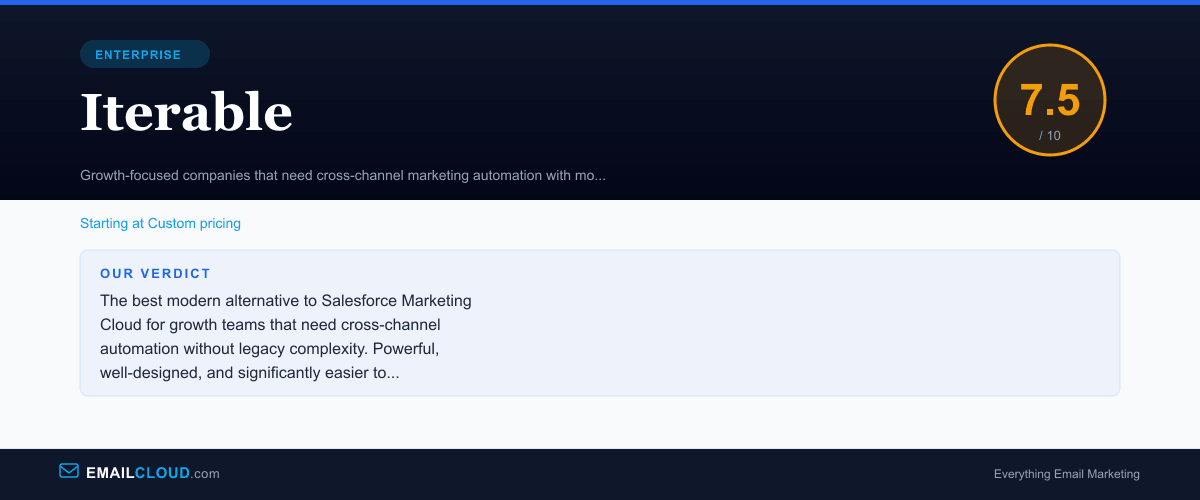
The best modern alternative to Salesforce Marketing Cloud for growth teams that need cross-channel automation without legacy complexity. Powerful, well-designed, and significantly easier to implement than traditional enterprise platforms.
Review Summary
Share this visual summary. Right-click to save.
Frequently Asked Questions
How much does Iterable cost?
Iterable uses custom, quote-based pricing. Published pricing is not available. Based on market data, most implementations start around $1,000-2,000/mo for growth-stage companies and scale to $5,000-15,000+/mo for larger enterprises depending on contact volume, channels used, and feature requirements. Iterable positions itself as more affordable than Salesforce Marketing Cloud while offering comparable cross-channel capabilities.
How does Iterable compare to Salesforce Marketing Cloud?
Iterable is the modern alternative to Marketing Cloud for companies that need cross-channel capabilities without the complexity and cost of the Salesforce ecosystem. Iterable's interface is dramatically more intuitive, implementation is faster (weeks vs months), and the data model is more flexible. Marketing Cloud has deeper CRM integration (if you use Salesforce) and a larger partner ecosystem. For companies not locked into Salesforce, Iterable is often the better choice.
Is Iterable good for ecommerce?
Yes. Iterable handles ecommerce use cases well — catalog-driven recommendations, browse and cart abandonment sequences, post-purchase flows, and lifecycle campaigns across email, push, and SMS. The flexible data model ingests product catalogs and purchase events without rigid schemas. For Shopify-specific needs, Klaviyo is more specialized, but for cross-channel ecommerce marketing at scale, Iterable is strong.
How long does it take to implement Iterable?
Typical implementations take 4-8 weeks, which is significantly faster than Salesforce Marketing Cloud (3-6 months). Iterable provides dedicated onboarding support, and the platform's modern architecture means less custom configuration is needed. Companies with complex data integrations or multi-region deployments may take longer, but the implementation experience is generally smoother than legacy enterprise platforms.