EmailOctopus Review: Simple, Cheap, and Surprisingly Effective
Pros
- Generous free plan with 2,500 subscribers and 10,000 monthly emails
- Extremely simple interface — zero learning curve
- Amazon SES integration option for advanced users wanting sub-penny sending costs
- Paid plans are among the cheapest in the industry
- Clean, no-nonsense approach to email without feature bloat
Cons
- Very limited automation — basic sequences only
- No A/B testing on the free plan
- Minimal template selection compared to competitors
- Reporting is bare-bones — no click maps or engagement scoring
The Quick Verdict
EmailOctopus is the email marketing platform for people who think email marketing platforms are too complicated. It does a few things — collect subscribers, design emails, send campaigns, run basic automations — and it does them without the feature sprawl that makes bigger platforms overwhelming. The free plan is generous (2,500 subscribers, 10,000 emails/mo), the paid plans are among the cheapest available, and the Amazon SES integration option gives technically savvy users access to some of the lowest sending costs in the industry. The trade-off is obvious: limited automation, basic reporting, and a template library that fits in one scroll.
What EmailOctopus Does Well
Simplicity as a Core Feature
EmailOctopus was founded in 2014 with a clear philosophy: email marketing should not require a degree in software. The platform reflects that philosophy at every level. The dashboard shows your lists, your campaigns, and your automations. The navigation has five items. The settings page fits on one screen.
This is not simplicity born of laziness — it is a deliberate design choice. Where Mailchimp has evolved into a sprawling marketing platform with CRM features, audience insights, social posting, website building, and analytics dashboards, EmailOctopus has stayed focused on the core email workflow. For users who just want to build a list and send newsletters, that focus is a feature, not a limitation.
The email editor follows the same principle. Drag-and-drop blocks cover text, images, buttons, dividers, and social links. Templates are clean and minimal. The preview tool shows desktop and mobile rendering. You design an email, choose your audience, write a subject line, and hit send. The entire process takes minutes, not hours.
Free Plan Generosity
EmailOctopus’s free plan provides:
- 2,500 subscribers — matching Sender and exceeding Mailchimp and MailerLite
- 10,000 emails per month — four emails per subscriber per month
- Basic automation sequences — time-based drip sequences
- Landing pages and forms — basic opt-in capture tools
- EmailOctopus branding on sent emails
The free plan is genuinely usable for small newsletters, personal blogs, community groups, and early-stage businesses. The subscriber limit is generous enough that most creators will not outgrow it quickly, and the monthly email limit supports regular weekly sending for lists under 2,500.
Amazon SES Integration for Power Users
EmailOctopus originally launched as a front end for Amazon SES, and that integration remains available for users who want it. Amazon SES charges approximately $0.10 per 1,000 emails — meaning a 10,000-email campaign costs about $1. For high-volume senders, this pricing is an order of magnitude cheaper than any traditional email marketing platform.
Setting up the SES integration requires an AWS account, SES domain verification, and API credential configuration. It is not difficult for technically comfortable users, but it is a process that would intimidate true beginners. The reward is sending costs that make even Sender and MailerLite look expensive by comparison.
For newsletters and content publishers sending to large lists on tight margins — particularly media companies, independent publishers, and community organizations — the SES integration creates a cost structure that is hard to match anywhere else.
Affordable Paid Plans
When you outgrow the free plan or want to remove branding, EmailOctopus’s paid pricing is competitive:
- 2,500 subscribers: $9/mo
- 5,000 subscribers: $18/mo
- 10,000 subscribers: $30/mo
- 25,000 subscribers: $65/mo
- 50,000 subscribers: $115/mo
- 100,000 subscribers: $210/mo
These prices include unlimited emails on all paid plans. At 50,000 subscribers, EmailOctopus at $115/mo undercuts MailerLite ($239/mo) and Mailchimp ($270/mo) significantly. The pricing advantage grows with scale, making EmailOctopus one of the most cost-effective options for large-list publishers.
Paid plans add priority support, removal of EmailOctopus branding, and access to premium features as they are released.
Where EmailOctopus Falls Short
Automation Is Minimal
EmailOctopus’s automation is limited to time-based drip sequences. You can create an automation that sends email one immediately upon signup, email two after three days, email three after seven days, and so on. That covers welcome sequences and basic onboarding flows.
What you cannot do is build conditional workflows based on subscriber behavior. There are no “if subscriber clicked link X, send email Y” branches. No tag-based triggers. No purchase-based automation. No lead scoring. If your marketing strategy depends on behavioral automation — and increasingly, effective email marketing does — EmailOctopus’s automation will not satisfy you.
This is the platform’s most significant limitation. Automation is what separates email marketing from email broadcasting, and EmailOctopus’s offering keeps it firmly in the broadcasting category with only the most basic automation on top.
Reporting Stays Basic
Campaign reports show opens, clicks, bounces, and unsubscribes. You can see which links received clicks and which subscribers engaged. That is essentially the full extent of the reporting.
There are no click maps, no engagement-over-time visualizations, no subscriber-level engagement scores, no comparative analytics across campaigns, and no revenue attribution. For content newsletters where open rates and click rates are your primary metrics, the reporting is adequate. For businesses trying to optimize conversion funnels or measure email’s contribution to revenue, the data is insufficient.
Template Library Is Small
EmailOctopus offers a modest collection of email templates — around 30 to 40 designs across categories. They are clean and functional, but the selection is a fraction of what Mailchimp, MailerLite, or even Moosend offer. If you enjoy browsing templates for design inspiration or need industry-specific layouts, the options are limiting.
The plain-text-style templates and simple layouts work well for content newsletters where the focus is on writing rather than visual design. But brand-conscious businesses wanting polished, design-forward emails will find the template selection frustrating.
Pricing Breakdown
EmailOctopus keeps pricing simple:
- Free: 2,500 subscribers, 10,000 emails/mo, EmailOctopus branding, basic automation, landing pages
- Pro ($9/mo starting): Unlimited emails, priority support, no branding, all features
If using Amazon SES, sending costs are separate — roughly $0.10 per 1,000 emails through AWS, plus any EmailOctopus subscription fees.
Annual billing is available at a discount.
Who Should Use EmailOctopus
EmailOctopus is the right fit for:
- Newsletter creators and bloggers who value simplicity and just want to write, design, and send without complexity — the platform stays out of your way
- Budget-constrained organizations with large subscriber lists where per-subscriber pricing on other platforms becomes prohibitive
- Technically savvy senders who want to use Amazon SES for ultra-low-cost email delivery but need a user-friendly front end for campaign management
Who Should Look Elsewhere
If automation is important to your email strategy — and for most businesses it should be — EmailOctopus is not the right platform. MailerLite offers significantly more automation at a comparable price point. ActiveCampaign delivers enterprise-grade workflows for a reasonable premium.
Ecommerce businesses should skip EmailOctopus entirely. There are no meaningful ecommerce integrations, no product recommendation blocks, and no purchase-based automation. Omnisend or Klaviyo are purpose-built for those needs.
The Bottom Line
EmailOctopus is honest about what it is: a simple, affordable email marketing tool for people who value simplicity. It does not try to be a marketing automation platform, a CRM, a website builder, or an analytics suite. It collects subscribers, helps you design emails, sends them reliably, and charges very little for the privilege. For newsletter creators and small publishers, that is exactly enough. For businesses with growth ambitions and complex marketing needs, it is not — but EmailOctopus does not pretend otherwise, and we respect that clarity.
Our Verdict
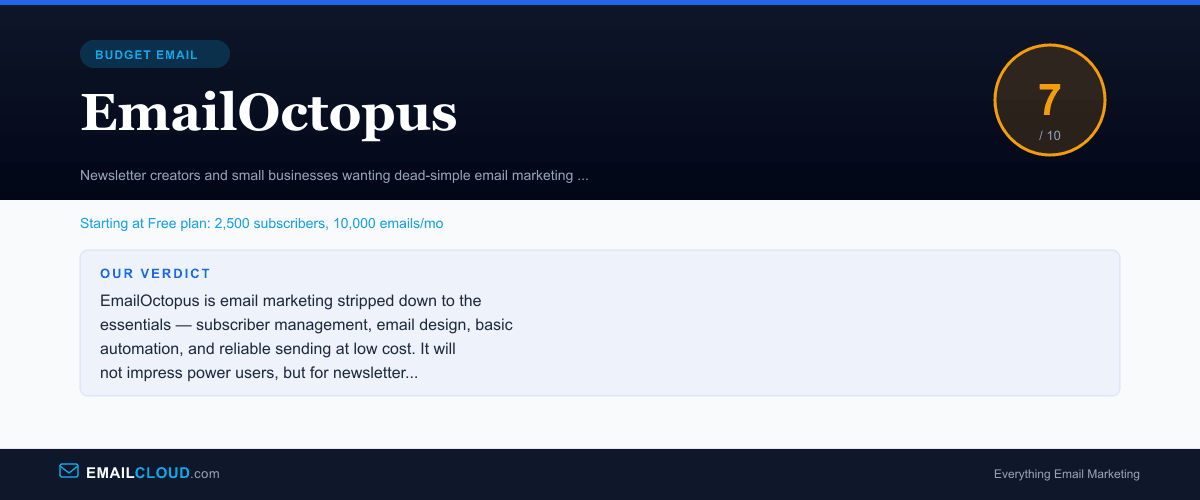
EmailOctopus is email marketing stripped down to the essentials — subscriber management, email design, basic automation, and reliable sending at low cost. It will not impress power users, but for newsletter creators and small businesses who want simplicity above all, it is a refreshingly uncomplicated choice.
Review Summary
Share this visual summary. Right-click to save.
Frequently Asked Questions
What is the difference between EmailOctopus and Amazon SES?
EmailOctopus is a front-end email marketing platform — it provides the interface, templates, subscriber management, and automation. Amazon SES (Simple Email Service) is an email delivery infrastructure. Previously, EmailOctopus exclusively used Amazon SES for sending, requiring users to set up their own AWS account. Now EmailOctopus offers its own sending infrastructure as the default, with Amazon SES as an optional integration for advanced users who want lower per-email costs and more control over deliverability.
Is EmailOctopus good for beginners?
EmailOctopus is excellent for beginners specifically because of its simplicity. The interface is deliberately stripped down — there are fewer options, fewer menus, and less complexity than any major competitor. If you want to collect subscribers and send them emails without spending hours learning a platform, EmailOctopus is one of the fastest paths from signup to first email sent.
How does EmailOctopus compare to MailerLite?
MailerLite is a more feature-rich platform with better automation, more templates, a website builder, and stronger segmentation. EmailOctopus is simpler and slightly cheaper. If you want the most features for your money, MailerLite wins. If you want the simplest possible tool and plan to use Amazon SES for ultra-cheap sending, EmailOctopus has a niche advantage.