Cisco Secure Email Review: Enterprise Security for the Cisco Ecosystem

Pros
- Talos threat intelligence is world-class with unmatched global visibility
- Excellent choice for organizations already using Cisco security products
- Flexible deployment — cloud, on-premise, or hybrid configurations
- Advanced Malware Protection (AMP) provides continuous file analysis and retrospective alerting
Cons
- Complex to deploy and manage — requires experienced Cisco administrators
- Expensive, especially for organizations not already in the Cisco ecosystem
- The platform feels fragmented across multiple product names and management consoles
What Is Cisco Secure Email?
Cisco Secure Email — formerly known as Cisco Email Security Appliance (ESA), and before that, IronPort — is Cisco’s enterprise email security platform. It protects against spam, phishing, business email compromise, malware, and data loss through a combination of multi-layered filtering, Talos threat intelligence, Advanced Malware Protection (AMP), and content policies.
The product’s lineage traces back to IronPort, which Cisco acquired in 2007 for $830 million. IronPort was already a respected name in email security, and Cisco enhanced it with their massive threat intelligence operation (Talos) and integrated it into their broader security portfolio. The result is a platform that is technically capable but carrying the weight of nearly two decades of product evolution, rebranding, and architectural additions.
We have evaluated Cisco Secure Email in several enterprise environments, primarily in organizations that were already running Cisco infrastructure. This review reflects what we found — including where the product excels and where its complexity works against it.
Deployment Options
Cisco Secure Email offers more deployment flexibility than most competitors, which is both a strength and a source of complexity:
Cloud Gateway (Cisco Secure Email Cloud Gateway) is the hosted version. Email flows through Cisco’s cloud infrastructure for filtering before delivery to your environment. This is the simplest deployment path and the one Cisco is pushing most aggressively.
On-Premise Appliance is the traditional IronPort heritage — purpose-built hardware or virtual appliances that sit in your data center. Cisco offers multiple appliance models (C195, C395, C695) for different organizational sizes. On-premise deployments give you maximum control but require more infrastructure and administration.
Hybrid combines cloud gateway with on-premise appliances, allowing organizations to route different traffic through different paths. This is common in organizations transitioning from on-premise to cloud or those with specific data residency requirements.
Cloud Mailbox (Cisco Secure Email Cloud Mailbox) is the newer API-based option that integrates directly with Microsoft 365 or Google Workspace. No MX record changes required. It scans email after delivery and can remediate threats found in mailboxes.
The variety of deployment options is useful for large enterprises with complex requirements, but it also means the product lacks a single, clear deployment path. Different deployment models have different feature sets, different management consoles, and different limitations. Make sure you understand exactly which deployment model aligns with your requirements before committing.
Key Features We Tested
Talos Threat Intelligence
Talos is Cisco’s global threat intelligence organization and the single most compelling reason to consider Cisco Secure Email. With visibility into approximately 1.5% of all global internet traffic (through Cisco’s networking infrastructure), Talos sees threats at a scale that few organizations can match.
Talos provides threat intelligence across multiple dimensions:
- IP reputation scoring based on real-time monitoring of global email and web traffic
- Domain intelligence that identifies newly registered and suspicious domains before they are widely used in attacks
- File reputation through AMP’s massive file hash database
- URL intelligence with real-time analysis of web destinations
- Outbreak intelligence that detects coordinated spam and phishing campaigns as they launch
The practical impact is that Cisco Secure Email often blocks emerging threats faster than competitors because Talos sees attack infrastructure (compromised servers, malicious domains, command-and-control hosts) through Cisco’s network visibility before the attacks reach email channels.
In our testing, Talos-powered detection caught several phishing campaigns in their early stages — within the first hour of launch — while other platforms did not flag them for several hours until their own threat feeds updated. This lead time is Talos’s tangible advantage.
Advanced Malware Protection (AMP)
AMP is Cisco’s file analysis and malware detection technology, integrated directly into Cisco Secure Email. What distinguishes AMP from basic antivirus scanning is its continuous analysis model.
When an email attachment passes through Cisco Secure Email, AMP calculates a file hash and checks it against the global AMP database. Known malicious files are blocked instantly. Unknown files can be sent to Cisco’s Threat Grid sandbox for behavioral analysis, which monitors the file’s actions in an isolated environment across multiple OS versions.
The unique aspect of AMP is retrospective security. If a file is allowed through initial analysis but is later determined to be malicious (based on new intelligence from the global AMP network), Cisco Secure Email generates a retrospective alert. Administrators can then search for and remediate the threat in affected mailboxes. This continuous analysis means that the security verdict on any file can be updated at any time, closing the window between initial delivery and threat identification.
In practice, we saw AMP reclassify several files that initially appeared clean. The retrospective alerts arrived within hours of the global AMP database being updated, giving security teams actionable intelligence to remove threats that had already been delivered.
Outbreak Filters
Outbreak Filters are Cisco’s zero-day threat protection technology, and they use an approach that differs from traditional sandboxing. Instead of analyzing individual files, Outbreak Filters look for patterns in global email traffic that indicate a new attack campaign is launching — sudden spikes in messages with specific characteristics, unusual attachment types, or coordinated sends from distributed infrastructure.
When Outbreak Filters detect a potential new threat campaign, matching emails are quarantined preemptively while deeper analysis completes. This pattern-based approach can catch threats that signature-based and even sandbox-based detection miss, because it identifies the attack campaign rather than the individual malicious payload.
The trade-off is that Outbreak Filters can occasionally quarantine legitimate emails during high-volume, legitimate campaign sends (product launch announcements, event invitations) that trigger pattern-matching heuristics. Tuning the sensitivity requires ongoing attention.
Content Filtering and DLP
Cisco Secure Email includes a comprehensive content filtering engine for both inbound and outbound email. Administrators can create rules based on:
- Message content (keywords, regular expressions)
- Attachment types, sizes, and content
- Sender and recipient attributes
- Message headers and metadata
- DLP dictionaries (PII, financial data, healthcare identifiers)
The DLP capabilities are more granular than most competing email security gateways, with pre-built dictionaries for common regulatory frameworks (HIPAA, PCI-DSS, GDPR). Outbound DLP rules can encrypt, quarantine, redirect, or block messages containing sensitive data.
For organizations with complex content policies — financial services firms, government agencies, healthcare providers — the depth of the content filtering engine is a genuine advantage. For simpler environments, the complexity may be unnecessary.
Encryption
Cisco Secure Email includes built-in email encryption for outbound messages. Encryption can be triggered manually by users (via a subject line flag or Outlook button) or automatically by DLP policies. Encrypted messages are delivered via a secure envelope — recipients click a link to access the encrypted content through a web portal.
The encryption implementation is functional but not the most user-friendly experience for recipients. Competing products like Barracuda and Virtru offer smoother recipient experiences. However, for organizations that need encryption capability without deploying a separate product, having it built into the email gateway is convenient.
Pricing Breakdown
Cisco Secure Email pricing is not publicly available. Everything is custom quoted through Cisco sales or a Cisco partner. Based on our experience:
- Cloud Gateway: Approximately $4-6 per user per month on a subscription basis
- On-Premise Appliance: Hardware purchase ($5,000-$50,000+ depending on model) plus annual SmartNet support and license subscription
- Cloud Mailbox (API-based): Approximately $3-5 per user per month
- AMP for Email (advanced malware): Often included in premium bundles, sometimes an add-on
- Enterprise agreements: Organizations with existing Cisco EAs can often add Secure Email at favorable terms
Perpetual license options exist for on-premise deployments but are being phased out in favor of subscription models. Cisco’s enterprise agreement (EA) licensing bundles Secure Email with other Cisco security products (Umbrella, Secure Endpoint, SecureX) and often represents the best value for organizations already committed to the Cisco ecosystem.
For organizations without existing Cisco infrastructure, the standalone pricing is in line with Proofpoint and Mimecast — which offer more modern management experiences and comparable protection. The value of Cisco Secure Email is most compelling when it is part of a broader Cisco security investment.
The Cisco Ecosystem Advantage
This is the central value proposition of Cisco Secure Email, and it deserves explicit discussion.
Cisco Secure Email integrates with:
- SecureX — Cisco’s security orchestration platform that correlates threat data across email, network, endpoint, and cloud. A phishing email detected by Secure Email can trigger automated investigation across all connected Cisco security products.
- Cisco Umbrella — DNS-layer security that blocks malicious domains before they resolve. Email threats that reference malicious URLs can be correlated with Umbrella’s DNS intelligence for faster, more confident blocking.
- Cisco Secure Endpoint (formerly AMP for Endpoints) — The same AMP file analysis that runs in email security also runs on endpoints, creating shared file reputation across both vectors.
- Cisco XDR — Extended detection and response that combines signals from email, network, endpoint, and cloud for comprehensive threat hunting.
When all of these products are deployed together, the shared intelligence creates a detection capability greater than the sum of its parts. A malicious file blocked in email can be instantly flagged on endpoints. A compromised domain identified by Umbrella can be blocked in email. An incident detected through network analysis can trigger email quarantine of related messages.
This ecosystem integration is Cisco’s strongest competitive advantage. No other email security vendor can offer the same depth of cross-domain integration, because no other email security vendor sells firewalls, endpoint protection, DNS security, and network analytics.
The flip side is equally important: if you are not running other Cisco security products, you are paying for an email security platform designed around ecosystem integration that you are not using. In that case, standalone platforms like Proofpoint or Mimecast may offer better value.
What Cisco Secure Email Gets Wrong
Complexity Is the Persistent Challenge
Cisco Secure Email is not a product for generalist IT administrators. The management interface (whether the legacy on-premise console or the newer cloud management) is dense with options, and the learning curve is steep. Configuration changes that should take minutes can take much longer because of the interface design and the number of interconnected settings.
Organizations need either experienced Cisco-certified administrators or a managed security service provider (MSSP) to get the most out of the platform. This operational cost is often underestimated during procurement.
Product Identity Is Fragmented
The naming history (IronPort to ESA to Cisco Secure Email), multiple deployment models (cloud gateway, on-premise, cloud mailbox, hybrid), and overlapping product lines (Secure Email Gateway vs. Secure Email Cloud Mailbox vs. Secure Email Threat Defense) create genuine confusion. Even experienced security professionals sometimes struggle to understand which Cisco email security product does what and how the pieces fit together.
Cisco has been working to simplify the portfolio, but the complexity remains a barrier for new customers trying to evaluate the product.
The Management Experience Needs Modernization
Compared to cloud-native platforms like Mimecast or even Proofpoint’s more recent interfaces, Cisco Secure Email’s management experience feels dated. The on-premise console is a legacy web interface that has been incrementally updated rather than redesigned. The cloud management portal is newer but lacks the polish and workflow optimization of competing products.
For daily administrative tasks — quarantine management, policy changes, report generation — the interface works. But it does not make administrators’ lives easier, and the reporting capabilities are not as flexible or visually compelling as what competitors offer.
How Cisco Secure Email Compares
Against Proofpoint, Cisco competes on threat intelligence (Talos vs. Proofpoint’s proprietary feeds — both are excellent) and ecosystem integration. Proofpoint has better BEC detection, a more modern management experience, and the people-centric security model. Cisco wins when the organization is already a Cisco shop and can leverage cross-platform intelligence.
Against Mimecast, Cisco offers more deployment flexibility (on-premise, hybrid, cloud) but lacks Mimecast’s email continuity and built-in awareness training. Mimecast is easier to deploy and manage as a standalone product. Cisco is the better choice when ecosystem integration with existing Cisco infrastructure is a priority.
Against Barracuda, Cisco has superior threat intelligence and more enterprise-grade features but at significantly higher cost and complexity. Barracuda is the better choice for mid-market organizations. Cisco targets large enterprise deployments.
Against SpamTitan, the comparison spans different markets entirely. SpamTitan is an affordable SMB solution. Cisco Secure Email is an enterprise platform. The only scenario where both are evaluated is when a growing organization is transitioning from SMB tools to enterprise infrastructure.
Who Should Use Cisco Secure Email?
Cisco Secure Email is the right choice for:
- Large enterprises already invested in the Cisco security ecosystem — the cross-platform intelligence integration is unmatched
- Organizations with on-premise or hybrid email infrastructure that need flexible deployment options
- Enterprises with Cisco Enterprise Agreements where email security can be added at favorable terms
- Security teams with Cisco expertise who can manage the platform effectively
Cisco Secure Email is probably not the right choice for:
- Organizations without existing Cisco infrastructure — the ecosystem benefits are the primary value driver
- Mid-market or small businesses who would be better served by simpler, more affordable solutions
- IT teams without dedicated email security expertise — the complexity demands experienced administrators
- Companies looking for a modern, cloud-native management experience
The Bottom Line
Cisco Secure Email is a technically capable email security platform built on the foundation of world-class threat intelligence from Talos. For organizations already running Cisco security infrastructure, adding email security creates an integrated defense that is genuinely greater than the sum of its parts. The shared intelligence, automated response, and unified visibility across email, network, and endpoint represent a level of integration that multi-vendor approaches cannot replicate.
Outside the Cisco ecosystem, the calculus changes. The management complexity, fragmented product identity, and enterprise pricing make it difficult to recommend Cisco Secure Email as a standalone product when platforms like Proofpoint and Mimecast offer comparable protection with better management experiences.
The bottom line is simple: if you are a Cisco shop, Cisco Secure Email is a natural extension of your security investment. If you are not, look elsewhere.
Related Comparisons
Looking for more options? Check out our detailed comparison pages:
- Cisco Secure Email vs Proofpoint — Two threat intelligence powerhouses compared
- Cisco Secure Email vs Mimecast — Ecosystem integration versus email resilience
- Cisco Secure Email vs Barracuda — Enterprise complexity versus mid-market simplicity
Our Verdict
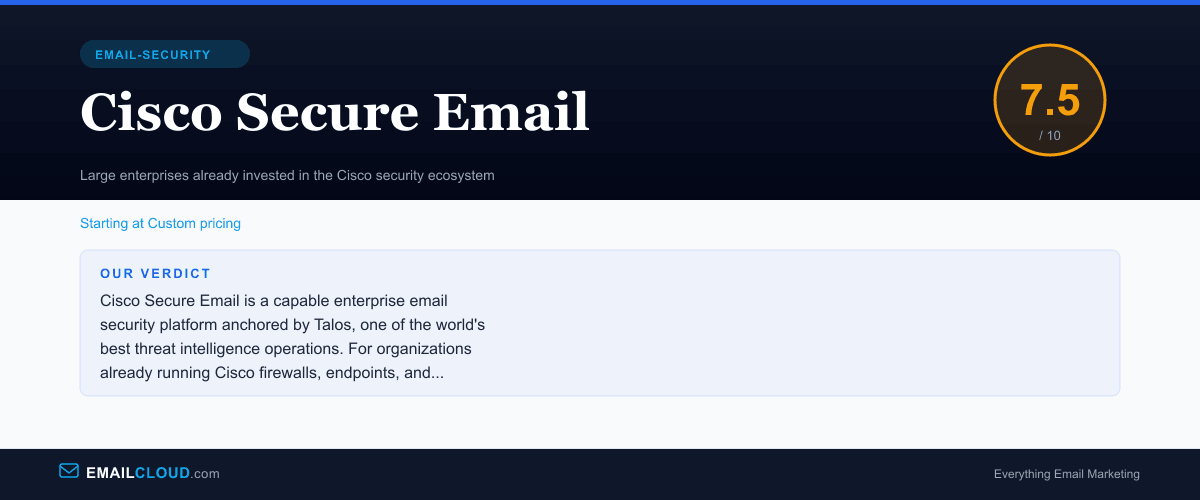
Cisco Secure Email is a capable enterprise email security platform anchored by Talos, one of the world's best threat intelligence operations. For organizations already running Cisco firewalls, endpoints, and network security, adding Cisco Secure Email creates a unified security ecosystem with shared intelligence and coordinated response that no multi-vendor approach can match. Outside the Cisco ecosystem, the value proposition weakens significantly. The platform is complex to manage, the pricing is enterprise-level, and standalone competitors like Proofpoint and Mimecast offer more modern management experiences with comparable protection. Choose Cisco Secure Email if you are a Cisco shop. Choose something else if you are not.
Review Summary
Share this visual summary. Right-click to save.
Frequently Asked Questions
Is Cisco Secure Email the same as IronPort?
Yes, it is the same product lineage. Cisco acquired IronPort in 2007 for $830 million. The product was renamed to Cisco Email Security Appliance (ESA), then to Cisco Secure Email as part of Cisco's broader security portfolio rebrand. The core technology traces back to IronPort's original email security gateway, though it has been significantly enhanced with Cisco's Talos threat intelligence, Advanced Malware Protection, and cloud capabilities.
Do you need other Cisco products to use Cisco Secure Email?
No, Cisco Secure Email works as a standalone email security product. However, it delivers the most value when deployed alongside other Cisco security products like SecureX, Umbrella, and Secure Endpoint. The integration between these products creates a unified security ecosystem with shared threat intelligence and coordinated response. Organizations without other Cisco infrastructure will still get effective email protection but will miss out on the ecosystem benefits that are a major selling point.
How does Cisco Secure Email compare to Proofpoint?
Both are enterprise-grade email security platforms with world-class threat intelligence (Talos for Cisco, proprietary for Proofpoint). Proofpoint has stronger BEC detection, a more modern management experience, and a people-centric security model. Cisco counters with ecosystem integration across its broader security portfolio and more flexible deployment options (on-premise, cloud, hybrid). Proofpoint is the better pure email security platform. Cisco is the better choice for organizations already invested in the Cisco security ecosystem.