2017: The Fall of Yahoo Mail: From Webmail King to Cautionary Tale
The acquisition closed on June 13, 2017. Verizon Communications, a telecommunications company whose core competency was running cell towers and fiber optic networks, officially took ownership of Yahoo’s internet business for $4.48 billion. The price was a rounding error by tech industry standards — less than what Facebook had paid for WhatsApp three years earlier, less than what Microsoft had paid for LinkedIn the year before, and roughly one-tenth of the $44.6 billion that Microsoft had offered for all of Yahoo in 2008.
The gap between those numbers — $44.6 billion and $4.48 billion — tells the story of one of the most dramatic declines in corporate technology history. And at the center of that decline, both as a symptom and a cause, was Yahoo Mail: once the world’s largest email service, the anchor of the Yahoo ecosystem, the account that hundreds of millions of people used as their primary digital identity. How Yahoo Mail went from market leader to acquisition afterthought is a story about security failures, strategic confusion, and the brutal cost of standing still while competitors move forward.
The Simple Version: Yahoo used to be the biggest email service in the world, but they stopped improving while Gmail got better and better. Then hackers stole every single Yahoo account — all 3 billion of them — and Yahoo did not tell anyone for three years. When they finally tried to sell the company, the breach knocked hundreds of millions off the price. Verizon bought what was left, and Yahoo Mail went from being the king of email to a brand passed between corporate owners like an unwanted piece of furniture.
The Decline in Numbers
The raw market share data tells the story with brutal clarity. In 2004, the year Gmail launched, Yahoo Mail was the dominant webmail platform with an estimated 280 million users. Hotmail (later Outlook.com) was second. Gmail was a curiosity — invitation-only, with a user base measured in thousands.
By 2007, Gmail’s growth trajectory was unmistakable. Google’s combination of superior search, 1 GB of free storage (later “unlimited”), threaded conversations, and a clean interface was pulling users away from Yahoo Mail in measurable numbers. Yahoo responded with redesigns and storage increases, but these were reactive moves — matching what Gmail already offered rather than innovating beyond it.
By 2012, Gmail had overtaken Yahoo Mail in global usage. By 2015, Gmail’s dominance was overwhelming — over 900 million active users to Yahoo Mail’s roughly 250 million. By 2020, Gmail claimed over 1.8 billion active accounts. Yahoo Mail’s user base had stabilized around 225 million — still substantial in absolute terms, but a fraction of the email market and a shadow of its former dominance.
The trajectory is stark: in a decade, Yahoo Mail went from the unquestioned market leader to a distant also-ran. The question is why.
Death by a Thousand Paper Cuts
Yahoo Mail’s decline was not caused by a single catastrophic failure (though the breach came close). It was caused by a decade of incremental erosion — small decisions, missed opportunities, and institutional failures that compounded over time.
The storage wars were lost early. When Gmail launched with 1 GB of free storage in 2004, Yahoo was offering 100 MB. Yahoo scrambled to match, eventually offering “unlimited” storage in 2007. But Gmail had already defined the narrative: Google was the innovative company, Yahoo was the one playing catch-up. That perception, once established, proved impossible to reverse.
The interface fell behind. Yahoo Mail’s interface went through multiple redesigns — 2007, 2010, 2013 — and each one was met with user complaints. The 2013 redesign, implemented under Marissa Mayer’s leadership, was particularly controversial: it removed features users relied on (including the tab-based interface), introduced new visual designs that prioritized aesthetics over functionality, and broke workflows that longtime users had built over years. The backlash was fierce and sustained.
Mobile was an afterthought. As email usage shifted to mobile devices — surpassing desktop by 2015 — Gmail’s tight integration with Android gave it an enormous structural advantage. Every Android phone shipped with Gmail pre-installed and pre-configured. Yahoo Mail required a separate download and setup. On iOS, Gmail’s app was consistently better-reviewed and more frequently updated than Yahoo’s.
The ecosystem never materialized. Google understood that email was the anchor of a broader ecosystem. A Gmail account was also a YouTube account, a Google Drive account, a Google Calendar account, a Google Photos account, and an Android login. The entire Google ecosystem reinforced Gmail usage. Yahoo tried to build a similar ecosystem — Yahoo Finance, Yahoo Sports, Yahoo News, Flickr, Tumblr — but the pieces never cohered into something greater than the sum of their parts. Yahoo Mail existed alongside Yahoo’s other services rather than integrating with them in a way that created lock-in.
The Breach That Changed Everything
In August 2013, state-sponsored hackers breached Yahoo’s systems and exfiltrated data from what Yahoo would eventually acknowledge was every single user account — all 3 billion of them. The stolen data included names, email addresses, phone numbers, dates of birth, hashed passwords (using the weak MD5 algorithm), and in many cases, unencrypted security questions and answers.
Yahoo did not disclose the breach publicly until December 2016 — more than three years later. And even then, the initial disclosure was misleading: Yahoo claimed only 1 billion accounts had been affected. The full scope of 3 billion accounts was not revealed until October 2017, four months after the Verizon acquisition closed.
The three-year concealment was extraordinary. During the period between the breach and its disclosure, Yahoo continued to market itself to advertisers on the basis of its massive user base, continued to accept new user registrations without informing potential users that existing accounts had been compromised, and continued to negotiate its sale to Verizon without initially disclosing the breach to the buyer.
A separate breach in 2014, attributed to Russian state-sponsored hackers by the U.S. Department of Justice (which later indicted two FSB officers), compromised an additional 500 million accounts. This breach was disclosed in September 2016, shortly before the 2013 breach came to light.
The Acquisition Discount
The breach disclosures landed squarely in the middle of the Verizon acquisition. Verizon had agreed to pay $4.83 billion in July 2016. The September 2016 disclosure of the 2014 breach raised immediate questions about whether the deal would proceed. The December 2016 disclosure of the far larger 2013 breach nearly killed it entirely.
Verizon renegotiated. The final price — $4.48 billion — reflected a $350 million reduction. But the financial consequences extended far beyond the acquisition discount. The SEC fined Yahoo’s successor entity $35 million — the first time the SEC had penalized a company for failing to timely disclose a data breach. Class-action lawsuits resulted in a $117.5 million settlement. Yahoo’s former CISO resigned. The company’s reputation for security was permanently destroyed.
The breach also had a cascading effect on Yahoo Mail’s user trust. When users learned that their passwords, security questions, and personal information had been stolen — and that Yahoo had known about it for years without telling them — many abandoned their Yahoo Mail accounts. The breach accelerated a migration to Gmail that was already underway and gave wavering users a concrete, personal reason to leave.
The Corporate Carousel
After the acquisition, Yahoo Mail’s corporate parent changed names and owners with dizzying frequency. Verizon merged Yahoo with AOL (which it had acquired in 2015 for $4.4 billion) into a subsidiary called Oath. In 2019, Oath was renamed Verizon Media. In 2021, Verizon sold Verizon Media — including Yahoo Mail, Yahoo Finance, AOL, TechCrunch, and other properties — to Apollo Global Management, a private equity firm, for $5 billion. The combined entity was rebranded as simply Yahoo.
Through all of this corporate turbulence, Yahoo Mail continued to function. The service processed billions of messages, served over 225 million monthly active users, and remained the primary email provider for a large segment of the internet population — many of them longtime users who had built their digital lives around their @yahoo.com addresses and saw no compelling reason (or lacked the technical confidence) to migrate.
The Redesigns Nobody Asked For
Between 2015 and 2023, Yahoo Mail underwent multiple redesigns, each attempting to modernize the interface and recapture relevance. The 2017 redesign under Verizon introduced a cleaner layout and improved mobile experience. The 2019 redesign added features like package tracking, travel organization, and subscription management — attempting to position Yahoo Mail as an intelligent inbox rather than a plain email client.
These features were, individually, competent. But they suffered from a perception problem: by the time Yahoo Mail added them, Gmail or Outlook had already offered similar features, often for years. Yahoo Mail was consistently two to three years behind its competitors in shipping features, and when those features arrived, they felt like belated responses rather than innovations. The narrative of “Yahoo Mail as follower, not leader” had become self-reinforcing.
Why Yahoo Mail Still Exists
Despite the decline, the breaches, the corporate chaos, and the complete loss of market leadership, Yahoo Mail has not died. As of 2026, it remains one of the world’s largest email services, with a user base that would be impressive for any company that is not named Google or Microsoft.
Several factors explain this persistence. Legacy addresses — people who have used @yahoo.com for two decades, who have that address linked to banking, social media, and government accounts — face significant switching costs. The effort required to migrate an email address that has accumulated twenty years of registrations is substantial enough to keep many users in place. For these users, Yahoo Mail is not the email service they would choose today; it is the email service they chose fifteen years ago and have not yet left.
Yahoo Mail also retains a meaningful presence in certain demographics and regions. In parts of Southeast Asia, Latin America, and among older internet users in the United States, Yahoo Mail remains a significant or even dominant email provider. These users may not be the highest-value demographic for advertisers, but they represent a real and substantial user base.
The Cautionary Tale
Yahoo Mail’s story is studied in business schools as a case study in squandered advantage. The service had first-mover benefits, the largest user base, massive brand recognition, and the financial resources to innovate. What it lacked was a coherent strategy for turning email into the anchor of a broader platform.
Google understood what Yahoo did not: email is identity infrastructure. A Gmail address is not just a mailbox — it is the key to an ecosystem of productivity tools, cloud storage, mobile operating systems, and online services. Yahoo treated email as one feature among many in a portal. Google treated email as the foundation on which everything else was built.
For email marketers, Yahoo Mail’s continued existence carries a practical reminder. Yahoo Mail users still appear on subscriber lists in meaningful numbers, and Yahoo’s spam filtering, authentication requirements, and deliverability quirks differ from Gmail’s. The 2024 authentication requirements that Gmail and Yahoo jointly announced reminded the industry that Yahoo, for all its corporate travails, still processes enough email traffic to shape deliverability standards. Ignoring Yahoo Mail means ignoring a segment of your audience — and that segment is larger than most marketers assume.
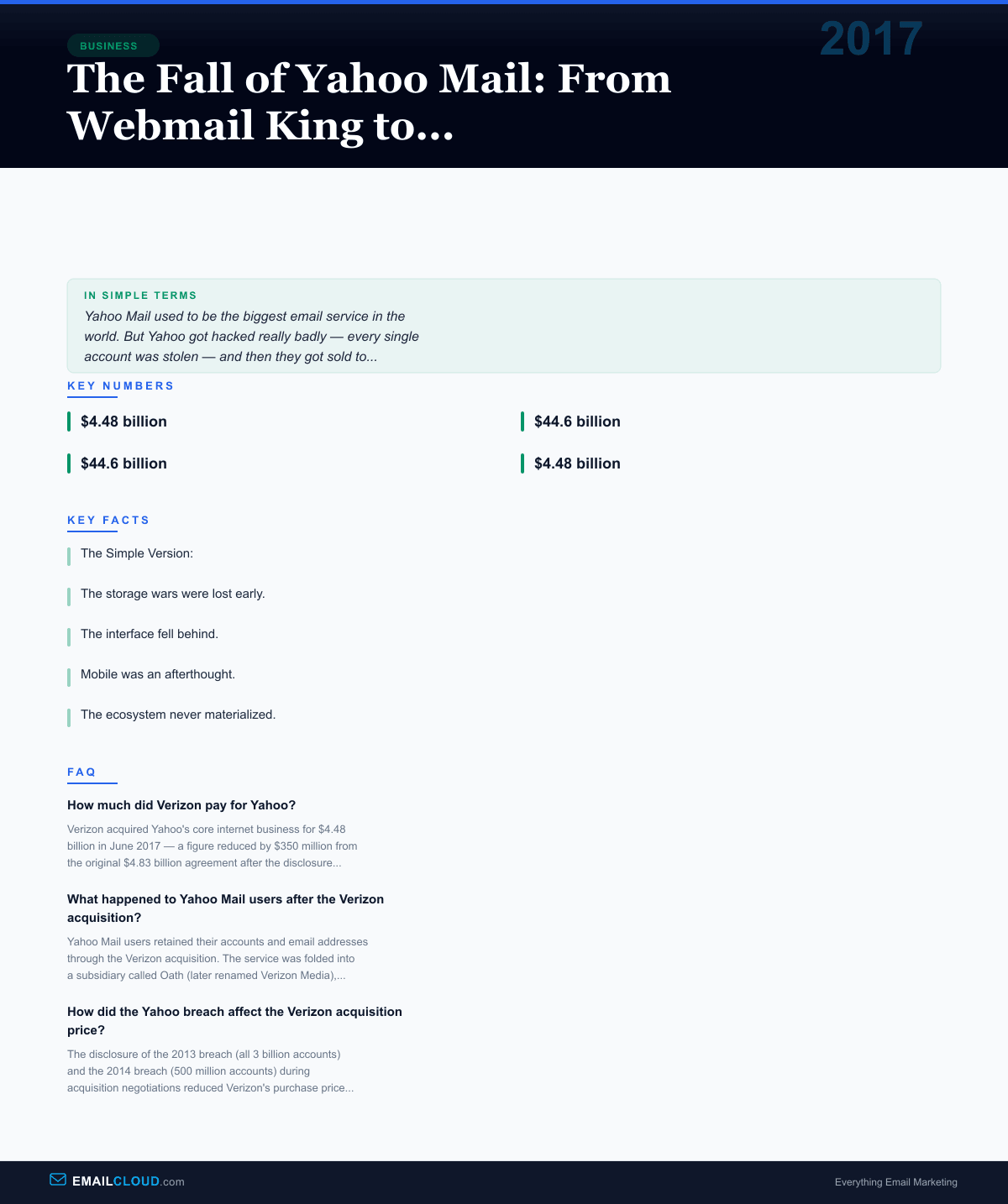
Infographic
Share this visual summary. Right-click to save.
Related Events
Frequently Asked Questions
How much did Verizon pay for Yahoo?
Verizon acquired Yahoo's core internet business for $4.48 billion in June 2017 — a figure reduced by $350 million from the original $4.83 billion agreement after the disclosure of two massive data breaches. For context, Microsoft had offered $44.6 billion for all of Yahoo in 2008, meaning Yahoo sold for roughly one-tenth of what it could have received nine years earlier.
What happened to Yahoo Mail users after the Verizon acquisition?
Yahoo Mail users retained their accounts and email addresses through the Verizon acquisition. The service was folded into a subsidiary called Oath (later renamed Verizon Media), then sold again to Apollo Global Management in 2021 for $5 billion as part of a combined Yahoo entity. Throughout the corporate turbulence, Yahoo Mail continued operating and maintained over 225 million monthly active users as of 2025.
How did the Yahoo breach affect the Verizon acquisition price?
The disclosure of the 2013 breach (all 3 billion accounts) and the 2014 breach (500 million accounts) during acquisition negotiations reduced Verizon's purchase price by $350 million, from $4.83 billion to $4.48 billion. The breaches also triggered SEC investigations, class-action lawsuits resulting in a $117.5 million settlement, and a $35 million SEC fine — the first time the SEC penalized a company for failing to disclose a data breach.
Stay ahead of the inbox
Weekly tips on deliverability, automation, and growing your list. No spam, ever.
No spam. Unsubscribe any time. We respect your inbox.