1996: The Webmail Revolution: How Browser-Based Email Changed Everything
Today, checking email means opening a browser tab or tapping an app. The idea that you could only read your email on one specific computer, using a specific piece of software that you had to configure yourself, sounds absurd. But that was the reality for the first 25 years of email’s existence. Webmail — the ability to access your email through a web browser, from any computer, anywhere — was not always obvious. It was an invention, and it changed the relationship between people and their email in ways that are easy to underestimate.
The Desktop Email Era
Before webmail, email was a desktop application. On university Unix systems, you used Pine or Elm — text-based mail clients that ran in a terminal window. On Windows PCs, you used Eudora, Pegasus Mail, or later Microsoft Outlook. On corporate networks, you used Lotus Notes or cc:Mail. On AOL, you used AOL’s built-in mail client.
Each of these programs required configuration. You needed to know your mail server’s hostname, the POP3 port (110), the SMTP port (25), and your authentication credentials. You entered these settings into the application, and the software connected to the server, downloaded your messages, and stored them locally on your hard drive. Your email lived on your computer. If you wanted to check email from a different machine, you had to configure the software all over again — and if you used POP3 (the standard protocol), downloading messages on one computer removed them from the server, making them inaccessible from any other device.
This meant your email was effectively anchored to your desk. You checked email when you were sitting in front of your computer, and you couldn’t check it when you weren’t. If you traveled, your email waited for you. If your hard drive crashed, your email was gone. For most of the 1980s and early 1990s, this was simply how email worked, and nobody questioned it because there was no alternative.
Hotmail: Independence Day
The alternative arrived on July 4, 1996 — a launch date chosen deliberately for its symbolism. Sabeer Bhatia and Jack Smith launched Hotmail, a free, browser-based email service that required nothing more than a web browser and an internet connection. No software to install. No servers to configure. No port numbers to know. You went to hotmail.com, created an account, and started sending email.
The technical challenge was significant. Building a full-featured email client inside a web browser in 1996 was not straightforward. Web browsers of that era — Netscape Navigator 3 and Internet Explorer 3 — had limited capabilities. JavaScript was in its infancy. CSS barely existed. The concept of a “web application” was new. Hotmail’s interface was basic by modern standards — simple HTML forms, minimal formatting, slow page reloads for every action — but it worked, and the convenience was revolutionary.
Hotmail’s growth was explosive. The service added users at a rate that stunned the tech industry — 8.5 million users in the first 18 months. Much of this growth was driven by a viral marketing tactic that would become legendary: every outgoing Hotmail message included a footer that read “Get Your Free Email at Hotmail.” Every email a Hotmail user sent was an advertisement for the service, delivered directly to someone who was probably still using a desktop email client. Microsoft acquired Hotmail in December 1997 for approximately $400 million, recognizing that free webmail was going to be a massive market.
Yahoo Mail and the Portal Strategy
Yahoo followed in 1997, acquiring Four11 Corporation and its RocketMail webmail service, rebranding it as Yahoo Mail. Yahoo had an advantage that Hotmail didn’t: it was already the most popular website on the internet. Yahoo’s portal — a one-stop homepage with news, weather, sports, finance, and search — drew hundreds of millions of visitors daily. Adding free email to that ecosystem was a strategic masterstroke. Users who came to Yahoo for news stayed for email. Users who came for email checked the news while they were there.
Yahoo Mail grew rapidly and eventually surpassed Hotmail in users, becoming the world’s most popular webmail service by the early 2000s. The portal-plus-email model established a template that would influence web strategy for a decade: give away email for free, use it to keep users in your ecosystem, and monetize the attention with advertising.
The Portable Identity
Webmail’s deepest impact wasn’t technical — it was conceptual. Before webmail, your email address was tied to an institution. Your address was john@companyname.com or jsmith@university.edu or user@aol.com. If you changed jobs, you lost your email address. If you switched ISPs, you lost your email address. If you graduated from college, you lost your email address. Your digital identity was owned by whatever organization provided your internet access.
Webmail decoupled email from institutions. Your Hotmail or Yahoo Mail address was yours. It didn’t matter who your employer was, who your ISP was, or where you lived. You could change jobs, move across the country, switch internet providers, and your email address — and all the contacts, conversations, and accounts associated with it — stayed the same. Your email address became your identity on the internet, the one constant in a sea of changing affiliations.
This portable identity had cascading effects. When websites started requiring registration, they asked for an email address — your permanent, portable, institution-independent email address. Your email became your username, your verification method, your password recovery mechanism, and eventually the key to your entire online life. Every account you create today — shopping, banking, social media, streaming — is anchored to an email address. Webmail made that possible by making email addresses permanent and personal.
Gmail: The Quantum Leap
For seven years after Hotmail’s launch, webmail was useful but limited. Storage caps were tiny — Hotmail offered 2 MB of free storage, Yahoo Mail offered 4 MB. Users spent significant time deleting old emails to stay under quota. The interfaces were clunky, relying on full page reloads for every action. Webmail was convenient, but anyone who needed serious email productivity still used a desktop client.
Gmail changed that on April 1, 2004 — a launch date that made many people assume it was an April Fool’s joke. Google offered 1 GB of free storage — 250 to 500 times what competitors provided. The interface used AJAX (Asynchronous JavaScript and XML) to create a responsive, desktop-like experience in the browser. Conversations were threaded. Search was fast and accurate (this was Google, after all). Spam filtering was excellent.
The 1 GB storage offer forced an immediate industry response. Yahoo bumped its free storage first to 100 MB, then eventually to “unlimited.” Microsoft increased Hotmail’s storage and eventually rebuilt the service as Outlook.com. But Gmail’s real innovation wasn’t storage — it was the philosophy that storage enabled. Gmail’s design principle was “search, don’t sort.” Instead of organizing emails into folders (the desktop paradigm), Gmail encouraged users to archive everything and find it later with search. This only worked if you never had to delete anything, and 1 GB of storage made that possible.
Gmail’s invitation-only launch created artificial scarcity that turned email — the most mundane internet service — into a status symbol. Gmail invitations traded on eBay for $50 or more in the early months. Getting a gmail.com address signaled that you were technologically connected. The exclusivity was brilliant marketing that cost Google nothing.
The Death of Desktop Email (for Consumers)
Webmail’s rise corresponded with the decline of desktop email clients for consumer use. Eudora, which had been the dominant email client for individual users through the 1990s, saw its user base erode steadily through the 2000s. Development effectively ceased in 2006. Pegasus Mail, Thunderbird, and other desktop clients retained small but dedicated user bases, but the mass market had moved to the browser.
The reasons were straightforward. Webmail was free. Desktop clients often cost money. Webmail required no configuration. Desktop clients required server settings. Webmail was accessible from any device. Desktop clients were tied to one machine. Webmail handled spam filtering on the server. Desktop clients required local spam filters. For the average user who wanted to send and receive email without thinking about technical details, webmail was simply better.
Desktop email survived in the corporate world, where Outlook and Exchange dominated, and among power users who valued offline access, advanced filtering, and local storage. But for the hundreds of millions of people who used email for personal communication, webmail became the default — and for most of them, it was the only email they ever knew.
The Advertising Bargain
Webmail established a bargain that would define the consumer internet: free services, paid for by advertising and data. Hotmail, Yahoo Mail, and Gmail all offered email for free. In exchange, users saw ads alongside their inbox and implicitly agreed to let the provider scan their messages for ad targeting (a practice that Gmail pioneered and later discontinued under privacy pressure).
This bargain was enormously successful. Gmail alone has over 1.8 billion active users. Yahoo Mail has over 225 million. The services cost users nothing, are available everywhere, and are reliable enough that most people never think about them. The providers, in turn, built advertising businesses worth billions on the attention and data these services generate.
The webmail revolution is easy to take for granted precisely because it succeeded so completely. The idea that your email should be accessible from any device, anywhere, at any time, isn’t a feature — it’s a baseline expectation. But someone had to invent it, build it, and convince hundreds of millions of people to trust their communications to a browser window. That happened in 1996, and it changed what email was, what email meant, and how a permanent digital identity worked for everyone who came online after it.
Infographic
Share this visual summary. Right-click to save.
Related Events
Frequently Asked Questions
What was the first major webmail service?
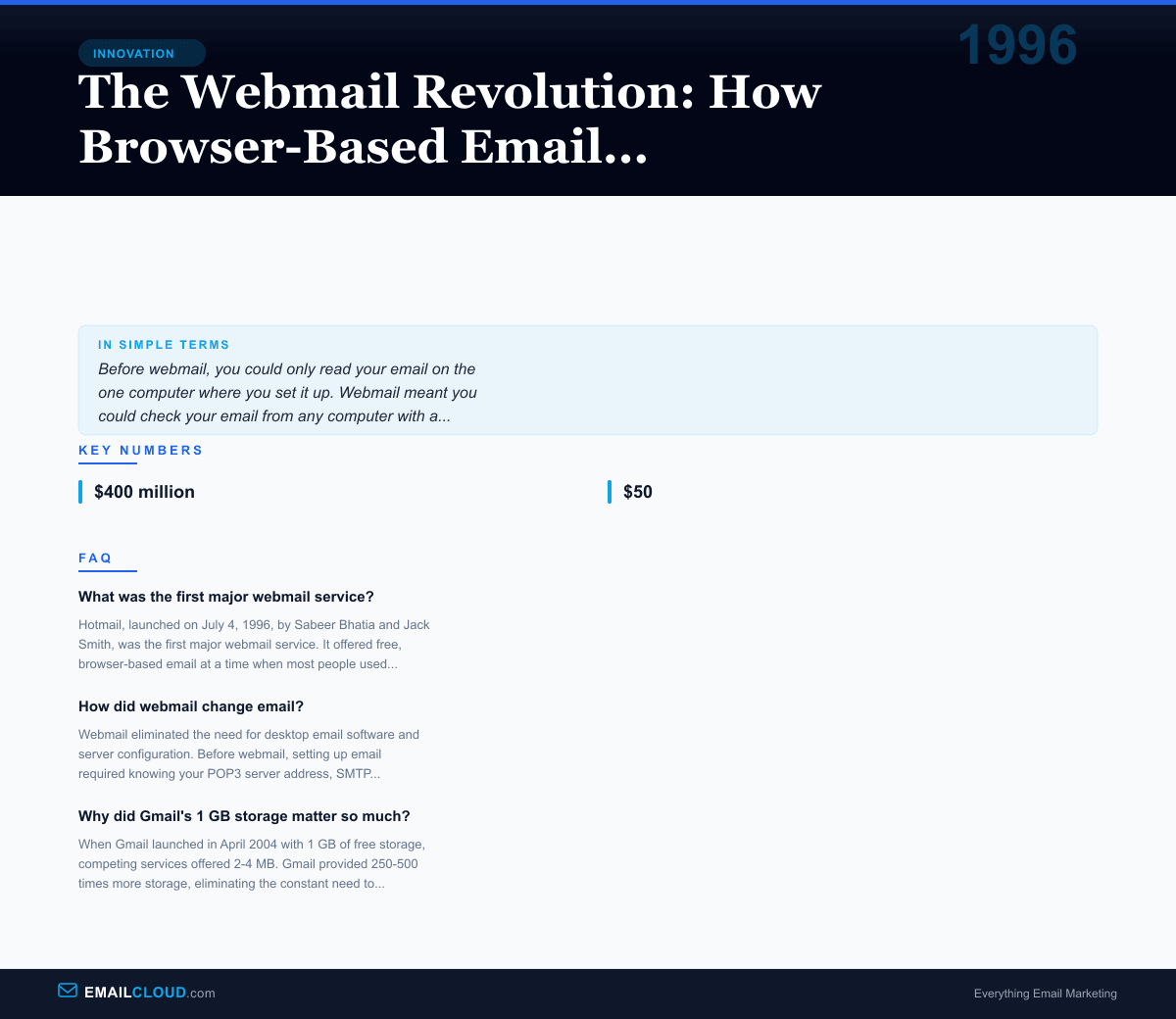
Hotmail, launched on July 4, 1996, by Sabeer Bhatia and Jack Smith, was the first major webmail service. It offered free, browser-based email at a time when most people used desktop clients like Eudora or Pine. Hotmail grew to 8.5 million users in its first year and was acquired by Microsoft in December 1997 for approximately $400 million.
How did webmail change email?
Webmail eliminated the need for desktop email software and server configuration. Before webmail, setting up email required knowing your POP3 server address, SMTP server address, port numbers, and authentication details. Webmail required only a browser and a password. More importantly, it freed email from a single machine — you could access your messages from any computer anywhere in the world.
Why did Gmail's 1 GB storage matter so much?
When Gmail launched in April 2004 with 1 GB of free storage, competing services offered 2-4 MB. Gmail provided 250-500 times more storage, eliminating the constant need to delete emails to stay under quota. The generous storage also enabled Gmail's core design philosophy — 'search, don't sort' — encouraging users to archive everything instead of organizing into folders.
Stay ahead of the inbox
Weekly tips on deliverability, automation, and growing your list. No spam, ever.
No spam. Unsubscribe any time. We respect your inbox.