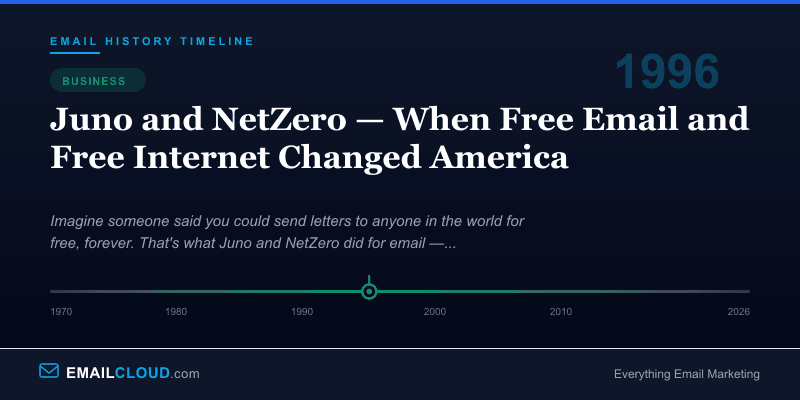
1996: Juno and NetZero — When Free Email and Free Internet Changed America
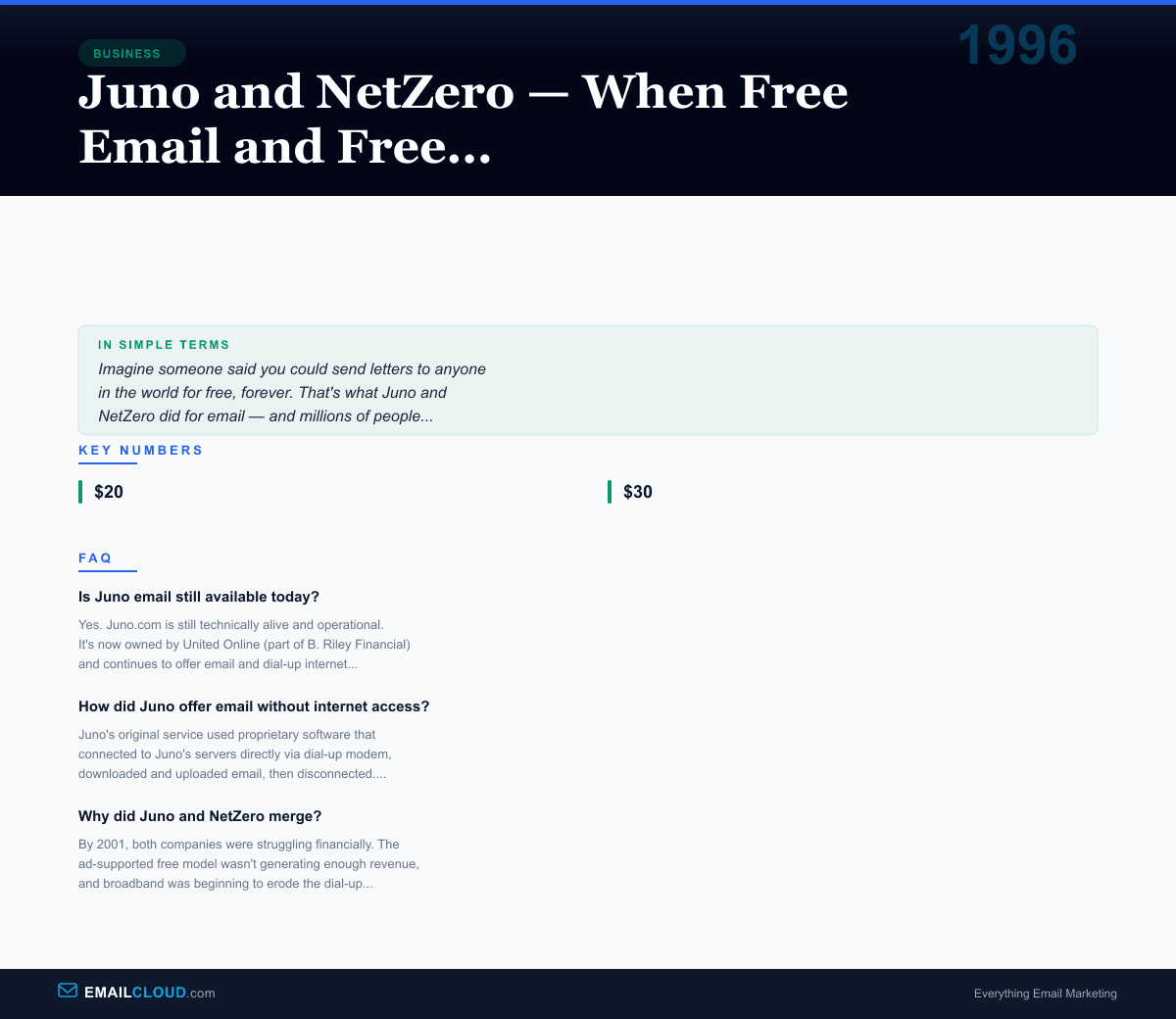
In the mid-1990s, the internet was still expensive. Monthly ISP subscriptions ran $20 to $30 — real money for many American households. The computer itself was a significant purchase, and the idea of paying a monthly fee on top of that just to send electronic messages felt extravagant to a lot of people. Two companies saw that barrier and decided to demolish it entirely: Juno Online Services and NetZero. Their weapon was a radical business model that sounded too good to be true. Everything would be free. The catch? Advertising. Lots of it.
Juno: Email Without the Internet
Juno Online Services launched in 1996 with a proposition so unusual that many people didn’t believe it at first. The company offered free email — not free-trial email, not temporarily-free email, but genuinely, permanently free email service. And it didn’t even require internet access.
That last part is worth pausing on, because it sounds impossible to modern ears. Juno’s software was a standalone Windows application that users installed from a floppy disk or CD-ROM. When you wanted to check email, the software would dial a local phone number through your modem, connect briefly to Juno’s servers, upload any outgoing messages, download any incoming messages, and then hang up. The entire process took less than a minute. You composed and read your emails offline, in the Juno application, without ever touching the internet.
This was clever engineering in service of a clever business model. Juno didn’t need to provide bandwidth for web browsing, file downloads, or any of the other services that made running an ISP expensive. It only needed enough server capacity to shuttle small text-based emails back and forth. The cost per user was minimal.
The trade-off was advertising. Juno’s software displayed banner ads while users read and composed email. The company also collected demographic data from users during signup — age, income, interests — and used it to serve targeted advertising. In 1996, this felt like a fair deal to millions of Americans who were curious about email but didn’t want to pay for an ISP subscription.
The Scale of Free
Juno’s growth was remarkable. By 1999, the service had attracted over 9 million registered users. D.E. Shaw & Co., the quantitative hedge fund where Jeff Bezos had worked before founding Amazon, was one of Juno’s key backers. The company went public in May 1999 during the dot-com frenzy, and its stock soared on IPO day.
For many Americans, Juno was their very first email address. It was particularly popular among older users, lower-income households, and people in rural areas — demographics that weren’t ready to commit to a monthly ISP subscription but were intrigued by the idea of electronic mail. A Juno email address became a cultural signifier: it told the recipient that you were online, sort of, but you weren’t paying for it.
Juno eventually expanded beyond email-only service to offer free internet access in 1999, directly competing with a company that had beaten it to that particular punch by about a year.
NetZero: Free Internet for the Ad-Tolerant
NetZero launched in October 1998 with an even bolder promise than Juno’s: free internet access. Not just free email — free everything. Web browsing, chat, downloads, the whole internet, completely free.
The catch was a persistent advertising banner — a bar that sat at the top or bottom of your screen at all times while you were connected to NetZero’s service. The bar couldn’t be minimized, closed, or hidden behind other windows. It was always there, rotating through advertisements while you browsed the web, checked email, or did anything else online.
NetZero’s technology tracked which websites you visited and used that data to serve targeted ads in the persistent bar. The company called this its “ZeroPort” ad delivery platform. Privacy-conscious users were horrified. Budget-conscious users didn’t care. NetZero signed up 6 million users in its first year.
The NetZero experience was a recognizable sight in late-1990s America. You’d visit a friend’s house and see that telltale ad bar anchored to their screen, cycling through ads for mortgage refinancing and weight loss supplements while they checked their Yahoo Mail. It was the price of admission, and millions of people happily paid it.
The Business Model Problem
The economics of “give everything away and sell ads” proved more challenging than either company’s investors hoped. The core problem was that free users were, by definition, people who didn’t want to spend money — which made them a difficult audience for advertisers. Click-through rates on the ad banners were low. Revenue per user was thin. And the cost of maintaining dial-up infrastructure, customer support, and server capacity was real.
Both companies tried to pivot. Juno introduced premium tiers with faster connections and fewer ads. NetZero added paid plans and throttled free users to 10 hours per month. But the broader market was moving against them. Broadband internet — DSL and cable — was spreading across American suburbs, offering speeds that made dial-up feel prehistoric. Users who could afford broadband had no reason to tolerate ad bars and connection limits. Users who couldn’t afford broadband were exactly the low-value audience that advertisers didn’t want to target.
The Merger and After
In September 2001, Juno and NetZero merged to form United Online. The timing was brutal — weeks after the September 11 attacks, in the middle of a tech recession, with the dot-com bubble already burst. The merger was a defensive move: by combining their subscriber bases and eliminating duplicate infrastructure, the two companies could survive as one where neither could survive alone.
United Online limped through the 2000s as a dial-up provider in an increasingly broadband world. The company found a surprisingly durable niche serving users in rural areas where broadband wasn’t available, elderly users who were comfortable with their existing setup, and budget-conscious users who preferred free (or very cheap) internet to no internet at all.
In 2016, United Online was acquired by B. Riley Financial, a Los Angeles-based financial services firm. As of 2026, both Juno.com and NetZero.net remain operational. They still offer dial-up internet service. Their websites look like time capsules from 2003.
The Legacy
Juno and NetZero matter because they democratized email and internet access in a way that the market wasn’t providing on its own. Before these services, getting online required disposable income and a willingness to pay monthly fees. Juno and NetZero proved that ad-supported access could work — at least well enough to bring millions of people online who wouldn’t have gotten there otherwise.
They also pioneered the ad-supported free service model that would later define the consumer internet. The trade-off that Juno and NetZero offered — free access in exchange for advertising and data collection — is fundamentally the same deal that Gmail, Facebook, and most of the modern internet offers today. The execution has gotten more sophisticated, but the underlying contract hasn’t changed.
For email marketers, the Juno and NetZero story is a reminder that access matters. The tools and platforms we use today to build campaigns and grow lists exist because companies like these made email accessible to everyone, not just the technically inclined or financially comfortable. Test your campaigns against any inbox — legacy or modern — by running your subject lines through our Subject Line Grader and checking your copy with the Spam Word Checker.
Infographic
Share this visual summary. Right-click to save.
Related Events
Frequently Asked Questions
Is Juno email still available today?
Yes. Juno.com is still technically alive and operational. It's now owned by United Online (part of B. Riley Financial) and continues to offer email and dial-up internet service, primarily serving a small base of long-time users who never switched. The website looks remarkably unchanged from the early 2000s.
How did Juno offer email without internet access?
Juno's original service used proprietary software that connected to Juno's servers directly via dial-up modem, downloaded and uploaded email, then disconnected. Users composed and read emails offline. The connection was purely for email transfer — there was no web browsing, no chat, no internet access at all. It was essentially a dedicated email-only dial-up service.
Why did Juno and NetZero merge?
By 2001, both companies were struggling financially. The ad-supported free model wasn't generating enough revenue, and broadband was beginning to erode the dial-up market. They merged in September 2001 to form United Online, combining their user bases and reducing overhead. The merger was a survival move as much as a strategic one.
Stay ahead of the inbox
Weekly tips on deliverability, automation, and growing your list. No spam, ever.
No spam. Unsubscribe any time. We respect your inbox.