2000: FW: FW: FW: The Golden Age of Email Forwarding
If you had an email account between roughly 1998 and 2008, you know the feeling. You open your inbox and there it is: “FW: FW: FW: RE: YOU HAVE TO READ THIS!!!” from your aunt, your coworker, your college roommate, or your grandmother — possibly all four, because they all received the same email from different sources and independently decided you needed to see it. The subject line has been forwarded so many times that the “FW:” prefixes stack up like sedimentary layers of digital enthusiasm. Inside, buried beneath a geological record of forwarding headers and email signatures, is a joke you’ve already read three times, an urban legend that’s been debunked since 2001, or a dire warning about a computer virus that doesn’t exist.
This was the forwarding era — a decade-long phenomenon when email functioned as the internet’s primary social network, and the forward button was the share button. It was chaotic, sentimental, credulous, and deeply human. And despite the eye-rolling it inspired, it was the first time most people used the internet to connect with each other for reasons that had nothing to do with work.
The Mechanics of Forwarding
Email forwarding was the original viral distribution mechanism. Unlike modern social media sharing, which happens on a platform visible to a curated audience, email forwarding was private and manual. Someone received an email they found funny, touching, or alarming. They hit “Forward,” selected contacts from their address book — often literally everyone in it — and sent it onward. Each recipient who forwarded it amplified the reach exponentially.
The result was a distribution network that looked remarkably like a biological virus. A single email could reach millions of people within days, not through any central platform or algorithm but through individual human decisions to share. There was no analytics dashboard, no engagement metrics, no A/B testing. Just people passing along things they thought other people should see.
The content that thrived in this ecosystem was content that provoked an emotional response strong enough to overcome the small friction of selecting contacts and clicking “Forward.” Humor worked. Fear worked. Sentimentality worked. Outrage worked. The forwarding era was, in retrospect, a preview of every dynamic that would later define social media virality — just slower, clunkier, and with a lot more forwarding headers.
The Greatest Hits
Certain forwarded emails achieved a kind of immortality, circulating for years and resurfacing cyclically like seasonal allergies. The greatest hits of forwarding culture included:
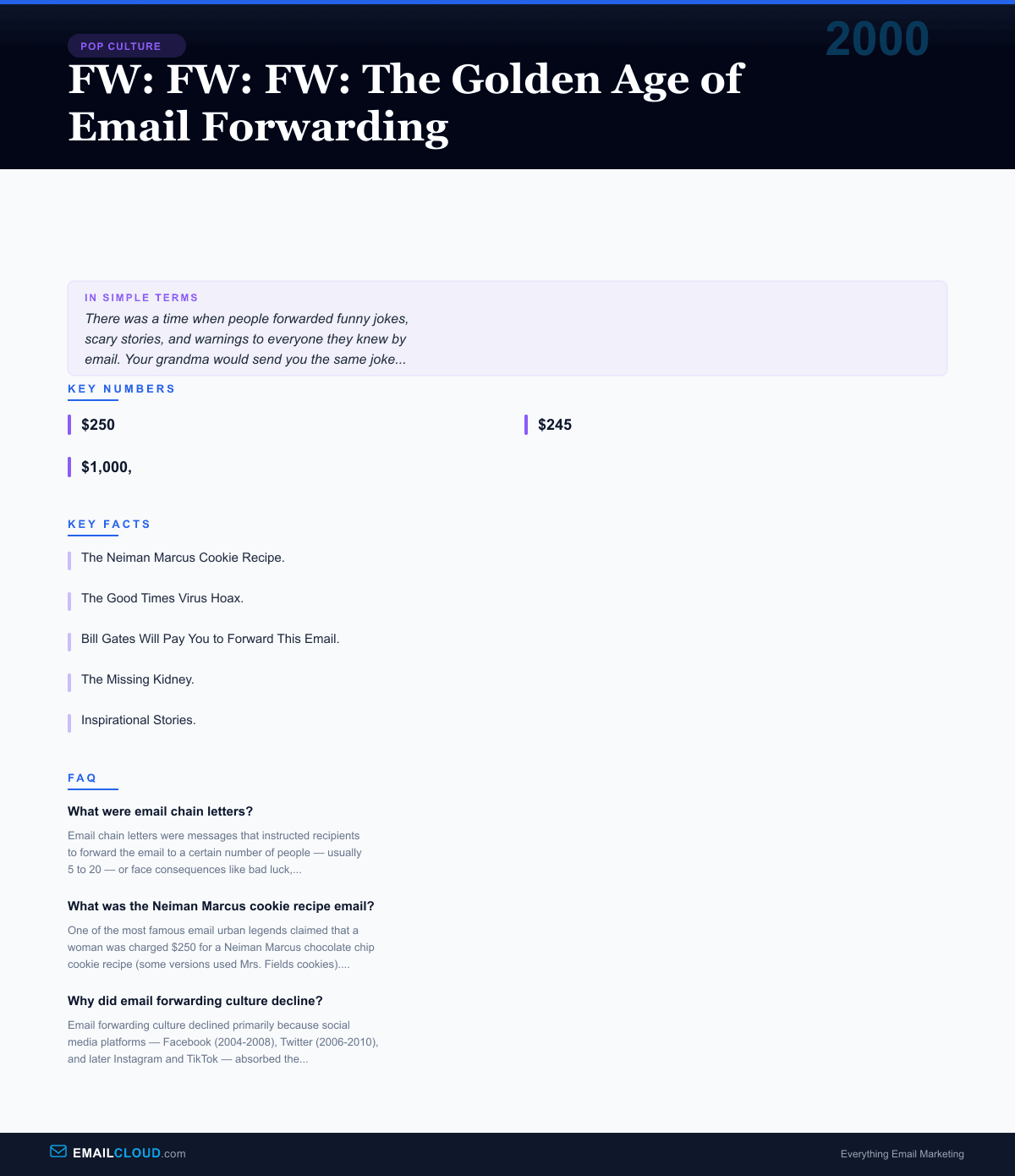
The Neiman Marcus Cookie Recipe. A woman was allegedly charged $250 for a chocolate chip cookie recipe at Neiman Marcus (or, in earlier versions, Mrs. Fields). Outraged, she decided to share the recipe with the entire internet, forwarding it freely so the company couldn’t profit. The recipe was real — and decent — but the story was fabricated. Neiman Marcus didn’t sell cookie recipes. It didn’t matter. The email circulated for a decade.
The Good Times Virus Hoax. “DO NOT OPEN ANY EMAIL WITH THE SUBJECT LINE ‘GOOD TIMES.’ IT WILL ERASE YOUR HARD DRIVE.” This warning, first circulated in 1994, was entirely false. There was no Good Times virus. But the hoax spread so widely and persisted so long that it arguably caused more disruption than many actual viruses, as panicked users deleted legitimate emails and flooded IT help desks with questions.
Bill Gates Will Pay You to Forward This Email. Microsoft was supposedly tracking email forwards as a beta test, and Bill Gates would personally pay $245 (or $1,000, depending on the version) to everyone who forwarded the message. This was, of course, nonsense — email forwarding is not trackable by a third party, and Bill Gates was not writing checks to strangers. But the combination of greed, plausibility (Microsoft was a huge company, maybe they could do that?), and zero downside risk (it costs nothing to forward an email) made this one of the most persistently forwarded emails in history.
The Missing Kidney. A man wakes up in a bathtub full of ice in a hotel room with a note that says “CALL 911. YOUR KIDNEYS HAVE BEEN HARVESTED.” This urban legend predates email but found its ultimate distribution channel in forwarding culture. Despite being thoroughly debunked by law enforcement and medical professionals (organ harvesting doesn’t work like this), the email circulated for years.
Inspirational Stories. A teacher who changed a student’s life. A soldier’s last letter home. A father’s advice to his daughter. These stories — often beautifully written, frequently fabricated, always emotionally manipulative — were the sentimental backbone of forwarding culture. They were forwarded most aggressively by parents and grandparents, and receiving one was simultaneously touching and exhausting.
The Chain Letter Phenomenon
Chain letters were forwarding culture at its most coercive. “Forward this to 10 friends in the next 24 hours or you’ll have bad luck for 7 years.” “Send this angel to everyone you love. If you get it back, you’re truly loved.” “If you don’t forward this, a little girl in the hospital won’t get her wish.”
The chain letter format was ancient — postal chain letters date back to at least the early 1900s — but email removed the friction that had limited their spread. Mailing a physical chain letter required envelopes, stamps, and addresses. Forwarding a digital chain letter required three clicks. The volume exploded. At the peak of chain letter culture, chain emails constituted a measurable percentage of total email traffic, clogging inboxes and consuming storage on mail servers that were already straining under the load.
The emotional manipulation was effective. People who would never have mailed 10 physical letters found themselves forwarding chain emails “just in case.” The cost was zero, the superstitious downside felt real (what if bad luck IS real?), and the social pressure — “the person who sent this to you is watching to see if you forward it” — was surprisingly potent.
PowerPoint Culture
A subset of forwarding culture deserves special mention: the PowerPoint slideshow. Starting in the early 2000s, emails began arriving with attached .pps files — PowerPoint presentations set to auto-play with transitions, sound effects, and embedded music. The content was typically inspirational quotes over sunset photographs, cute animal pictures with captions, or joke compilations with clip art illustrations.
These files were enormous by the standards of the era. A 5 MB PowerPoint attachment on a connection with 15 MB of total email storage was a meaningful imposition. IT departments watched in horror as mail servers filled up with forwarded slideshows of kittens wearing hats set to “Wind Beneath My Wings.” Some organizations instituted attachment size limits specifically to combat the PowerPoint forwarding epidemic.
Snopes: The Antidote
As forwarding culture grew more credulous, a counterforce emerged. Snopes.com, founded by David and Barbara Mikkelson in 1994 as a repository of urban legend research, became the de facto fact-checker for email forwards. “Check Snopes before you forward” became a common refrain — although, predictably, this advice was itself often forwarded as a chain email.
Snopes catalogued hundreds of email hoaxes, chain letters, and urban legends, providing detailed explanations of why each was false. The site became one of the most important reference resources on the internet, and its existence introduced millions of people to the concept of fact-checking online claims — a skill that would become exponentially more important in the social media era.
The Migration to Social Media
Email forwarding culture didn’t die — it migrated. When Facebook opened to the public in 2006 and achieved mass adoption by 2008, the sharing behavior that had driven forwarding culture found a more efficient platform. Instead of selecting contacts and clicking “Forward,” you could share a link or image with your entire social network in one click. The content was the same — jokes, inspirational quotes, urban legends, political outrage — but the distribution mechanism was dramatically more efficient.
Twitter (2006), Instagram (2012), and later TikTok accelerated the migration further. Each platform offered faster, more visual, more social sharing than email could provide. The grandmother who forwarded PowerPoint slideshows in 2005 was sharing Facebook memes by 2012. The coworker who forwarded joke lists was posting them on Twitter. The forwarding impulse hadn’t changed. The venue had.
Why It Mattered
It’s easy to dismiss forwarding culture as a naive and annoying phase of internet history. And it was, frequently, both naive and annoying. But forwarding culture was also the first time most people used the internet socially — not for work, not for commerce, not for information retrieval, but simply to share something with another human being because they thought that person would enjoy it. The forwarded joke was a gesture of connection. The chain letter was a (misguided) gesture of care. The inspirational story was a way of saying “I’m thinking of you” without the vulnerability of saying it directly.
Email forwarding was social networking before social networks existed. It was clumsy, inefficient, and prone to hoaxes, but it established the fundamental behavior — see something, share something — that would become the defining interaction model of the internet. Every retweet, every share, every TikTok duet is a descendant of “FW: FW: FW: MUST READ!!!” We just got better tools. The impulse was always there.
Infographic
Share this visual summary. Right-click to save.
Related Events
Frequently Asked Questions
What were email chain letters?
Email chain letters were messages that instructed recipients to forward the email to a certain number of people — usually 5 to 20 — or face consequences like bad luck, broken friendships, or missing out on a reward. They were digital descendants of postal chain letters and exploited social pressure and superstition to propagate. At their peak, chain letters constituted a significant percentage of personal email traffic.
What was the Neiman Marcus cookie recipe email?
One of the most famous email urban legends claimed that a woman was charged $250 for a Neiman Marcus chocolate chip cookie recipe (some versions used Mrs. Fields cookies). In revenge, she supposedly shared the recipe with everyone via email. The story was false — Neiman Marcus didn't sell cookies or recipes at the time — but the email circulated for years and spawned countless variations.
Why did email forwarding culture decline?
Email forwarding culture declined primarily because social media platforms — Facebook (2004-2008), Twitter (2006-2010), and later Instagram and TikTok — absorbed the sharing behavior. It became easier to share jokes, stories, and viral content on social feeds than to manually forward emails. Email became more professional and transactional, while social media became the venue for casual sharing.
Stay ahead of the inbox
Weekly tips on deliverability, automation, and growing your list. No spam, ever.
No spam. Unsubscribe any time. We respect your inbox.