2005: How Email Built the Ecommerce Industry
Online commerce and email grew up together, and neither could have become what it is without the other. Ecommerce needed email to function — to confirm orders, deliver receipts, notify customers about shipping, reset passwords, and verify accounts. Email marketing needed ecommerce to prove its value — to demonstrate, with trackable revenue and measurable ROI, that sending emails to people who wanted to receive them was the most profitable marketing channel ever invented.
The relationship between email and ecommerce is so deeply intertwined that it is difficult to discuss one without the other. Every significant development in ecommerce — from Amazon’s rise to the Shopify era, from flash sales to subscription boxes, from one-click purchasing to same-day delivery — has had a corresponding email strategy. And every significant development in email marketing — from segmentation to automation, from personalization to behavioral triggers — has been driven, in large part, by the needs and revenues of online retail.
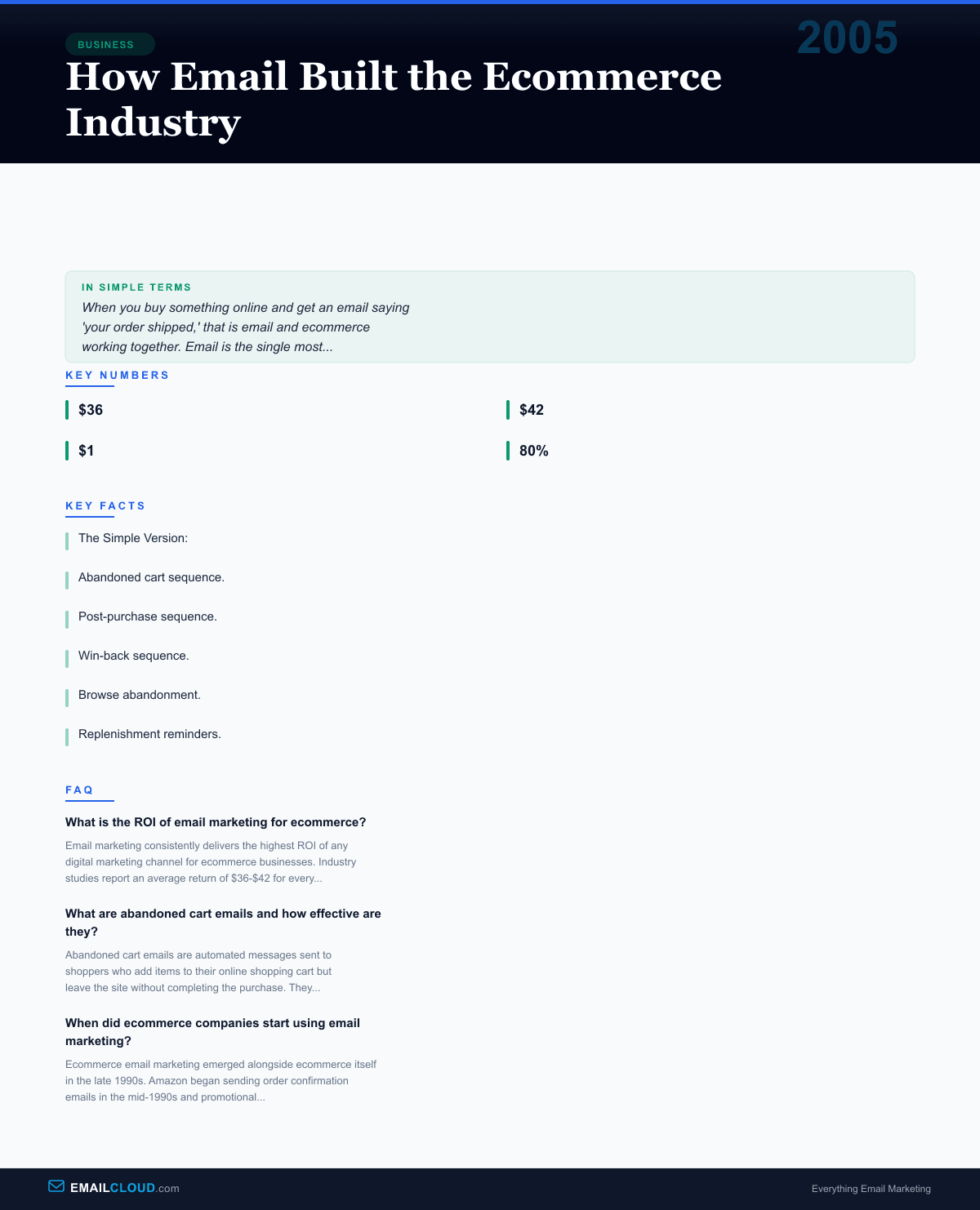
The Simple Version: Online stores and email need each other. Stores use email to tell you your order shipped, remind you about stuff you left in your cart, and send you deals. Email marketing makes more money for online stores than almost any other kind of advertising — about $36 to $42 for every $1 they spend. Without email, online shopping as we know it would not work.
The Foundation: Transactional Email (1995-2002)
Before email was a marketing channel for ecommerce, it was operational infrastructure. The birth of transactional email around 2000 established the fundamental relationship between email and online commerce: every transaction generates an email, and every email reinforces the relationship between the customer and the store.
Amazon was the pioneer. By the late 1990s, Amazon’s order confirmation emails were a model of functional design — order number, items purchased, shipping address, estimated delivery date, and a link to track the order. These emails served multiple purposes simultaneously: they confirmed the transaction (reducing customer anxiety), provided a receipt for the customer’s records, and established a communication channel that Amazon would later use for marketing.
The genius of Amazon’s approach was recognizing that transactional emails were not just operational necessities — they were attention assets. An order confirmation email has a 60-80% open rate because the recipient is actively expecting it and wants the information it contains. That attention, once captured, could be directed toward additional commercial messages. Amazon was among the first to include product recommendations in order confirmation and shipping notification emails — “Customers who bought this also bought…” — blurring the line between transactional communication and marketing in a way that would define ecommerce email for the next two decades.
The Promotional Email Era (2002-2008)
As ecommerce matured, retailers discovered that email was not just useful for post-purchase communication — it was the most effective channel for driving new purchases. The economics were compelling: email was essentially free to send (compared to the per-impression cost of display advertising or the per-click cost of search ads), it reached customers who had already expressed interest by subscribing, and it generated measurable, attributable revenue.
The early 2000s saw the rise of the promotional blast — a weekly or daily email to the entire subscriber list announcing sales, new arrivals, seasonal promotions, and special offers. Retailers like J.Crew, Gap, and Banana Republic built massive email programs that drove a significant percentage of their online revenue. The formula was simple: large list + frequent sends + compelling offers = revenue.
The problems with this approach became apparent quickly. Subscriber fatigue set in as inboxes filled with daily promotions from every retailer a customer had ever purchased from. Unsubscribe rates climbed. Spam complaints increased. The retailers who sent the most email saw declining engagement over time, while the retailers who segmented their lists and sent targeted, relevant messages maintained higher engagement.
This tension — between the short-term revenue gain of sending more email and the long-term cost of list fatigue — has defined ecommerce email strategy ever since. It is, in many ways, the central strategic question of email marketing: how much is too much?
The Abandoned Cart Revolution (2006-2012)
If there is a single email automation that defines ecommerce email marketing, it is the abandoned cart email. The concept is simple: a shopper adds items to their online shopping cart, begins the checkout process, and then leaves the site without completing the purchase. An automated email — typically sent one to three hours later — reminds them of the items they left behind and invites them to complete the purchase.
The abandoned cart email is brilliant because it targets shoppers who have already demonstrated high purchase intent. They found the product, selected it, and began checkout — they were 90% of the way to a purchase. The reasons for abandonment vary (unexpected shipping costs, comparison shopping, distraction, checkout friction), but the intent was there. The email serves as a gentle nudge to complete an action the shopper already wanted to take.
The numbers are extraordinary. The average online shopping cart abandonment rate hovers around 70% — meaning seven out of ten shoppers who add items to a cart leave without buying. Abandoned cart emails typically achieve open rates of 40-45%, click-through rates of 10-15%, and conversion rates of 5-10% of opened emails. For a large ecommerce operation, recovering even a fraction of abandoned carts represents millions of dollars in revenue that would otherwise be lost.
The abandoned cart email also pioneered the concept of the behavioral trigger — an email sent automatically in response to a specific user action (or inaction). This was a fundamental shift from the promotional blast model, where the same email was sent to everyone on the same schedule. Behavioral triggers made email responsive to individual customer behavior, and the abandoned cart email proved that this approach was dramatically more effective than batch-and-blast.
The Rise of Email-Driven Ecommerce Platforms (2012-2018)
The mid-2010s saw the emergence of email marketing platforms specifically designed for ecommerce. Klaviyo, founded in 2012, built its entire product around ecommerce email marketing, offering deep integrations with Shopify, Magento, WooCommerce, and BigCommerce that allowed retailers to segment their email lists based on purchase history, browsing behavior, and customer lifetime value.
Klaviyo’s approach represented a maturation of ecommerce email. Instead of sending the same promotional email to every subscriber, retailers could now send targeted campaigns based on what a customer had previously purchased, what they had browsed, how much they had spent, and how recently they had engaged. A customer who bought running shoes last month would receive emails about running accessories. A customer who browsed winter coats but did not buy would receive a targeted email about winter coat sales.
This level of segmentation and personalization — driven by the integration between the email platform and the ecommerce platform — produced measurably better results. Klaviyo’s growth to a $10 billion valuation was driven almost entirely by its ability to demonstrate attributable revenue for ecommerce clients. The platform could show, to the dollar, how much revenue each email campaign and automation generated.
Other platforms followed. Omnisend, Drip, and Privy built similar ecommerce-focused email tools. Mailchimp, traditionally a general-purpose email platform, invested heavily in ecommerce features and Shopify integration. The message was clear: ecommerce was where the email marketing money was, and platforms that served ecommerce clients would capture the most value.
The Automation Stack (2015-Present)
Modern ecommerce email marketing is built on a stack of automated sequences that cover the entire customer lifecycle. These automations run continuously, triggered by customer behavior, and collectively generate a significant percentage of total email revenue — often 30-50% — without requiring manual campaign creation.
Welcome series. When a new subscriber joins the email list, a sequence of 3-7 emails introduces the brand, communicates value propositions, and offers an incentive (typically a discount code) to make a first purchase. Welcome series emails have among the highest engagement rates of any ecommerce email type.
Abandoned cart sequence. Usually 2-3 emails sent over 24-72 hours, with escalating incentives. The first email is a simple reminder. The second may include social proof or product reviews. The third may offer a small discount to close the sale.
Post-purchase sequence. After a purchase, a sequence of emails confirms the order, provides shipping updates, requests a product review, and cross-sells related products. The timing and content of post-purchase emails significantly influence repeat purchase rates.
Win-back sequence. When a previously active customer stops engaging — no opens, no clicks, no purchases for a defined period — a re-engagement sequence attempts to reactivate them. Win-back emails often include “we miss you” messaging, exclusive offers, or surveys asking why the customer disengaged.
Browse abandonment. Similar to abandoned cart emails, browse abandonment emails target shoppers who viewed specific products but did not add them to cart. These have lower conversion rates than cart abandonment emails (the intent is lower) but still outperform general promotional campaigns.
Replenishment reminders. For consumable products — coffee, vitamins, pet food, cleaning supplies — automated emails remind customers to reorder based on estimated consumption rates. These emails are highly effective because they arrive at the moment the customer is likely to need the product.
The $36:1 ROI Question
The frequently cited statistic that email marketing generates $36-$42 for every $1 spent deserves examination. The number comes from industry studies by the Data & Marketing Association and Litmus, and it represents an average across all industries and company sizes. For ecommerce specifically, the ROI can be higher — particularly for businesses with large, engaged email lists and well-optimized automation sequences.
The ROI calculation benefits from email’s cost structure. The primary costs of email marketing are the email service provider subscription (typically $50-$500/month for small to mid-size businesses) and the labor to create and manage campaigns. The incremental cost of sending an additional email is effectively zero. Compare this to paid advertising, where every click or impression incurs a cost, and the structural advantage of email becomes clear.
However, the $36:1 figure can be misleading if interpreted uncritically. Attribution — determining which revenue was truly “caused” by an email versus revenue that would have occurred anyway — is an ongoing challenge. A customer who receives an abandoned cart email and then completes their purchase may have returned to complete it without the email. A customer who clicks through a promotional email may have been planning to buy that product already. The true incremental ROI of email is difficult to isolate, and most attribution models give email more credit than it strictly deserves.
Email as Ecommerce Infrastructure
By 2026, the relationship between email and ecommerce is so fundamental that it is easy to take for granted. Every online purchase generates a trail of emails. Every customer relationship is maintained, in part, through email communication. Every ecommerce platform includes email marketing as a core feature or a tightly integrated add-on.
The practical lesson for ecommerce businesses is that email is not a marketing channel to be optimized in isolation — it is infrastructure that touches every part of the customer experience. The order confirmation email is a customer service touchpoint. The shipping notification is a brand experience. The abandoned cart email is a sales tool. The post-purchase review request is a social proof generator. The win-back sequence is a retention mechanism.
The businesses that generate the most revenue from email are not the ones that send the most email. They are the ones that send the right email to the right customer at the right moment — and that requires the integration of email with every other system in the ecommerce operation. For marketers looking to optimize their email programs, our ROI Calculator helps quantify the revenue potential of your email list based on your specific metrics.
Infographic
Share this visual summary. Right-click to save.
Related Events
Frequently Asked Questions
What is the ROI of email marketing for ecommerce?
Email marketing consistently delivers the highest ROI of any digital marketing channel for ecommerce businesses. Industry studies report an average return of $36-$42 for every $1 spent on email marketing. For ecommerce specifically, the figure can be higher — Klaviyo reports that its ecommerce customers attribute an average of 30-35% of their total online revenue to email marketing campaigns and automations.
What are abandoned cart emails and how effective are they?
Abandoned cart emails are automated messages sent to shoppers who add items to their online shopping cart but leave the site without completing the purchase. They are among the most effective email automations in ecommerce: industry data shows that abandoned cart emails have average open rates of 40-45% and recover approximately 5-10% of abandoned carts. Given that the average cart abandonment rate is roughly 70%, even modest recovery rates represent significant revenue.
When did ecommerce companies start using email marketing?
Ecommerce email marketing emerged alongside ecommerce itself in the late 1990s. Amazon began sending order confirmation emails in the mid-1990s and promotional recommendation emails shortly after. By the early 2000s, automated transactional emails (order confirmations, shipping notifications) were standard. Sophisticated email marketing — segmented campaigns, behavioral triggers, abandoned cart sequences — became widespread between 2005 and 2010 as email service providers added ecommerce-specific features.
Stay ahead of the inbox
Weekly tips on deliverability, automation, and growing your list. No spam, ever.
No spam. Unsubscribe any time. We respect your inbox.