Smartwriter.ai Review: Automated Personalization for Cold Outreach

Pros
- Automates the most time-consuming part of cold outreach — personalized prospect research
- Scrapes LinkedIn, company websites, blog posts, and news for relevant talking points
- Generates personalized first lines, full emails, and LinkedIn messages from scraped data
- Batch processing handles hundreds of prospects simultaneously
Cons
- Personalization quality varies wildly — some outputs are excellent, many feel robotic or forced
- Expensive for what you get — $59/mo minimum with no free tier or trial
- Dependent on available public data — thin prospect profiles produce generic output
What is Smartwriter.ai?
Smartwriter.ai attacks the most painful bottleneck in cold outreach: personalization. Every sales team knows that personalized emails outperform generic templates — reply rates can be 2-3x higher when the email references something specific about the recipient. The problem is that meaningful personalization requires research: scanning LinkedIn profiles, reading company blog posts, finding recent news, identifying relevant talking points. At 5-10 minutes per prospect, this research does not scale.
Smartwriter automates this research. Feed it a list of prospect URLs (LinkedIn profiles, company websites, or both) and it scrapes available public data, identifies potential talking points, and generates personalized content — first lines, complete emails, LinkedIn messages, or backlink outreach. The promise is personalization at the speed of templates, without the template feel.
Founded in 2021, Smartwriter entered a market that was quickly recognizing the gap between the proven value of personalization and the practical difficulty of doing it at volume. The tool has gained traction with agencies and high-volume sales teams who need to personalize hundreds of emails weekly without hiring a research team.
We tested Smartwriter across three use cases: B2B cold outreach to SaaS companies, agency prospecting for marketing services, and link-building outreach for SEO. This review covers the results — the good, the inconsistent, and the genuinely frustrating.
Key Features
Prospect Data Scraping
Smartwriter’s engine scrapes multiple public data sources to build a profile for each prospect:
- LinkedIn profiles: Job title, company, recent posts, shared content, skills, education, career trajectory.
- Company websites: About pages, blog posts, team pages, press releases, product information.
- News and PR: Recent company mentions, funding announcements, product launches, awards.
- Podcast appearances: If the prospect has appeared on podcasts, Smartwriter can reference specific topics discussed.
- Blog posts and articles: Content published by the prospect, used to reference their expertise or opinions.
The scraping is automated — you upload a CSV of LinkedIn URLs or email addresses, and Smartwriter processes them in batch. For a list of 100 prospects, the research phase that would take a human 8-16 hours completes in roughly 10-15 minutes.
The quality of the scraped data depends entirely on what is publicly available. Prospects with active LinkedIn profiles, published content, and recent press coverage produce rich data that enables strong personalization. Prospects with sparse online presence produce thin profiles that lead to generic or forced personalization — “I noticed you work at [Company]” is not meaningful personalization.
Personalized First Lines
The primary use case. Smartwriter generates an opening line for each prospect that references something specific about them or their company:
- “Saw your LinkedIn post about the challenges of scaling remote engineering teams — our clients in similar situations found that…”
- “Congratulations on the Series B announcement. As you scale the team at [Company], I wanted to share how…”
- “Your article on customer retention metrics resonated with me, especially the point about cohort analysis…”
When these work, they work well. A genuine reference to a prospect’s recent activity signals that the email is not a mass blast, which is the primary hurdle cold email must clear. In our testing, emails using Smartwriter’s better first lines saw reply rates 40-60% higher than the same email body with a generic opener.
When they do not work, the output ranges from awkward to damaging:
- References to outdated information (“Congrats on the new role!” when the prospect changed jobs 18 months ago)
- Forced connections between the prospect’s background and your pitch that do not logically follow
- Robotic phrasing that reads as clearly AI-generated: “I was impressed by your extensive experience in the field of…”
- Surface-level personalization that any mass email tool could achieve: “As someone in the marketing industry…”
In our testing across 200 prospects, roughly 35-40% of first lines were usable without significant editing. Another 25-30% needed moderate rewriting. The remaining 30-35% needed to be discarded entirely. That hit rate means Smartwriter saves time overall compared to manual research, but it does not eliminate the review step.
Full Email Generation
Beyond first lines, Smartwriter can generate complete cold emails using scraped prospect data combined with your product/service description. The full emails follow standard cold email structure — personalized opener, pain point, value proposition, social proof, CTA — with prospect-specific details woven throughout.
Full email quality is lower than first-line quality. The longer the generated content, the more likely it drifts into generic territory or forces connections that feel unnatural. We found the best approach is using Smartwriter for the personalized first 1-2 sentences and writing the rest of the email manually or with a template. This hybrid approach captures the personalization benefit without the quality risk of fully generated copy.
Batch Processing and Integrations
Smartwriter processes prospect lists in bulk — upload a CSV, select your output type, and receive results for the entire list. This batch approach is the practical way to use the tool. One-off personalization does not justify the subscription; batch processing hundreds of prospects weekly does.
The platform integrates with cold email tools including Lemlist, Mailshake, and Woodpecker, allowing you to push personalized content directly into your outreach sequences. The integration saves the manual step of copying generated content into your sending platform.
Pricing Breakdown
Smartwriter’s pricing scales with volume:
- Basic ($59/mo): 400 personalized outputs per month, LinkedIn and web scraping, email and LinkedIn message generation. Annual billing drops this to approximately $49/mo.
- Popular ($149/mo): 1,500 outputs per month, priority processing, advanced personalization modes, API access.
- Pro ($359/mo): 3,500 outputs per month, dedicated support, custom AI training, highest priority processing.
There is no free plan and no trial. This is the single biggest barrier to evaluation — you must commit $59 before you can assess whether Smartwriter’s output quality meets your standards. Given the inconsistency we observed in testing, this is a real concern. You might pay for a month and discover that your prospect pool produces mostly generic output because they lack substantial online presence.
At $59/mo for 400 outputs, the per-email cost is $0.15. For comparison, outsourcing prospect research to a virtual assistant at $10/hour produces roughly 6-12 researched prospects per hour, or $0.83-$1.67 per prospect. Smartwriter is cheaper per unit, but the VA produces more reliable quality. The tradeoff is cost versus quality consistency.
For the same $59/mo, you could use Lavender ($29/mo Starter) plus Copy.ai (free tier) and get both email coaching and AI-generated copy — neither of which scrapes prospect data, but both of which produce more consistent output for the non-personalization components of your emails.
Who It’s Best For
Smartwriter delivers value in specific contexts:
- Agencies managing outreach for multiple clients who need to personalize at scale across different industries and prospect types. The batch processing handles the volume, and agency teams have the editing capacity to clean up inconsistent output.
- SDR teams sending 50+ personalized emails daily where manual research is the bottleneck. Even at a 40% hit rate on usable first lines, Smartwriter saves hours compared to manual LinkedIn scanning.
- Link-building and PR outreach where the personalization pattern is different (referencing the prospect’s content rather than their business problems). Smartwriter’s blog post and article scraping is well-suited to this use case.
- Account-based marketing teams building personalized campaigns for target account lists. Smartwriter can process an entire target account list and generate personalized entry points for each stakeholder.
Limitations
The limitations are significant enough to warrant careful evaluation before committing:
Inconsistent quality is the core issue. At a 35-40% hit rate on genuinely usable personalization, Smartwriter requires human review of every output. This does not eliminate the time investment — it shifts it from “research + write” to “review + edit.” The net time savings are real but smaller than the marketing suggests.
No quality signal. Smartwriter does not score or rate the quality of its own output. Every generated first line looks the same in the interface — there is no indication of whether the tool is confident in a particular personalization or guessing. A confidence score would help users prioritize which outputs to use and which to rewrite. Tools like Lavender solve this with real-time scoring; Smartwriter does not.
Expensive without a trial. At $59/mo with no free plan and no trial, the barrier to evaluation is high. Combined with inconsistent quality, the risk of paying for a month and being disappointed is real. If Smartwriter offered even 50 free outputs to test, the evaluation risk would be manageable. It does not.
Dependent on prospect data availability. Smartwriter cannot personalize what it cannot find. Prospects in industries with limited online presence, at early-stage companies without press coverage, or with private LinkedIn profiles produce generic output. Before subscribing, audit your target prospect pool — if most of your prospects have thin online profiles, Smartwriter will underperform.
No deliverability awareness. Smartwriter generates content but does not evaluate it for email deliverability. AI-generated personalization can inadvertently include spam trigger phrases that affect inbox placement. Run every generated email through our Spam Word Checker before sending, and review our guide on AI email personalization at scale for deliverability best practices in personalized outreach.
Can feel performative. There is a fine line between genuine personalization and performing the act of personalization. When Smartwriter forces a connection between a prospect’s blog post about supply chain optimization and your SaaS marketing tool, the prospect knows. Bad personalization is worse than no personalization — it signals that you used a tool to fake interest, which is the opposite of the authentic engagement that drives replies.
How It Compares
The cold email personalization space has several players with distinct approaches:
- Vs. Lavender: Lavender coaches your entire email writing process in real time. Smartwriter automates the research and generates the opening. They solve different parts of the same problem and pair well — use Smartwriter for the personalized opener, then score the complete email with Lavender. See our Lavender review.
- Vs. Copy.ai: Copy.ai generates cold email copy from prompts but does not scrape prospect data. If you provide your own research, Copy.ai can produce the email. Smartwriter’s advantage is automated research; Copy.ai’s advantage is a free tier and broader email template coverage.
- Vs. Lemlist: Lemlist is a cold email sending platform that includes some personalization features (custom images, dynamic landing pages). Smartwriter is a research and generation tool that feeds into sending platforms. They are complementary — Smartwriter generates the personalized content, Lemlist sends it.
- Vs. manual research: A skilled SDR doing manual LinkedIn research produces better personalization 100% of the time. The question is whether the 2-3x quality premium of manual research is worth the 10x time cost. For high-value prospects (enterprise deals, large contracts), manual research wins. For high-volume outreach (SMB prospecting, agency work), Smartwriter’s speed advantage matters more.
For subject line optimization on your cold emails — whether manually written or AI-generated — use our free Subject Line Grader. The subject line determines whether your carefully personalized email gets opened at all.
The Bottom Line
Smartwriter.ai solves a real problem with an imperfect solution. Automating prospect research is genuinely valuable for high-volume outreach teams, and when the personalization hits, it is impressive. But the inconsistent output quality means you cannot trust the tool blindly — every generated line needs human review, and a third of them need complete rewrites or replacement.
At $59/mo with no trial, the evaluation risk is higher than it should be. We would rate Smartwriter higher if it offered a free trial, added a confidence score to outputs, or improved consistency to the point where 60%+ of outputs were usable without editing. As it stands, the tool is a time-saver for teams with the volume to justify the cost and the editing capacity to clean up the output — but it is not the automatic personalization solution its marketing suggests.
If you are considering Smartwriter, first audit your prospect pool for online presence depth. Then decide whether the 35-40% hit rate on usable personalization, combined with time savings on the remaining 60%, justifies $59/mo over manual research. For many teams, the answer is yes. For others, spending that budget on Lavender for coaching and doing manual research will produce better results per email.
Our Verdict
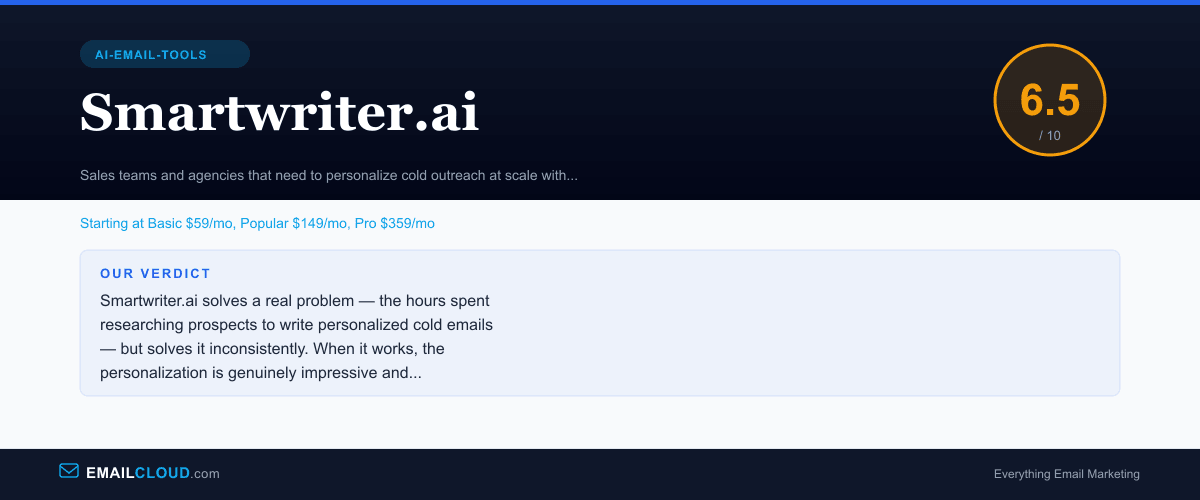
Smartwriter.ai solves a real problem — the hours spent researching prospects to write personalized cold emails — but solves it inconsistently. When it works, the personalization is genuinely impressive and saves significant time. When it misses, the output feels robotic and requires complete rewrites. At $59/mo with no free tier, the risk-reward ratio is unfavorable for teams that cannot absorb the occasional poor output.
Review Summary
Share this visual summary. Right-click to save.
Frequently Asked Questions
How does Smartwriter.ai generate personalized emails?
Smartwriter scrapes publicly available data about your prospects — LinkedIn profiles, company websites, blog posts, recent news, podcast appearances, awards — and feeds this information into its AI engine. The system identifies potential talking points and generates personalized content that references specific details about the prospect or their company. You can generate personalized first lines, complete emails, or LinkedIn connection messages.
Is Smartwriter.ai worth $59 per month?
The value depends on your outreach volume and the alternative cost of manual research. If you are personalizing 20+ emails per day and each manual personalization takes 5-10 minutes of research, Smartwriter saves 100-200 minutes daily. At $59/mo, that is roughly $0.10 per personalized email for the Basic plan. However, the quality is inconsistent enough that you will still need to review and edit each output, which reduces the time savings. For high-volume senders, the math works. For low-volume senders, manual research produces better results.
How does Smartwriter compare to Lavender?
Different tools for different problems. Smartwriter automates prospect research and generates personalized content. Lavender coaches you to write better emails based on what drives replies. Smartwriter saves time on the research phase. Lavender improves quality in the writing phase. Some teams use both — Smartwriter for the personalized opening, Lavender to score and refine the complete email.
Does Smartwriter.ai work with LinkedIn?
Yes. Smartwriter can scrape LinkedIn profiles for prospect data and generate personalized LinkedIn connection messages and InMail content. It also uses LinkedIn data as one input source for email personalization. However, Smartwriter does not automate LinkedIn actions — it generates the content, which you send manually or through a separate outreach tool like Lemlist or Salesloft.
Stay ahead of the inbox
Weekly tips on deliverability, automation, and growing your list. No spam, ever.
No spam. Unsubscribe any time. We respect your inbox.