Phrasee Review: Enterprise AI That Actually Optimizes Subject Lines

Pros
- Proprietary NLG trained on brand-specific data — not a generic LLM wrapper
- Predictive scoring tells you which subject line will win before you send
- Brand guardrails prevent off-brand language while still exploring creative variations
- Proven client results — eBay, Domino's, Walgreens report 10-30% uplift in open rates
Cons
- Completely inaccessible to SMBs — enterprise-only pricing starts around $2,000/mo
- No self-serve option — requires sales process and onboarding
- Narrow focus on subject lines and marketing language — does not generate full email copy
What is Phrasee?
Phrasee occupies a unique position in the AI email tools landscape: it is the only major platform that builds custom natural language generation models specifically for email marketing language, trained on individual brand data, and optimized against real performance metrics. While tools like Jasper and Copy.ai wrap general-purpose large language models with email templates, Phrasee constructs proprietary NLG systems that learn what drives opens, clicks, and conversions for your specific audience.
Founded in 2015 by Parry Malm in London, Phrasee predates the current AI hype cycle by several years. The company built its technology during a period when “AI marketing” meant sophisticated statistical models, not consumer-facing chatbots. That foundation shows in the product — Phrasee is engineered for performance measurement, not content generation volume. In 2022, Phrasee was acquired by Jacquard (itself an AI marketing language company), consolidating two of the most credible enterprise-focused AI language platforms under one roof.
The client roster is the clearest signal of Phrasee’s position: eBay, Domino’s, Walgreens, Virgin Holidays, Groupon, and other brands sending at scales measured in tens of millions of emails per month. These are not companies experimenting with AI copy. They are using Phrasee because the performance data justifies the investment.
We have evaluated Phrasee through client case studies, industry benchmarks, and direct comparison against alternative approaches. This review covers what the technology does, who it is built for, and the honest assessment of whether it represents value — understanding that for most of our readers, the answer to “should I buy Phrasee?” is “you cannot afford to.”
Key Features
Proprietary Natural Language Generation
The technical distinction matters here. Most AI email tools feed your prompt into GPT-4, Claude, or a similar foundation model and return whatever it generates. Phrasee builds custom language models trained on three data sources:
- Your brand’s historical email data — subject lines, open rates, click rates, conversion data, and the correlations between language patterns and performance outcomes.
- Your brand’s style guidelines — approved vocabulary, prohibited terms, tone parameters, formatting rules.
- Cross-client performance data — aggregate learnings from across Phrasee’s client base about which linguistic patterns drive engagement in specific verticals.
The result is a model that does not just generate plausible-sounding subject lines — it generates subject lines calibrated to outperform your current baseline with your specific audience. The system learns that your audience responds better to questions than statements, or that urgency language drives opens but hurts clicks, or that emoji in subject lines performs 12% better for your Tuesday sends but 8% worse for your Saturday sends. These are the kinds of insights that general-purpose AI tools cannot surface because they have no access to your performance data.
Predictive Scoring
Before you send a campaign, Phrasee’s predictive engine scores each subject line variant against your historical data and estimates its likely open rate. This is not the simplified scoring you get from free tools (including our Subject Line Grader, which evaluates subject lines against general best practices). This is regression-based prediction calibrated to your audience’s actual behavior patterns.
In practical terms, Phrasee might generate 10 subject line variants and predict that variant 3 will achieve a 24.7% open rate, variant 7 will hit 22.1%, and variant 9 will underperform at 18.3%. You can then A/B test the top predictions against each other to validate the model’s accuracy — and that validation data feeds back into the model, making future predictions more accurate.
The predictive accuracy Phrasee claims — and that clients corroborate — is in the 85-95% range for ranking relative performance. The system does not guarantee absolute open rates (too many external factors affect those), but it reliably identifies which variant will beat which other variant.
Brand Guardrails
Enterprise brands have non-negotiable language rules. Regulated industries have compliance requirements. Global brands have cultural sensitivities across markets. Phrasee’s guardrail system encodes these rules directly into the generation model, making it structurally incapable of producing off-brand or non-compliant language.
This is different from — and more reliable than — adding instructions to a prompt and hoping the AI follows them. Jasper’s Brand Voice feature learns your tone, but it can still produce output that violates specific brand rules if the rules were not explicitly in the training data. Phrasee’s guardrails are hard constraints, not soft guidance. If “free” is a prohibited word in your marketing vocabulary (as it is for some luxury brands), Phrasee will never generate a subject line containing it.
For regulated industries like financial services and healthcare, this constraint-based approach to AI-generated marketing language is not just convenient — it is a compliance requirement that general-purpose tools cannot reliably satisfy.
A/B Testing Integration
Phrasee integrates with major ESPs and marketing clouds — Salesforce Marketing Cloud, Adobe Campaign, Oracle Responsys, Braze, and others — to automate the testing loop. It generates variants, pushes them to your ESP, monitors real-time performance, and automatically deploys the winning variant to the remaining audience. The performance data then feeds back into the model.
This closed-loop system means Phrasee gets smarter with every campaign you send. The typical trajectory is meaningful improvement in the first month, with compounding gains over the following 3-6 months as the model accumulates more brand-specific performance data.
Pricing Breakdown
Phrasee does not publish pricing on its website. The sales process involves a discovery call, a demo tailored to your use case, and a custom proposal based on sending volume, number of channels, and integration complexity.
Based on industry reports, user interviews, and competitive intelligence, here is what we understand about Phrasee’s pricing:
- Entry contracts typically start around $2,000-$3,000/mo for a single channel (email subject lines) with moderate sending volume.
- Mid-tier contracts covering multiple channels (email, push notifications, SMS) and higher volumes range from $5,000-$10,000/mo.
- Enterprise contracts with full integration, custom model development, and dedicated support can exceed $15,000/mo.
- Contract terms are typically annual with quarterly billing.
To put this in perspective: the minimum Phrasee investment buys you approximately 40 months of Jasper Pro or 50 months of Copy.ai Pro. The pricing reflects a fundamentally different value proposition — Phrasee is not selling AI-generated text, it is selling predicted performance improvement, backed by data.
The ROI calculation for enterprise senders is straightforward. If you send 10 million emails per month and Phrasee improves your open rate by 10%, that is 1 million additional opens per month. If your revenue per open is $0.05 (a conservative estimate for ecommerce), that is $50,000 in incremental monthly revenue against a $3,000 monthly tool cost. The math works at enterprise scale. It does not work at 50,000 subscribers.
Who It’s Best For
Phrasee makes financial sense for a narrow but well-defined audience:
- Enterprise ecommerce brands sending millions of emails monthly where open rate improvements directly translate to revenue. Retailers, travel companies, and marketplace platforms with large subscriber bases and high email frequency.
- Financial services companies that need AI-optimized marketing language within strict regulatory guardrails. Banks, insurance companies, and fintech firms that cannot risk non-compliant copy.
- Media and publishing companies sending daily newsletters to millions of subscribers where subject line performance determines ad revenue.
- Marketing teams with dedicated email operations — at least one person whose primary job is optimizing email campaigns. Phrasee’s value compounds with active management and iteration.
Limitations
Despite being the best tool in its specific category, Phrasee has clear limitations:
Inaccessible to everyone but enterprises. This is not a limitation of the technology — it is a business model decision. Phrasee has chosen to serve large clients exclusively, and the onboarding, integration, and ongoing optimization require a level of support that is not scalable at SMB price points. If you are reading this review and manage a list under 100,000 subscribers, Phrasee is not built for you.
Narrow scope. Phrasee optimizes subject lines and short marketing language — push notification text, SMS messages, Facebook ad headlines. It does not generate full email body copy, design email templates, or handle the dozens of other tasks that tools like Jasper cover. You need Phrasee alongside other tools, not instead of them.
Requires data volume. Phrasee’s predictive models need training data. If you send one campaign per month to a small list, there is not enough data to train a meaningful model. The system needs consistent sending volume — ideally multiple campaigns per week — to build the statistical foundation for accurate predictions. This is another reason why SMBs cannot extract value even if they could afford the tool.
Lengthy onboarding. Expect 4-8 weeks from contract signing to the first optimized campaign. Phrasee needs to integrate with your ESP, ingest historical data, train initial models, and calibrate guardrails. This is not a tool you can sign up for on Monday and use on Tuesday.
What SMBs Should Use Instead
Since most of our readers will not be purchasing Phrasee, here are practical alternatives for subject line optimization at any budget:
- Free: Our Subject Line Grader scores subject lines against deliverability best practices, length optimization, power word usage, and emotional engagement. It is not predictive — it cannot tell you which subject line will outperform for your audience specifically — but it catches common mistakes and suggests improvements.
- Free: Run every subject line through our Spam Word Checker to ensure AI-generated copy does not contain trigger phrases that spam filters flag.
- $49/mo: Jasper or Copy.ai generate subject line variants in bulk. Combine with manual A/B testing in your ESP to build your own performance data over time.
- Built-in ESP tools: Mailchimp, ActiveCampaign, and Klaviyo all include subject line A/B testing. Use it consistently. The data you accumulate over months of testing is the same kind of data Phrasee automates at scale.
For a detailed framework on optimizing subject lines with and without AI tools, see our guide on AI subject line optimization.
The Bottom Line
Phrasee is the gold standard for AI-driven email subject line optimization — and it is priced accordingly. The proprietary NLG, predictive scoring, and brand guardrails represent genuinely differentiated technology that general-purpose AI tools cannot replicate. Enterprise clients report 10-30% open rate improvements, and the closed-loop learning system means results compound over time.
But “gold standard” and “accessible” are different things. Phrasee is built for marketing teams spending six figures annually on email operations and sending at scales where a 1% improvement in open rates translates to meaningful revenue. For everyone else, the combination of free tools, affordable AI writers, and disciplined A/B testing covers 80% of the optimization opportunity at a fraction of the cost.
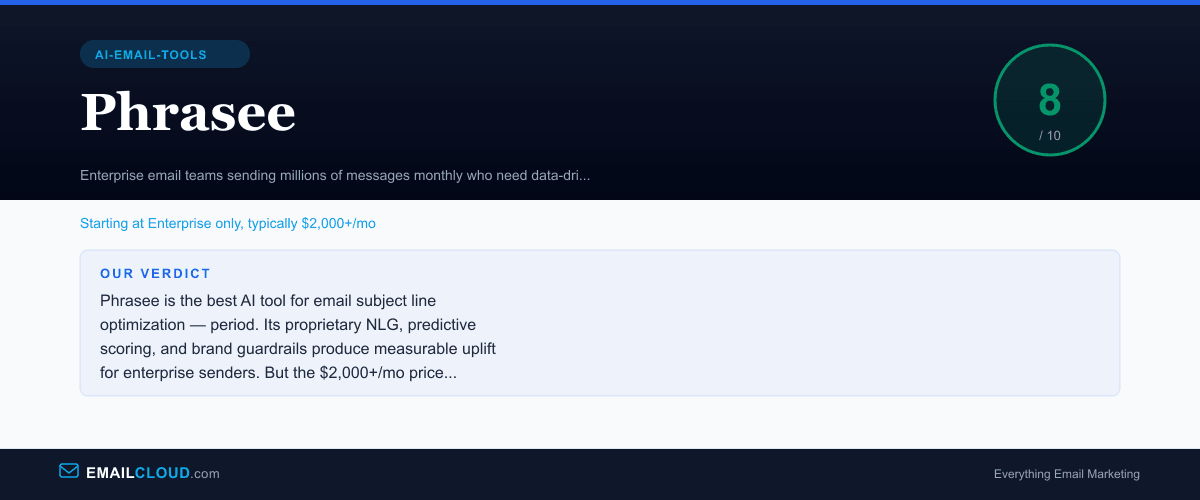
We rate Phrasee 8.0 — the highest score for any AI email tool in our reviews — because when you can use it, nothing else comes close. The score would be higher if the technology were accessible to the marketers who need optimization help the most.
Our Verdict
Phrasee is the best AI tool for email subject line optimization — period. Its proprietary NLG, predictive scoring, and brand guardrails produce measurable uplift for enterprise senders. But the $2,000+/mo price tag and enterprise-only model mean it is irrelevant for 95% of email marketers. If you send at enterprise scale, nothing else compares. If you do not, our free Subject Line Grader covers the basics.
Review Summary
Share this visual summary. Right-click to save.
Frequently Asked Questions
What makes Phrasee different from other AI writing tools?
Phrasee uses proprietary natural language generation models trained specifically on email marketing language, not general-purpose large language models. The system learns from your brand's historical email performance data — open rates, click rates, conversions — and generates subject lines optimized for your specific audience. It also predicts which variants will outperform before you send, which generic AI tools cannot do.
How much does Phrasee cost?
Phrasee is enterprise-only with no publicly listed pricing. Based on industry reports and our conversations with users, contracts typically start around $2,000 per month and scale with sending volume and the number of channels covered. This puts it firmly out of reach for small and mid-size businesses, which is by design — the platform is built for teams sending millions of emails monthly.
Can small businesses use Phrasee?
No. Phrasee does not offer a self-serve plan, free tier, or SMB pricing. Small businesses looking for AI subject line help should use free tools like our Subject Line Grader at /tools/subject-line-grader, which scores and suggests improvements at no cost. For AI-generated copy, tools like Copy.ai (free tier available) or Jasper ($49/mo) are accessible alternatives, though they lack Phrasee's predictive capabilities.
Does Phrasee actually improve email performance?
The published case studies suggest yes. eBay reported a 16% increase in open rates. Domino's saw 22% higher engagement on AI-generated subject lines. Virgin Holidays achieved a 2x improvement in click-through rates. These are enterprise clients with large enough sending volumes to make the results statistically significant. Whether similar results apply to your brand depends on your current baseline and audience.
Stay ahead of the inbox
Weekly tips on deliverability, automation, and growing your list. No spam, ever.
No spam. Unsubscribe any time. We respect your inbox.